
Two-tone closed-cell foam inserts inside modular trays, paired with a quick end-of-shift visual check, solve toolbox inventory control better than any spreadsheet or logbook. A tray cut for your sockets, drivers, and pliers shows a missing tool at a glance instead of forcing you to count pieces one by one. Teng Tools foam-kitted sets like the 1/4″ & 1/2″ Socket set FOAM4X4 75 pieces and the Insulated socket and pliers set FOAM4X4 31 Pieces are built around this exact layout. The checklist and design steps below show you how to build or expand a system like it.
TL;DR:
- Shadow foam inserts enable instant identification of missing tools, reducing search time from minutes to seconds during end-of-shift checks.
- Closed-cell foams like PE, XLPE, and EVA resist oil and impact, lasting years and providing more reliable tool protection than open-cell options.
- Regular routines such as daily visual sweeps, weekly full tray audits, and monthly inventory checks ensure ongoing accuracy and early detection of issues.
- Proper layout practices—grouping by function, matching orientation, and using finger lifts—significantly improve efficiency and tray reliability.
- Standardized foam kits from Teng Tools match common drawer depths and include customizable options, simplifying setup and long-term maintenance.
Table of Contents
- Why Foam Inserts and Modular Trays Solve Toolbox Inventory Control
- Choosing the Right Foam: PE, XLPE, EVA, and Why Pick-and-Pluck Falls Short
- Layout Rules: 5S, Tool Grouping, and Finger Lifts
- How Precision Cutting Creates Two-Tone Shadow Foam
- Matching Trays and Drawers Without Breaking Modularity
- A Simple End-of-Shift Inventory Routine
- Techniques for Initial Inventory Mapping and Documentation
- Common Challenges in Maintaining Inventory Accuracy
- Periodic Audits Beyond the Daily Sweep
- Why Engineered Foam Trays Are an Investment, Not an Expense
- Get Organized™: Foam-Kitted Kits Built for This Exact System
- Sources
- FAQ
Why Foam Inserts and Modular Trays Solve Toolbox Inventory Control
A stock plastic drawer liner tells you nothing. A foam tray tells you everything in under three seconds. Cut a silhouette for each tool and you turn a chaotic drawer into a self-auditing system, because an empty pocket is impossible to miss.
Two-tone, or “shadow,” foam pushes that advantage further. The insert pairs a dark top layer with a bright bottom color, so pulling a wrench exposes a contrasting cavity that jumps out even in a dim bay or a cluttered van. This visual-management effect is why shadow foam has become the standard for shops that can’t afford a missing 10mm socket mid-job.
The payoff shows up in three places:
- Speed. You stop hunting through a junk drawer and start scanning a tray. A five-minute search at the end of a shift becomes a five-second glance.
- Tool life. Closed-cell foam cushions impact and vibration, which protects torque wrenches and calibrated instruments from the kind of drawer-slam damage that throws off readings.
- Accountability. Visual gaps replace paper sign-out sheets, cutting the administrative overhead that compliance-driven shops in aviation and industrial maintenance rely on to pass audits.
Pro Tip: Foreign Object Debris (FOD) programs in aviation and heavy industry lean on this same principle. If a tool isn’t in its shadow, the drawer doesn’t close, and the aircraft or vehicle doesn’t leave the bay until someone accounts for it.
Choosing the Right Foam: PE, XLPE, EVA, and Why Pick-and-Pluck Falls Short
Skip the pick-and-pluck kits sold in big-box hardware aisles. That open-cell polyurethane foam soaks up oil and coolant, then breaks down into crumbs after a season of heavy use. Closed-cell foam resists moisture and chemical exposure and holds its shape for years, which is why it’s the material professional tool-tray manufacturers specify by default.
Three closed-cell options cover almost every shop need:
- Polyethylene (PE): The workhorse. Firm, inexpensive, and durable enough for daily-driver drawers of sockets, wrenches, and drivers.
- Cross-linked polyethylene (XLPE): A denser, tighter-cell version of PE built for high-cycle drawers that get opened dozens of times a shift.
- EVA foam: Softer and more shock-absorbent, best reserved for precision or delicate instruments like torque wrenches, gauges, and calibration tools.
Thickness matters as much as material. Most professional trays run 30 to 50 millimeters deep, which is enough to cradle a socket set without bottoming out on the drawer floor. Go thicker for heavier hand tools like hammers or breaker bars, where a shallow pocket lets the tool rock and wear the cavity edges prematurely.
Layout Rules: 5S, Tool Grouping, and Finger Lifts
A good foam tray follows the same logic as a well-run shop floor. Sort first: pull out duplicates, worn tools, and anything you haven’t touched in six months. Set in order second: build the layout so the tools you grab ten times a day sit front and center, not buried behind rarely used specialty sockets.
From there, four steps turn a rough idea into a tray you’ll actually trust:
- Group by function, not by size. Keep all your spark plug sockets together, all your pliers together, rather than sorting purely by dimension.
- Orient for the hand, not the eye. Lay ratchets and drivers so the working end faces the same direction you’ll grab them, cutting the fumble time on every retrieval.
- Cut finger lifts into every deep pocket. A cavity without a lift edge forces you to pry a socket out with a screwdriver, which chips foam and eventually wrecks the cutout.
- Photograph the finished layout. A clear photo taped inside the lid or saved to a shared drive becomes your template for replacing a lost tool in the exact right spot.
Pro Tip: Standardize one photo template per tray type across your whole fleet or shop. When a technician transfers between trucks or bays, the layout looks familiar instead of forcing them to relearn where everything lives.
How Precision Cutting Creates Two-Tone Shadow Foam
CNC routing and waterjet cutting both produce clean, repeatable pockets, but they solve slightly different problems. CNC routers excel at consistent recess depth across dozens of identical cavities, which matters when you’re outfitting ten identical vans with the same tray. Waterjet cutting handles tighter, more intricate silhouettes and leaves a cleaner edge on thinner foam, an advantage fabrication guides point to for detailed multi-drawer installs.
Two-tone shadow foam starts as two bonded layers, typically a dark color laminated over a bright base, then cut through the top layer only deep enough to expose the contrast color in the tool’s silhouette. Order custom-cut inserts when you’re fitting multiple drawers or replicating a layout across several boxes. A one-off cut works fine for a single small tray.
Before signing off on a fabricator, confirm three things:
- Recess depth stays consistent from cavity to cavity, not just accurate on the sample piece.
- Edges are clean and sealed, with no ragged foam that will shed into your tools.
- The two-tone lamination bond holds under repeated flexing, not just on day one.
Matching Trays and Drawers Without Breaking Modularity
Measure your drawer’s usable interior depth before you order a single tray, then subtract your foam thickness from that number. Skip this step and you’ll end up with a tray that won’t let the drawer close, or worse, one with several inches of dead space above it.
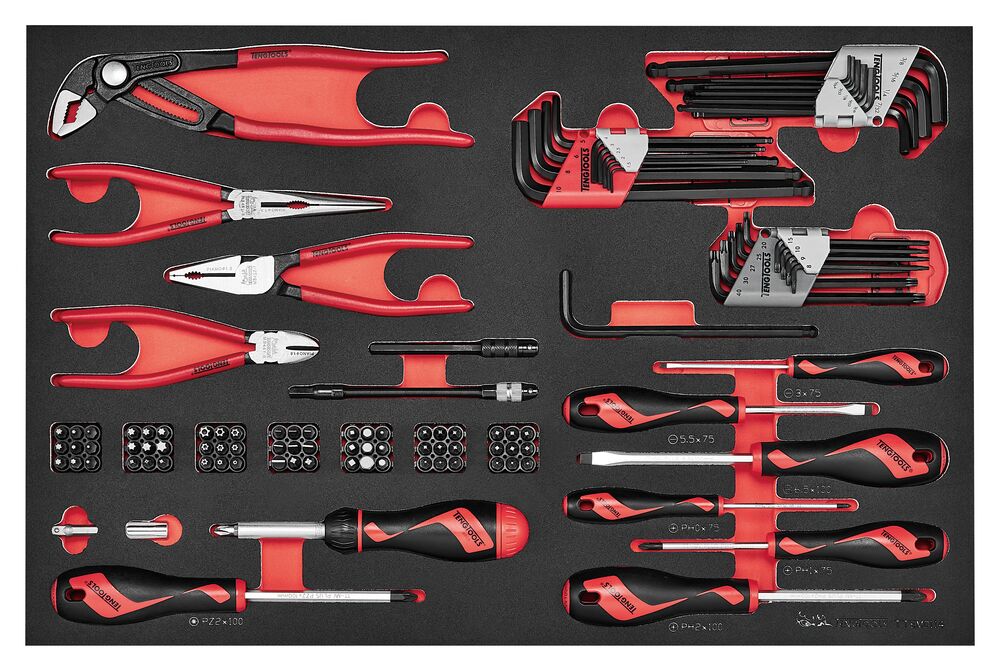
Stick to one tray generation per stack. Manufacturers redesign latch and ledge dimensions between product generations, and mixing old and new trays in the same modular stack is the most common way technicians end up with trays that rock, gap, or won’t click together at all.
A practical starter mix looks like this:
- Shallow trays for small parts, bits, and fasteners that don’t need much clearance.
- Deep trays for full-size drivers, ratchets, and wrenches that need real cavity depth.
- Reinforced or latched trays for van and mobile setups, where weight limits and carry handles matter more than they do in a stationary shop cabinet.
A Simple End-of-Shift Inventory Routine
You don’t need software to catch a missing wrench. You need ninety seconds and a habit. Run this three-step sweep before you clock out:
- Scan every tray visually, drawer by drawer, checking each shadow cutout against the tool that should be sitting in it.
- Flag or replace anything missing on the spot, rather than promising yourself you’ll deal with it tomorrow.
- Log exceptions, not full inventory. Write down only what’s missing and who had it last, so the next shift isn’t starting the search from zero.
A ten-item quick checklist keeps the sweep consistent across different technicians:
| # | Check item |
|---|---|
| 1 | All drawers counted and closed flush |
| 2 | Critical sockets present (most-used sizes) |
| 3 | Insulated tools accounted for |
| 4 | Chisels and punches in wall rack or tray |
| 5 | Hook and pick set complete |
| 6 | Spark plug sockets present |
| — | Torque wrench stored and undamaged |
| — | Pliers set complete |
| — | Driver bits and drivers accounted for |
| 10 | No foreign tools left in trays from other jobs |
Document the finished layout with photos so a new hire or a replacement tray can be rebuilt from memory in minutes, not guesswork. Run the daily sweep every shift, and escalate anything unresolved after 48 hours to a supervisor rather than letting it quietly disappear from the log.
Techniques for Initial Inventory Mapping and Documentation
Before you cut a single piece of foam, build a paper or spreadsheet map of every tool you own. Lay every tool from a drawer or box out on a table, photograph the full spread from directly overhead, and label each item by name and size in the image or an accompanying list. This overhead shot becomes your master reference for foam layout and your first line of defense if a tray gets lost entirely.
Assign each tool a unique reference, either a written label or a simple code tied to drawer and position (for example, “D2-S14” for drawer two, socket position fourteen). This matters most for sets with many similar-looking pieces, like a 75-piece socket kit, where a 10mm and 11mm socket look nearly identical from three feet away.
Once the foam is cut, take a second photograph of the finished tray with every tool in place. Store both images together, the flat-lay reference and the finished tray, in a shared folder or printed binder kept near the tool cabinet. When a tool eventually goes missing or a tray gets damaged, you’re rebuilding from a documented standard instead of trying to remember what belonged where.
For larger shops running multiple identical setups, this mapping step also standardizes training. A new technician learns the layout from the photo, not from trial and error, which cuts the ramp-up time for anyone new to the bay.
Common Challenges in Maintaining Inventory Accuracy
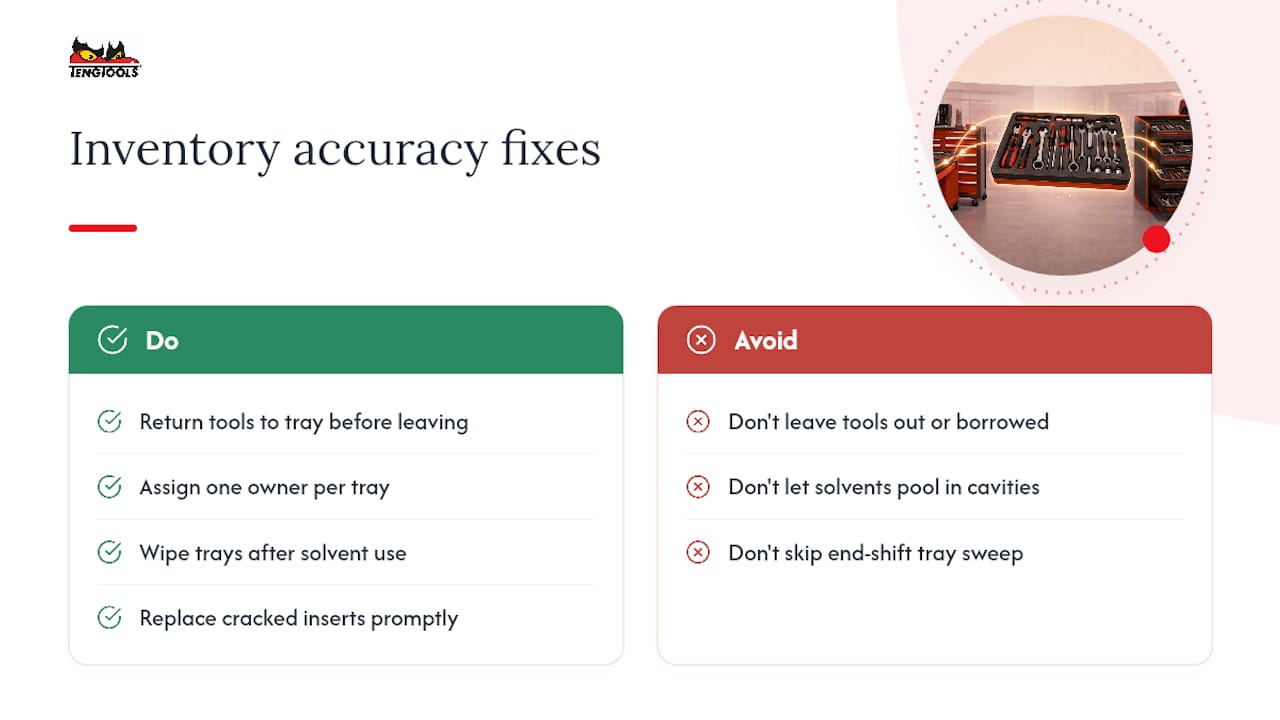
The most common failure point isn’t the foam. It’s borrowed tools that never make it back to their tray. A technician grabs a socket for a job two bays over, gets pulled into something else, and the shadow sits empty for three days before anyone notices. The fix is cultural more than mechanical: make returning a tool to its tray a non-negotiable step before walking away from a job, not an afterthought.
A second recurring problem is foam degradation from chemical exposure. Even closed-cell foam eventually shows wear from constant contact with penetrating oil, brake cleaner, or degreaser. Wipe trays down periodically rather than letting solvents pool in the cavities, and replace any insert that starts to crack or flake at the edges before it starts shedding debris into your sockets.
Shared tool carts and cross-trained crews create a third challenge. When more than one person pulls from the same tray, accountability gets fuzzy fast. Assigning a single owner per tray, even in a shared bay, gives you one person responsible for the end-of-shift sweep instead of everyone assuming someone else checked it.
Finally, watch for silent tray damage. A cracked latch or a warped tray edge can let pieces shift during transport, especially in a mobile van setup, and a shifted tool can look “present” in a quick glance while sitting in the wrong cavity entirely.
Periodic Audits Beyond the Daily Sweep
Daily visual checks catch obvious gaps, but they miss slow drift. A weekly audit closes that gap. Once a week, pull each tray fully out of the drawer, set it on a bench, and compare it against your documented layout photo rather than just scanning it in place. This catches tools that have quietly migrated to the wrong pocket or trays where foam has started separating from the drawer liner.
A monthly audit goes a level deeper. Cross-check your full tool count against your original inventory map, not just the trays currently in daily use. This is the point to inspect foam condition for cracking or oil saturation, check that labels and finger-lift cutouts are still legible and intact, and confirm that any custom-cut inserts ordered for specific kits still match the tools assigned to them.
Escalate anything that fails two consecutive weekly audits straight to replacement rather than repeated flagging. A tray that keeps coming up short usually points to a process problem, like a shared cart with no assigned owner, rather than a one-off mistake. Treat repeated audit failures as a signal to redesign the layout or reassign responsibility, not just a maintenance note to file away.
Why Engineered Foam Trays Are an Investment, Not an Expense
The math is simple once you count real downtime. A missing torque wrench that halts a job for twenty minutes costs more, in billable time, than most foam trays cost outright. Phase the investment: kit your highest-turnover drawers first, socket sets and drivers, then expand tray by tray as budget allows.
Teng Tools built its Get Organized™ system around exactly this logic. Every tray clicks into the next, so a shop that starts with one kitted drawer can grow into a full cabinet without redesigning the layout from scratch.
— David
Get Organized™: Foam-Kitted Kits Built for This Exact System
Teng Tools USA sells the foam-kitted sets that match everything above, so you’re not cutting foam from scratch to get a working tray. Every kit ships with profiled cavities and, on many sets, the two-tone shadow layer already built in, meaning you drop the tools in and the visual check works on day one.

Match the SKU to the job. Standardizing your socket drawers works well with the 1/4″ & 1/2″ Socket set FOAM4X4 75 pieces, while a shop running 3/4-inch work benefits from the Sockets 3/4" & Spanner Set FOAM6X6 52 Pieces. Electrical and insulated work has its own foam layout in the Insulated socket and pliers set FOAM4X4 31 Pieces, and a shop building out chisel storage can start with the Punch & Chisel Set Wall Rack 10 Pieces. Every set is built to meet industry standards and backed by a warranty, so the tray you kit out today is the one you’re still running years from now.
Measure your drawer depth, then browse the Mecca Pro Series and full foam-kitted lineup to find the set that matches your layout, or reach out about custom-cut inserts if your drawer doesn’t fit a standard tray.
Sources
- Best Practices for Custom Foam Tool Trays & Material Handling Solutions
- Kaizen Foam and Tool Drawer Inserts: A Practical Guide | IFOAM
- Tool Trays and Modular Storage: Organizing Tools on the Jobsite
- Importance of Visual Tool Control With Foam Inserts for Compliance-Driven Industries - Builder Master Construction News
FAQ
What Foam Is Best for Toolbox Inventory Control?
Closed-cell foams like PE, XLPE, and EVA hold up best because they resist oil, moisture, and abrasion far longer than open-cell pick-and-pluck foam. EVA works best for delicate or calibrated tools, while PE and XLPE handle everyday sockets and drivers.
How Often Should I Audit My Tool Trays?
Run a visual sweep every shift, a full pull-and-check audit weekly, and a complete inventory cross-check monthly. Escalate any tray that fails two straight weekly audits to redesign or reassignment rather than repeated flagging.
Why Is Two-Tone Shadow Foam Better Than Single-Color Foam?
Shadow foam laminates a dark top layer over a bright base, so a missing tool exposes an obvious contrast color in its empty cavity. Single-color foam requires a closer look to spot a gap, which slows down the exact visual check the system is designed to speed up.
Can Digital Tracking Replace Foam-Based Inventory Control?
Barcode and QR tracking add record-keeping and traceability, but physical tray-based visual control remains the faster method for catching a missing tool during a shift. Most professional shops treat digital systems as a complement to foam trays, not a replacement.