
The main torque wrench types are click, beam (including deflecting beam), dial, digital, and limiting or preset tools, plus specialty options like torque screwdrivers and multipliers. Pick a click wrench for everyday shop work, a digital or dial model when you need traceable, documented precision, and a beam wrench when you want a simple backup that almost never breaks. Accuracy on any of them depends less on the type and more on staying within the tool’s usable range and keeping up with calibration.
TL;DR:
- A click wrench works best when used within 20 to 100 percent of its rated torque range and is stored properly to maintain calibration.
- Beam wrenches are ideal for long-term, maintenance-free use in open, well-lit conditions, especially when calibration consistency is crucial.
- Dial indicator wrenches provide real-time torque readouts suitable for quality control but are more fragile and sensitive to impacts.
- Digital wrenches offer the highest accuracy, especially under 1 percent deviation, but require careful handling and regular battery checks.
- Choosing the correct torque range for your most common fasteners and maintaining proper technique ensures better accuracy than focusing solely on tool type or specifications.
Table of Contents
- Torque Wrench Types Compared at a Glance
- How Does a Click (Micrometer) Torque Wrench Work?
- Why Beam and Deflecting Beam Wrenches Still Earn a Spot
- Dial Indicator Torque Wrenches for Real-Time Readout
- Digital Torque Wrenches: When Precision Justifies the Cost
- Slip Wrenches, Torque Screwdrivers, and Multipliers for Specialty Jobs
- How to Choose the Right Torque Wrench for Your Work
- What ISO 6789 and ASME B107.300 Mean for Accuracy
- Technique, Storage, and the Mistakes That Wreck Accuracy
- Where Teng Tools Fits Into Your Torque Wrench Lineup
- The Real Lesson Buried in All These Torque Wrench Types
- Get the Right Torque Tool Without Guessing on Fit
- Sources
- FAQ
Torque Wrench Types Compared at a Glance
Before you commit to one, it helps to see how the main torque wrench categories stack up side by side. Each type trades off cost, precision, and maintenance differently, and the right pick depends more on your typical job than on brand loyalty.
- Click (micrometer): Best for general automotive and shop work; accuracy typically within a few percent when calibrated; no batteries, but needs periodic calibration.
- Beam/deflecting beam: Best for occasional use and budget kits; accuracy holds steady over years since there’s little to wear out; no batteries, minimal calibration needs.
- Dial indicator: Best for quality control and inspection tasks where you need to watch torque build in real time; sensitive to drops; no batteries required.
- Digital/electronic: Best for audited, regulated, or high-precision work; often the tightest accuracy of any hand tool category according to comparative testing from Schmidt Tools; requires batteries and careful handling.
- Slip/limiting (preset): Best for repetitive assembly-line style jobs at a fixed torque; no readout, so you set it once and trust the clutch.
- Torque screwdriver: Best for small fasteners specified in inch-pounds, like electronics or interior trim.
- Torque multiplier: Best for very high torque jobs, such as heavy truck lug nuts or industrial flange bolts, where hand strength alone won’t cut it.
For a typical home garage or part-time mechanic, a quality click wrench covers the vast majority of jobs. Shops running quality control or working under audit usually add a digital or dial model to the toolbox.
How Does a Click (Micrometer) Torque Wrench Work?
A click wrench uses an internal spring and cam mechanism set against a calibrated scale. You rotate the handle to dial in your target torque, then pull steadily until you feel and hear a distinct click, which tells you the mechanism has released and the fastener has reached spec. It’s the tool most mechanics reach for first, and for good reason: it’s fast, tactile, and doesn’t require batteries or a screen to read.
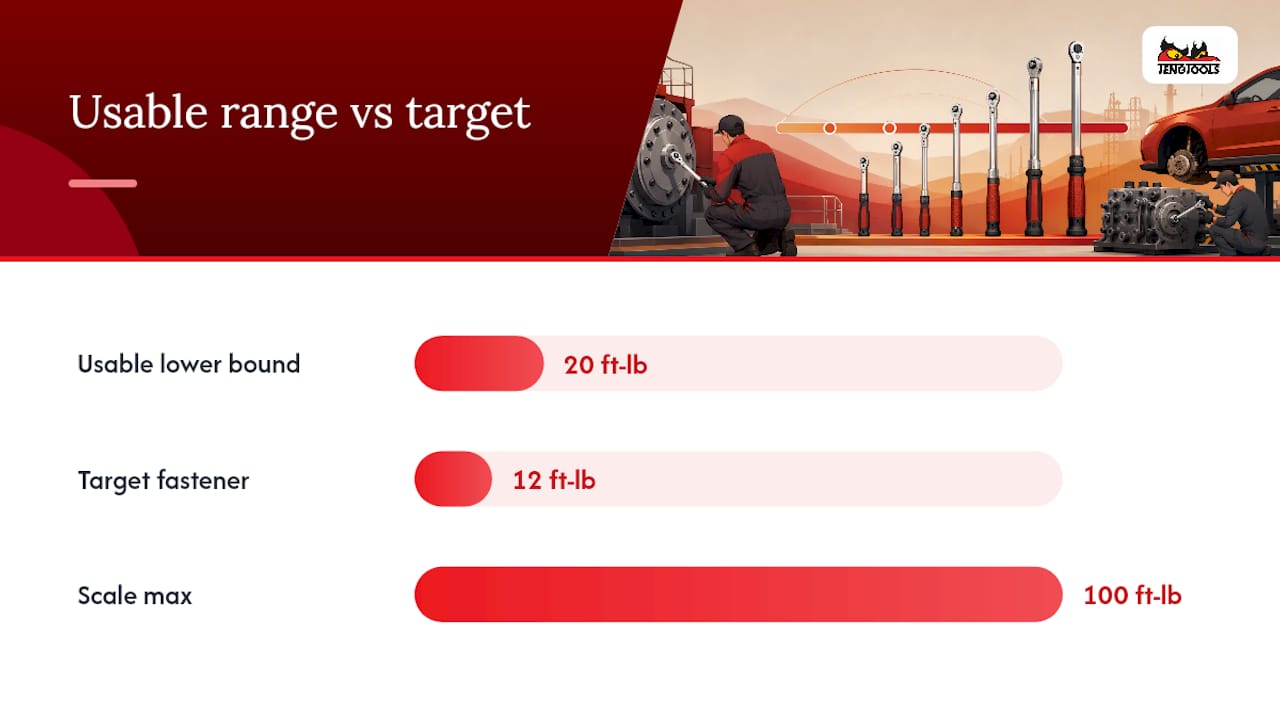
Accuracy varies more by build quality than by brand reputation alone. A well-made click wrench typically holds tolerances in the low single digits when it’s fresh from calibration, but that number only holds true if you’re using the tool within its sweet spot. Every torque wrench, regardless of type, performs best when the target torque falls within roughly 20 to 100 percent of its rated scale, according to calibration guidance from Accredited Labs. Set a 10 to 100 ft-lb wrench to torque a 12 ft-lb fastener, and you’re near the bottom of its usable range, where accuracy drops off fast.
Click wrenches come in a range of drive sizes, and most automotive work splits across three: 1/4 inch for small fasteners, 3/8 inch for engine and accessory bolts, and 1/2 inch for wheels and suspension. A 1/2 inch drive covering roughly 10 to 150 ft-lb handles most wheel and suspension jobs on a typical vehicle, according to buyer guidance from Rigs Rated.
A few habits keep click wrenches accurate for years:
- Always relock or return the handle to its lowest setting after use, never leave it wound up.
- Store it in its case, not loose in a drawer where it can get knocked around.
- Avoid using it as a breaker bar. That’s what ratchets are for.
Pro Tip: If you hear a second click after the first, or the torque feels inconsistent between fasteners, stop and check your calibration before you finish the job. A wrench that’s drifted out of spec will still click, it just won’t click at the right number.
Why Beam and Deflecting Beam Wrenches Still Earn a Spot
A beam wrench has no springs, gears, or clutches to wear out. It works on a straightforward principle: a flexible metal beam bends slightly under load, and a pointer attached to the handle tracks that deflection against a fixed scale. Because there’s nothing mechanical to drift, a beam wrench that reads accurately on day one tends to read just as accurately a decade later.
The deflecting beam variant refines this with a pivoting scale that moves independently of the handle, making the reading easier to see straight-on instead of at an angle. Both versions share the same core advantage: long-term stability with essentially zero internal wear.
The trade-off is visibility. You have to watch the scale while applying force, which is harder in tight engine bays or when you’re working at an awkward angle underneath a vehicle. That makes beam wrenches better suited to open, well-lit jobs like small engine repair, lawn equipment, farm machinery, or as a budget-friendly backup tool riding in a field kit.
Beam wrenches make sense over click or digital models in a few specific situations:
- You want a tool that never needs recalibration and rarely fails.
- Budget matters more than convenience, and you don’t mind reading a scale mid-pull.
- You need a reliable backup that can sit in a toolbox for years without attention.
Where a beam wrench falls short is speed and precision under pressure. If you’re doing dozens of fasteners a day, glancing at a moving needle while applying torque slows you down compared to the tactile click of a micrometer wrench.
Dial Indicator Torque Wrenches for Real-Time Readout
A dial torque wrench shows torque building in real time on a circular gauge, similar to a dial caliper. That live readout is the entire point. Instead of finding out you’ve hit target torque after the fact, you watch the needle climb and can stop the instant it reaches spec.
That real-time visibility makes dial wrenches valuable for quality control and inspection work. If a shop needs to verify that a fastener was actually torqued correctly, rather than just trust that a click happened, a dial wrench lets an inspector watch the process and confirm it. Some dial models also include a secondary needle that stays at the peak reading, so you can check the maximum torque applied even after you’ve released the handle.
The accuracy on a quality dial wrench is generally strong, competitive with click wrenches when both are properly calibrated. The catch is sensitivity. Dial mechanisms use precision internals that don’t take kindly to being dropped, and a hard impact can throw off the calibration without any obvious external damage. That fragility means dial wrenches usually stay in controlled environments: calibration labs, assembly lines, and QC stations, rather than getting tossed in a mechanic’s rolling toolbox.
If your work involves documenting torque application as part of an inspection process, or you need visual confirmation during the tightening process itself rather than just a click at the end, a dial wrench earns its place. For general field and shop use where durability matters more than live readout, click or beam wrenches hold up better to daily abuse.
Digital Torque Wrenches: When Precision Justifies the Cost
Digital torque wrenches use a strain gauge to measure the actual force being applied and display it as a live number on a screen, often backing that up with an audible buzzer, a flashing LED, or a vibration alert once you hit target torque. Many models also log readings and sync over Bluetooth, which turns every fastener into a data point instead of a one-off action you have to trust.
Comparative testing shows digital and electronic torque wrenches typically deliver the tightest accuracy among torque wrench categories, with high-end digital models showing deviations under 1 percent in some evaluations, according to testing from Schmidt Tools. Click and beam wrenches can get close, but their accuracy varies more by build quality and calibration history.
That precision matters most in regulated or audited environments, aerospace fastener assembly, warranty-sensitive automotive work, or any shop that needs a documented record showing exactly what torque was applied and when. If you’re only working on your own vehicles in a home garage, that level of data logging is nice to have but rarely essential.
The trade-offs are real. Digital wrenches run on batteries, which means dead batteries at the worst moment if you forget to check them. The electronics are more sensitive to drops than a simple mechanical beam, and calibration for digital models often requires sending the tool to a lab equipped to verify strain-gauge accuracy rather than a quick field adjustment.
A few practical notes on caring for digital wrenches:
- Check battery level before starting a job that matters.
- Store the wrench in its padded case; the electronics don’t forgive drops the way a beam wrench does.
- Keep firmware and calibration records if the model supports data logging, especially for warranty or audit purposes.
Slip Wrenches, Torque Screwdrivers, and Multipliers for Specialty Jobs
Not every fastening job fits neatly into click, beam, dial, or digital. A handful of specialty tools solve problems those four categories can’t handle well.
Slip or limiting torque wrenches use a clutch mechanism that disengages the moment target torque is reached, so the handle simply spins freely past that point rather than transmitting more force. They’re common in high-volume assembly settings where a worker needs to hit the same torque hundreds of times a day without watching a scale or listening for a click. There’s no readout, so you’re trusting the preset clutch rather than verifying each pull, which makes these tools better suited to controlled production environments than one-off repair work.
Torque screwdrivers apply the same click or dial logic to inch-pound specifications instead of foot-pounds. Small fasteners on electronics, interior trim panels, motorcycle bodywork, and delicate assemblies often call for torque values so low that a standard wrench can’t measure them accurately. A dedicated torque screwdriver set fills that gap, and it’s a tool many general mechanics don’t own until they run into a job that demands one.
Torque multipliers solve the opposite problem: fasteners that need far more torque than a person can apply by hand, even with a long breaker bar. Heavy truck lug nuts, industrial flange bolts, and some structural steel connections fall into this category. A multiplier uses internal gearing to amplify input force, letting you generate several hundred foot-pounds of output torque from a fraction of that input, according to background on specialty torque tools.
No-hub and plumbing-specific fixed-torque wrenches round out the specialty category, built to hit one exact torque value for cast-iron soil pipe couplings, a niche but common need in plumbing and construction trades.
How to Choose the Right Torque Wrench for Your Work
Picking the right wrench comes down to four decisions: drive size, torque range, accuracy needs, and how much you’re willing to spend on documentation and durability.
- Match drive size to your typical fasteners. A 1/2 inch drive handles wheels and suspension work, a 3/8 inch drive suits most engine bay bolts, and a 1/4 inch drive or dedicated torque screwdriver covers small fasteners under about 150 inch-pounds.
- Pick a torque range where your jobs land in the middle. If most of your fasteners fall between 20 and 80 ft-lb, a wrench rated 10 to 150 ft-lb keeps you inside that reliable 20 to 100 percent usable band rather than pushing the low or high edge of the scale.
- Decide how much accuracy documentation you actually need. A home mechanic rarely needs a calibration certificate. A shop working under warranty programs or safety audits usually does.
- Check for a protective case, calibration paperwork, and service availability before buying, since a wrench you can’t get recalibrated locally becomes a liability the moment it drifts out of spec.
For a home DIYer, one solid 1/2 inch click wrench covering roughly 10 to 150 ft-lb handles the overwhelming majority of jobs, from wheel lugs to suspension bolts. Add a 3/8 inch wrench if you work on engines regularly.
A part-time mechanic benefits from adding a torque screwdriver for interior and electronic work, since inch-pound fasteners show up more often than most people expect once they start looking for them. Sizing that second or third wrench correctly matters just as much as the first; a mismatched range undermines accuracy no matter how good the tool is, as covered in this guide to torque wrench sizing.
A professional shop generally needs the full spread: a 1/2 inch for wheels, a 3/8 inch for engine work, a torque screwdriver for small fasteners, and either a dial or digital wrench for any job requiring documented accuracy. Heavy-duty and fleet shops often add a torque multiplier for oversized lug nuts and structural fasteners that exceed comfortable hand torque.
Pro Tip: Buy your torque wrench range around your most common job, not your rarest one. A wrench sized for the 5 percent of jobs that need extreme torque will be inaccurate for the 95 percent of everyday fasteners that fall near the bottom of its scale.
What ISO 6789 and ASME B107.300 Mean for Accuracy
Two standards govern how torque wrenches get classified and tested: ISO 6789 and ASME B107.300. Both define tolerance classes for hand-operated torque tools, and understanding them helps you read a calibration certificate instead of just trusting the number on the box.
ISO 6789 sets classifications and tolerance requirements for hand torque tools used internationally, establishing the benchmark most calibration labs test against. ASME B107.300 provides a comparable classification system for manual and electronic torque tools used more commonly in North American professional and industrial settings. Neither standard guarantees a specific tool will hit a tolerance in the field, they define how manufacturers and labs test and rate accuracy under controlled conditions.
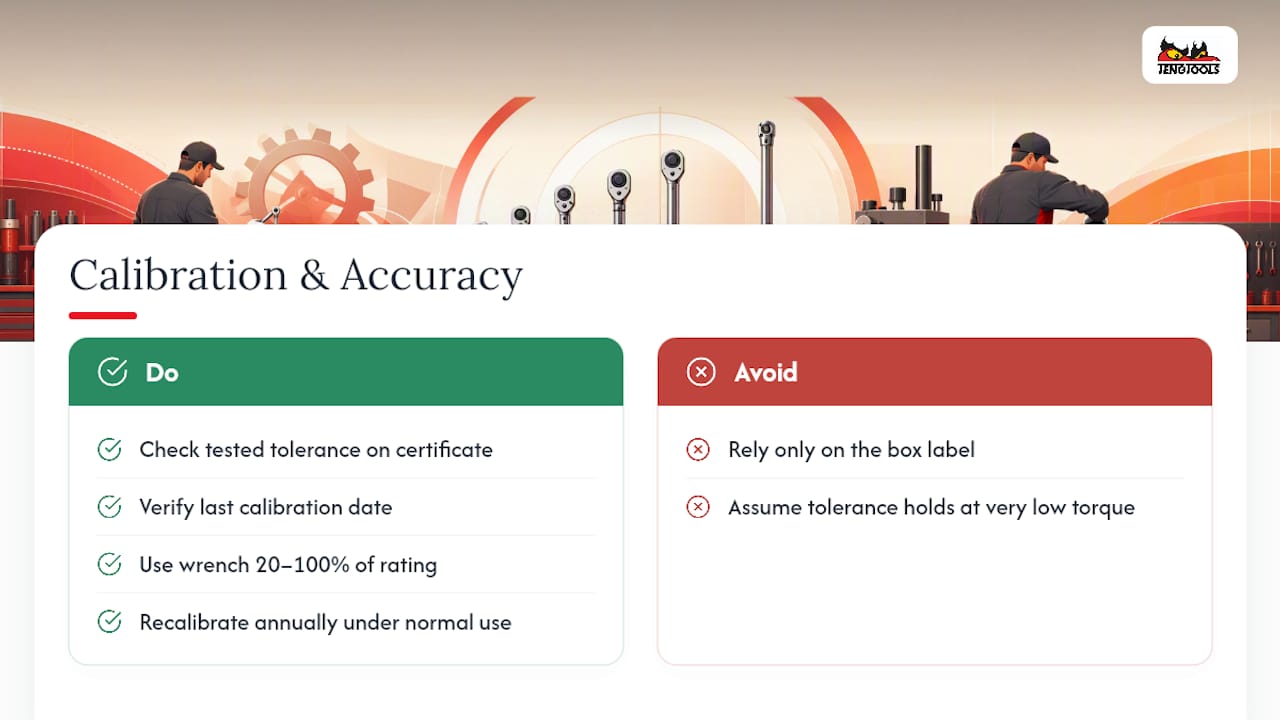
Torque wrenches are most accurate when used within roughly 20 to 100 percent of their rated capacity, according to calibration guidance from Accredited Labs. A wrench rated to plus or minus 4 percent accuracy only holds that tolerance inside its usable range, not at the extreme low end of the scale.
Reading a calibration certificate mainly means checking the tested tolerance percentage and the date of the last calibration. A tolerance of plus or minus 4 percent on a 100 ft-lb setting means the actual applied torque could land anywhere between 96 and 104 ft-lb, which is well within spec for the vast majority of automotive and light industrial fasteners.
Most manufacturers and calibration services recommend recalibrating a torque wrench annually under normal use, or immediately after any drop or suspected impact. Shops running high fastener volume often calibrate more frequently, sometimes quarterly, especially for tools tied to warranty or safety documentation. A guide to calibrating a torque wrench correctly walks through the process step by step for anyone doing it in house rather than sending tools to a lab.
Technique, Storage, and the Mistakes That Wreck Accuracy
Good technique matters as much as the tool itself. Apply pressure through the handle’s centerline, not off to one side, and pull with steady, even force rather than a jerky yank. A sudden jerk can trigger a click wrench early or produce an inaccurate peak reading on a dial or digital model, giving you a false sense that the fastener is properly torqued when it isn’t.
A few habits separate accurate work from guesswork:
- Never use a cheater bar or pipe extension on a click or digital wrench; it changes the leverage the internal mechanism was calibrated for and throws off the reading entirely.
- Avoid using extensions or adapters that add length beyond what the manufacturer specifies, since that also alters effective torque delivered to the fastener.
- Always relock a micrometer-style click wrench to its lowest setting after use rather than leaving it wound to your last torque value.
- Keep sockets clean and free of debris; grit between the socket and fastener head can throw off readings by a noticeable margin.
Storage matters just as much as technique. Keep wrenches in their protective case rather than tossed loose in a drawer, avoid stacking heavy tools on top of them, and never store a click wrench at a high torque setting for extended periods, since that keeps internal springs under tension longer than necessary.
If a wrench takes a hard drop, especially a dial or digital model, treat it as suspect until it’s been recalibrated. Any impact that could knock a wrench out of spec deserves the same caution regardless of type, whether it’s a dial gauge that got jarred or a digital unit that hit concrete. Recalibrate after drops, after any period of heavy daily use exceeding a few months, or any time readings start feeling inconsistent between similar fasteners.
Pro Tip: Keep a small log, even a simple notebook, tracking calibration dates and any drops or impacts. It takes thirty seconds and saves you from guessing whether a tool is still trustworthy six months down the line.
Where Teng Tools Fits Into Your Torque Wrench Lineup
Every torque wrench category above solves a different job, and matching the tool to the fastener matters more than brand loyalty. Teng Tools designs its torque equipment to ISO and DIN standards, backing each tool with a lifetime warranty and same-day shipping from its Fort Worth, Texas warehouse, so a mechanic who needs a replacement isn’t stuck waiting.
Three specific product lines map directly onto gaps covered in this guide:
- Small fastener work calling for inch-pound precision fits the Teng Tools Torque Screwdriver Set TT1, built for electronics, trim, and delicate assemblies where a standard wrench overshoots.
- High-torque jobs beyond comfortable hand strength, heavy lug nuts or industrial flange bolts, fit the Teng Tools Torque Multiplier Set TTX4, which amplifies input force through internal gearing.
- Core drive-size coverage for everyday shop work is handled by the Teng Tools Quick Wrench Set TTX4, spanning the common sizes most fastener jobs actually need.
Each tool also fits into Teng Tools’ Get Organized™ tray system, so instead of digging through a drawer for the right torque tool, you can see at a glance whether it’s in its place. For more on selecting and sizing a professional torque wrench, see this breakdown of what to look for in a professional torque wrench.
The Real Lesson Buried in All These Torque Wrench Types
Most buying advice treats torque wrench selection like a spec sheet contest, chasing the tightest advertised tolerance without asking whether that tolerance survives contact with actual shop conditions. It usually doesn’t. A digital wrench rated to under 1 percent accuracy means nothing if the battery dies mid-job or the tool spent six months uncalibrated in a truck bed.
The judgment this research actually supports is unglamorous: technique and calibration discipline matter more than which category you buy. A well-maintained click wrench used inside its 20 to 100 percent range will outperform a neglected digital wrench every time, regardless of what the box promised on day one.
Where conventional advice falls short is treating “most accurate” as a fixed property of a tool type rather than a moving target tied to maintenance habits. Digital and dial wrenches earn their reputation in controlled, audited environments precisely because someone is enforcing that discipline. Take that discipline away, and the category stops mattering.
If you take one thing from this guide, prioritize buying a torque range that matches your actual jobs before worrying about which mechanism reads the number. Get that right, and even a basic click wrench will serve you honestly for years.
— David
Get the Right Torque Tool Without Guessing on Fit
Teng Tools USA sells torque equipment built to ISO and DIN standards, backed by a lifetime warranty and same-day shipping from the Fort Worth, Texas warehouse, so replacing or expanding your torque lineup doesn’t mean waiting weeks for a part to arrive.
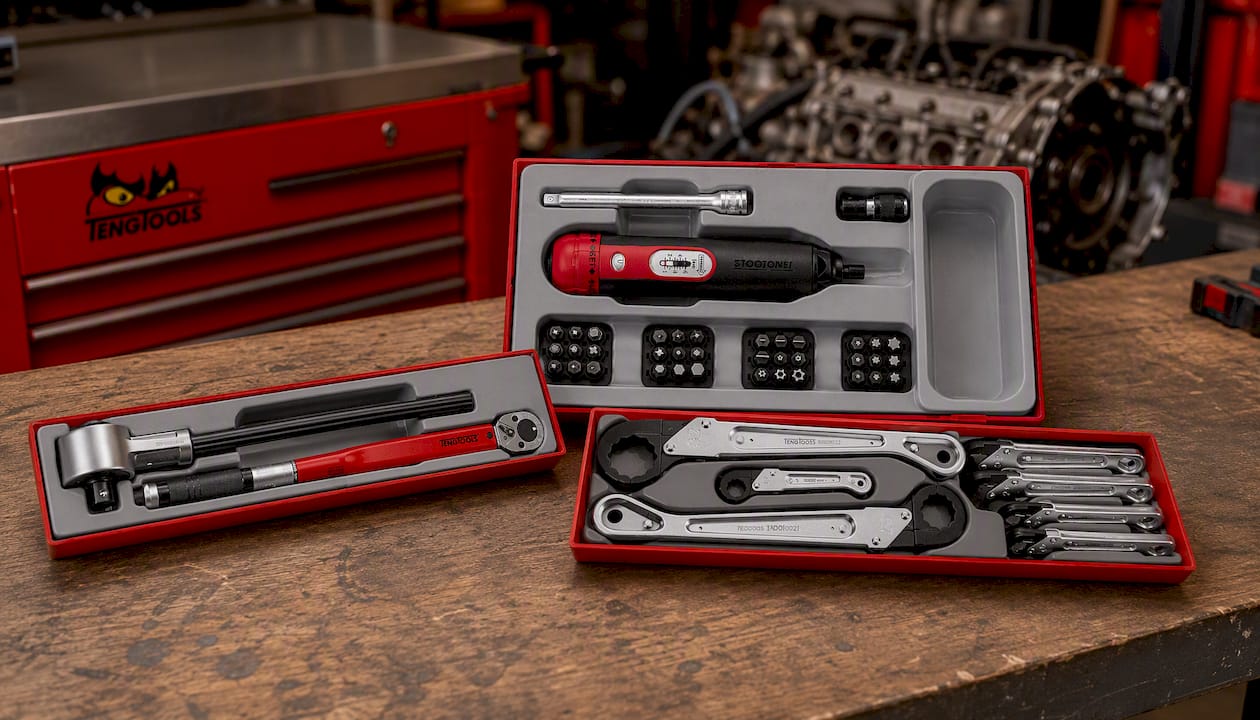
If this guide helped you pin down which category fits your work, the next step is straightforward. Need inch-pound precision for small fasteners? The Teng Tools Torque Screwdriver Set TT1 covers that gap. Facing lug nuts or industrial bolts beyond hand strength? The Teng Tools Torque Multiplier Set TTX4 handles the amplification. Building out core drive-size coverage for daily shop work? The Teng Tools Quick Wrench Set TTX4 rounds out the range. Every tool clicks into the Get Organized™ tray system, so your torque tools stay visible and accounted for instead of buried in a drawer. Browse the full torque wrench catalog to check specs and place an order today.
Sources
- Torque wrench — Wikipedia
- ASME B107.300 table of contents (B107-300_2021)
- Which Type Of Torque Wrench Is Most Accurate? - Schmidt Tools
- Understanding torque wrench accuracy — Accredited Labs blog
- Best Torque Wrench 2026: 5 Picks Compared for Home Garages | Rigs Rated
FAQ
What are the three main types of torque wrenches?
The three most common types are click (micrometer), beam, and digital/electronic, though dial indicator and slip/limiting wrenches also see regular use in shops and quality control settings. Click wrenches dominate general automotive work because they’re fast and tactile, while beam wrenches serve as durable, low-maintenance backups.
What is the most accurate type of torque wrench?
Digital and electronic torque wrenches typically deliver the tightest accuracy among the categories, with some high-end models showing deviations under 1 percent in comparative testing from Schmidt Tools. Click and beam wrenches can perform nearly as well, but their accuracy depends heavily on build quality and how recently they were calibrated.
What are the different categories of torque wrenches?
The main categories are click, beam and deflecting beam, dial indicator, digital/electronic, slip or limiting, torque screwdrivers for inch-pound fasteners, and torque multipliers for very high torque jobs. Each category fits a different combination of precision needs, budget, and job type, from small electronics fasteners to heavy truck lug nuts.
Is a click torque wrench or a digital torque wrench better?
Neither is universally better; it depends on whether you need documented, traceable data. Click wrenches handle the vast majority of general automotive and shop jobs reliably, while digital wrenches earn their higher cost in audited, regulated, or warranty-sensitive work that requires a logged record of applied torque.
How often should I calibrate a torque wrench?
Most manufacturers recommend annual calibration under normal use, or immediate recalibration after any drop or suspected impact. High-volume shops sometimes calibrate quarterly, and a step-by-step process is covered in this torque wrench calibration guide.
How much do Teng Tools torque wrenches cost?
Current prices for Teng Tools torque equipment, including the Torque Multiplier Set, Torque Screwdriver Set, and Quick Wrench Set, are listed on the Teng Tools USA website.