

The best van tool storage gives every tool a fixed home, puts the heavy gear low, keeps the daily tools by the door, and holds everything still while you drive. Racking and shelving decide how the space is divided. What goes inside each drawer and bin decides whether you find a 10 mm socket in five seconds or five minutes. That second layer is where we focus, with modular trays that click together so a missing tool shows at a glance.
TL;DR
- Plan the van in zones: heavy equipment on the floor or in low compartments, daily tools near the door, small parts in labeled bins.
- Use the unused surfaces: door interiors, ceiling, shelf sides and the space behind the driver’s seat.
- Everything in a moving van shakes, so shelves, boxes and trays need to be secured and lockable.
- Inside the drawers, fixed-position trays turn “where did that go?” into a quick visual check.
- Our Get Organized™ system gives each tool a designated home in customizable trays that click together.
Table of Contents
- Start with zones, not shelves
- Van tool storage ideas by area
- Inside the drawer is where the time is lost
- Keep it secure: in motion and when parked
- Choosing between built-in racking, DIY and modular
- Fleets, facilities and institutional buyers
- Our perspective
- Build your van around trays you can trust
- FAQ
- Sources
Start with zones, not shelves
Before you buy racking, sort what you carry into three groups: what you grab on nearly every job, what you use weekly, and what you only carry for the odd call. Most disorganized vans have those groups mixed together on the same shelf.
The guidance written for service trades is consistent on the layout. A work van organization guide for HVAC techs recommends dedicated compartments for different kinds of work and divider bins to separate tools from small parts. An electrician van setup guide suggests a clearly marked space behind the driver’s seat for daily tools, and labeled, color-coded bins and drawers for small parts.
A workable zone plan looks like this:
| Zone | What belongs there | Why |
|---|---|---|
| Floor and low compartments | Compressors, generators, heavy machines, big cases | Heavy loads stay low and lift without twisting your back |
| Door-side shelves and racks | Daily hand tools, drivers, testers, pliers | Reach them without climbing into the van |
| Door interiors | Magnetic strips, pocketed organizers, pegboard | Free surfaces most vans never use |
| Drawers and cabinets | Sockets, wrenches, bits, fasteners | Tools stay clean and out of sight |
| Ceiling | Ladders, long stock | Keeps long items off the floor |
Van tool storage ideas by area
Use the doors and the walls
The inside of the rear and side doors is the most wasted space in a service van. Magnetic strips and pegboards hold the hand tools you reach for every day, and pocketed organizers take screwdrivers and pliers. Jobber’s HVAC guide also mentions shelves built inside the back doors and hooks on the sides of shelving for larger tools.
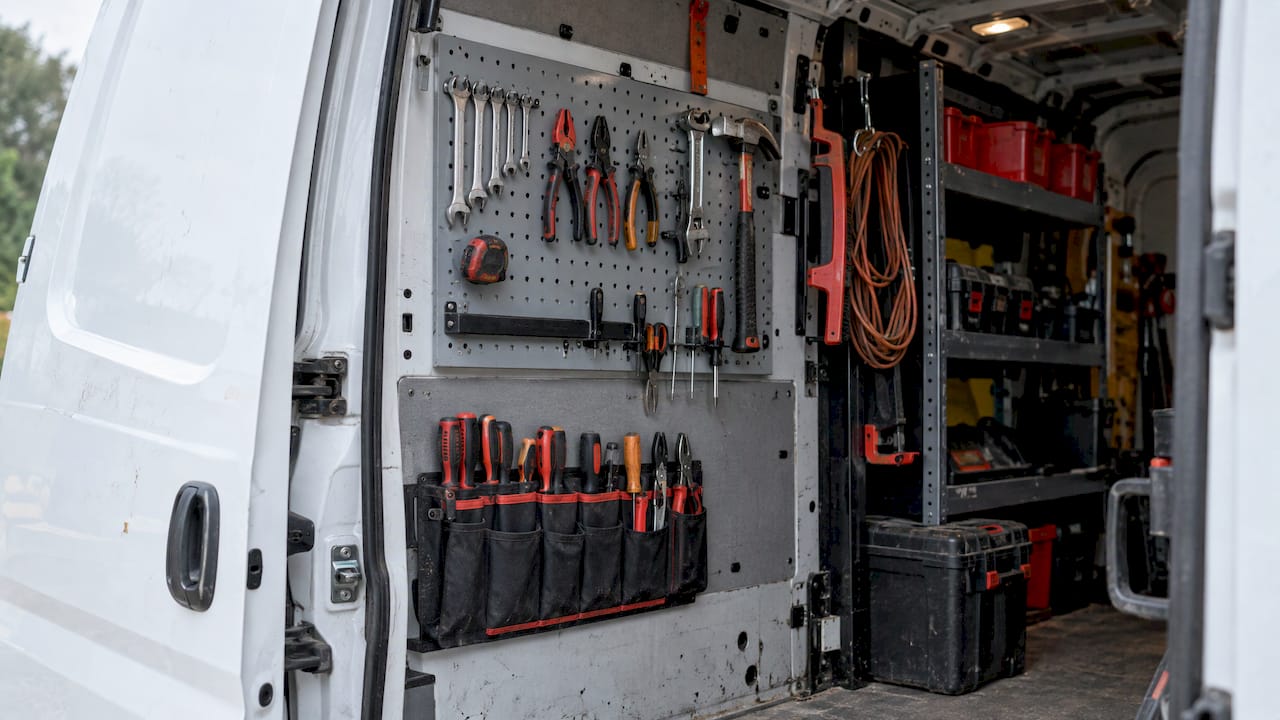
One example from the trade press: a service van customization piece describes an electrician’s van with both interior walls lined with shelves and bins, a stepladder mounted to the ceiling with hooks for a shovel and conduit bender, and holsters by the side door for a power drill. The floor stayed clear.
Tilt, slot and divide your shelves
Flat shelves hide things. A few small changes help:
- Tilted shelves make tools easier to see and grab.
- Slots or holes cut into a shelf hold tools upright.
- Divider bins keep small parts from migrating into your tool bins.
- Vertically stacked bins use the height of the van.
- Drawer cabinets that open outside the van let you work without climbing in.
All of these appear in Jobber’s list of shelving tactics.
Consider modular carts and job boxes
A builder writing in Fine Homebuilding describes a mobile tool-storage system made of specialized carts, such as a compressor cart with nailers and fasteners and a cordless cart with chargers. They lock onto French cleats in the truck, with E-track and ratchet straps for added securing. With modular boxes lining both sides and the aisle left open, he could make quick cuts in the van without unloading anything.
The idea carries over to mechanics: build kits by task, not by tool type, so one box holds everything for a brake job or a suspension job. A trade-press piece on work trucks notes that contractors often assemble task-specific kits and that modular storage makes it easy to move tools from vehicle to workspace.
Plan around long and heavy items
Long, delicate tools are the hardest part of a van layout because they have to be carried flat. A racking guide from the carpentry trade adds that heavy items should sit where you can lift them without bending and twisting at the same time. Put the heaviest tools where lifting is easiest, and keep them off the upper shelves.
Inside the drawer is where the time is lost
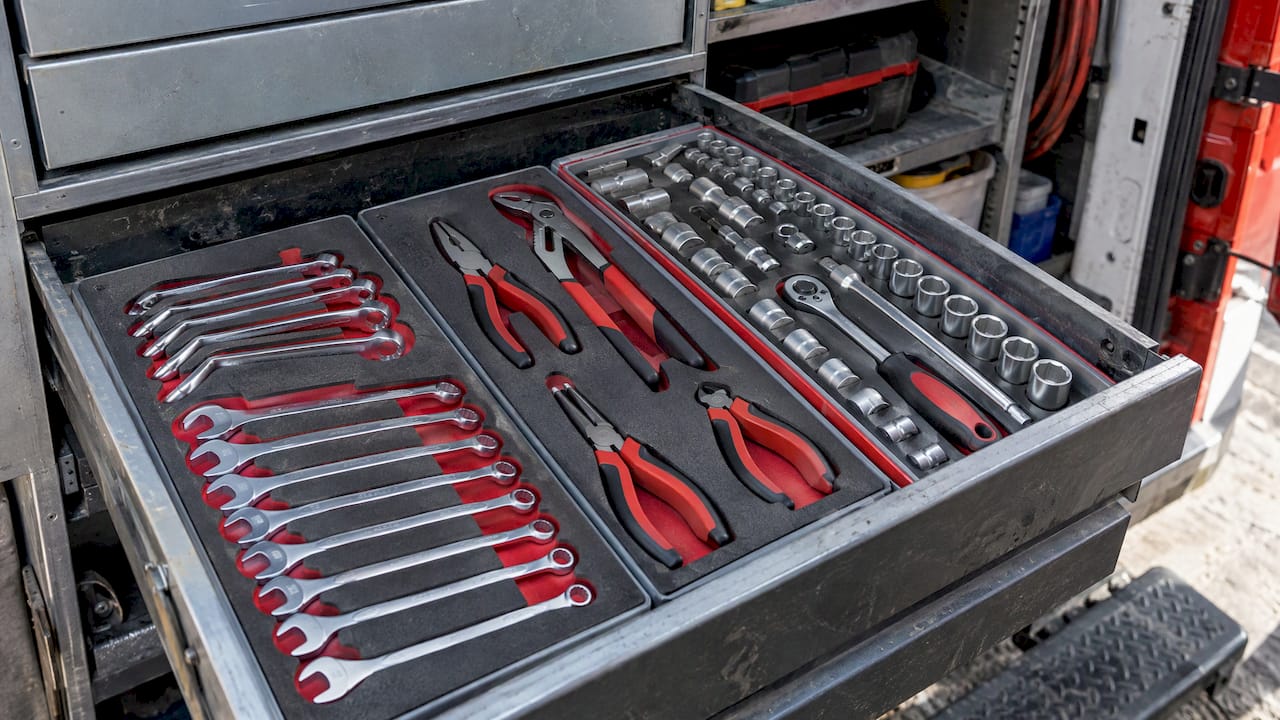
Racking gets the attention, but most of the minutes lost on a job are spent in a drawer of loose tools. Sockets roll, wrenches pile up, and you can’t tell at a glance whether the 13 mm is on the job or in the drawer.
The fix is a fixed position for every tool. Foam trays with a cutout or slot for each item make a missing tool obvious the moment you close the drawer or lid. This is what the Get Organized™ system is built around: customizable trays that click together, so each tool has a designated home. Our Foam Tool Trays (EVA Foam Series) and Tool Trays (TT Series) let you arrange the layout to the tools you actually carry. Our guide on how a modular tool storage system saves time shows the idea in practice, and the drawer-by-drawer tool cart system is a good template for deciding what goes where.
For mobile work specifically, see our articles on mobile mechanic tool storage and workshop-tested mobile mechanic storage.
Label and color-code
Labels and color work alongside trays. Jobber’s guide describes wrapping colored tape around toolbox handles so each box is identified at a glance. Keep the scheme simple: one color per job type or tool family, and keep red and yellow for hazards. Our pages on color-coded tool organization and a tool labeling system walk through palettes and numbering.
Keep it secure: in motion and when parked
Everything in a cargo area is subject to what one racking article calls “shake, rattle, and roll”. Tools and toolboxes must be secured so they cannot fall out. Angled slots, E-track, ratchet straps and cleat-mounted carts all do the job. Tool trays with snug fits in closed drawers add another layer: nothing slides when you brake.
When the van is parked, Jobber recommends keeping your most important equipment in a locked compartment, using padlocks wherever possible, and storing tools in a lockable chest or cabinet if the van sits unattended for long periods. A contractor profile in Plumbing & Mechanical describes lockable boxes combined with Bluetooth tracking tags that report location within 300 feet.
For larger fleets or high-value equipment, a GPS tracker for small equipment can add location tracking to a locked-up setup.
Choosing between built-in racking, DIY and modular
How you divide the van matters less than whether you can change it later. Plywood builds are cheap but bulky, and the shelves rarely adjust. Manufactured racking costs more and is quicker to install. Modular boxes and trays sit on top of either and move with you if you change vans or jobs.
Questions to ask before you commit:
- Do you change vans or tool loads? Modular pieces move over; built-ins stay with the van.
- How many tool families do you carry? The more you carry, the more fixed trays pay off.
- How often do you work from the van? If it is your shop, drawers at the door matter most.
- Do you share the van? Labels, colors and fixed positions let a second tech find things without asking.
Fleets, facilities and institutional buyers
If you equip several vans or a maintenance department, consistency matters more than any single clever idea. One article on a plumbing contractor’s trucks describes stocking each truck by department, so every technician starts with the same items. The same logic works for trays: copy one tray layout across every kit and anyone can run a quick visual check.
For government and institutional purchases, we offer TAA-approved options. Confirm the specific items you need on the product page, and contact us if your purchasing rules require documentation.
Our perspective
Most van storage advice stops at the shelf. We think the shelf is the easy part. The real time loss happens when you open a drawer and have to hunt.
That is why we designed the Get Organized™ system around a simple rule: every tool gets a designated home. The trays click together, so you can build a layout around the tools you carry, and a gap shows immediately. For a mechanic or service tech, that visual check is the difference between leaving a job with everything and finding out at the next one.
The tools themselves matter too. Our range of over 3,000 tools is built to ISO and DIN standards and backed by a lifetime warranty, so the sockets, wrenches and pliers you load into a tray are ones you can rely on.
David
Build your van around trays you can trust
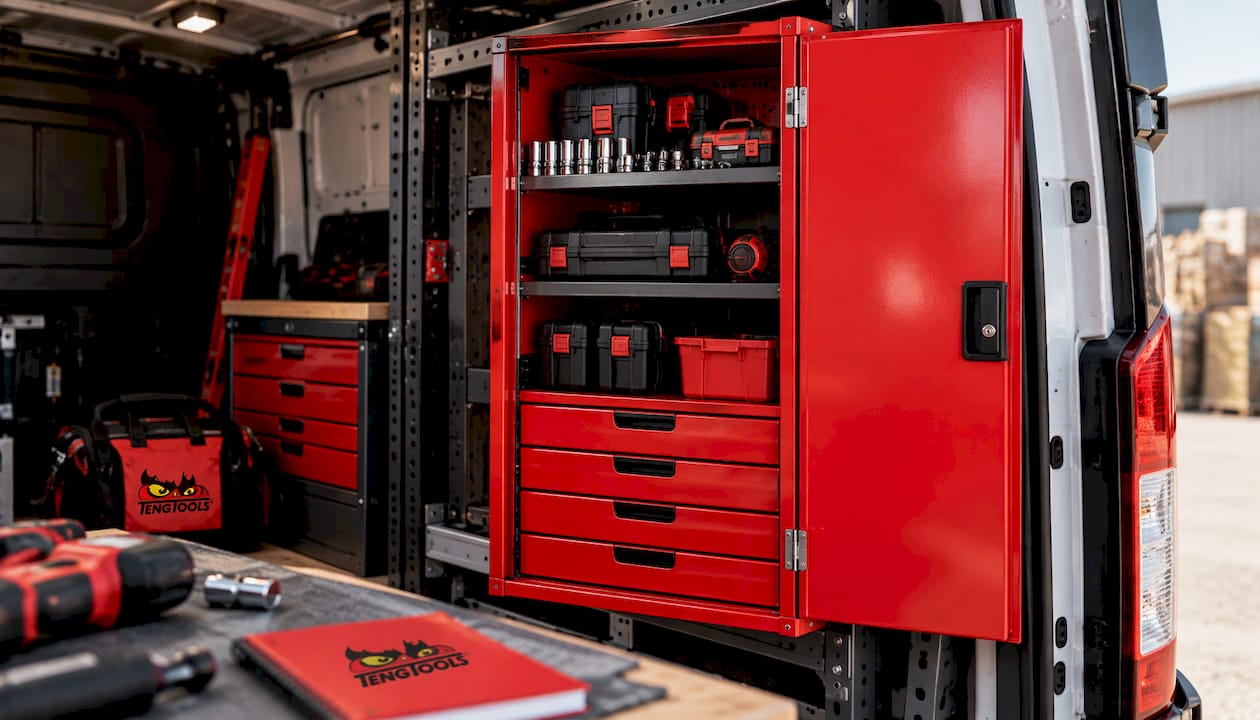
We ship same-day from our Fort Worth, Texas warehouse, so a new kit can be in the van quickly. Portable Storage starts from $89, the Mecca Pro Series from $189 and PRO35 Kits from $649. Our range also covers sockets, ratchets, wrenches, torque wrenches, screwdrivers, pliers and tool chests, roller cabinets and tool boxes. You can browse the whole line on tengtoolsusa.com, or look at the PRO35™ Side Cupboard if you want cabinet storage in the line-up.
For smaller spaces, our guide to tool storage that keeps professionals moving and the one on small garage storage show how the same tray logic scales down.
FAQ
What is the best way to organize tools in a service van?
Sort by zone. Put heavy equipment low, daily tools by the door, and small parts in labeled bins or drawers. Then give each tool a fixed position in a tray so a missing one is obvious.
Where should I keep the tools I use most?
Near the door you use most, and on the door interiors. Magnetic strips, pegboards and pocketed organizers work well. Another option is a marked space behind the driver’s seat, as recommended in an electrician van setup guide.
How do I stop tools from shifting while I drive?
Use closed drawers, snug trays, angled slots and straps such as E-track and ratchet straps. Anything on an open shelf should be held in place, as the Fine Homebuilding builder does with cleat-mounted carts.
How do I protect tools when the van is parked?
Keep the most valuable equipment in a locked compartment or lockable chest, and use padlocks where you can. Lockable boxes and tracking tags add another layer.
Sources
- HVAC Van Organization: Ideas for Safe and Efficient Tool Storage, Jobber
- Electrician Van Setup For Optimal Tech Efficiency, ServiceTitan
- How to Customize a Service Van, Work Truck Online
- Build a Mobile Tool-Storage, Fine Homebuilding
- Work trucks, the mobile workshop, Plumbing & Mechanical
- Van Racking, THISisCarpentry