
Use 6-point sockets for high-torque work, stuck fasteners, and anything you can’t afford to round off. Use 12-point sockets when clearance is tight and you need to reposition your ratchet fast on a fastener that isn’t fighting you. A 12-point will physically fit a 6-point hex head, but the tradeoff in torque handling means you shouldn’t treat it as a full substitute.
TL;DR:
- Use 6-point sockets for high-torque, high-stress, or damaged fasteners to prevent rounding and ensure better force distribution.
- Reserve 12-point sockets for quick repositioning and tight access where a 30-degree ratchet swing makes a significant difference.
- A 12-point socket can fit a 6-point hex head, but a 6-point socket cannot properly fit a true 12-point fastener, requiring matching tools for such cases.
- Impact-rated 6-point sockets have thicker walls and are better suited for high-torque, impact gun use, while chrome 12-point sockets are designed for hand tools.
- Prioritize building a toolkit with full 6-point coverage before adding select 12-point sockets for low-risk, quick work in confined spaces.
Table of Contents
- Why the Shapes Matter: Geometry, Contact, and Engagement Angles
- Torque Capacity, Rounding Risk, and Fit Compatibility Compared
- When Should You Reach for Each Socket Type?
- Fit Rules, Drive Sizes, and Deep vs. Shallow Sockets
- Building a Socket Kit That Actually Covers Your Work
- Why Trust These Recommendations
- The Real Tradeoff Nobody Puts in One Sentence
- Which Teng Tools Set Fits Your Bench
- Sources
- FAQ
Why the Shapes Matter: Geometry, Contact, and Engagement Angles
A 6-point socket has six internal points that sit flush against the six flat sides of a hex fastener. A 12-point socket doubles that to twelve points, which creates a double-hex pattern with points landing both on the flats and near the corners. That extra geometry is the whole story behind why these two socket types behave so differently under load.
The 6-point design contacts a fastener’s flats and distributes torque over a wider surface, spreading force across more metal instead of concentrating it at the corners. That matters most on a bolt head that’s already stressed, corroded, or slightly worn. A 12-point socket, because several of its points sit closer to the corners, pushes stress into a smaller area. On a fresh, undamaged fastener that difference barely registers. On a rusted exhaust manifold bolt, it’s the difference between the bolt breaking loose and the head turning into a smooth, useless nub.
The other half of the geometry story is repositioning. Because a 6-point socket only has six engagement points, you have to swing your ratchet through a full 60 degrees before the next point lines up. A 12-point socket lets you reposition every 30 degrees, cutting that swing requirement in half. In a wheel well or behind a dash bracket where your ratchet arc might only be 20 or 25 degrees, that difference decides whether you finish the job with a ratchet or end up breaking out a wrench and ratcheting it by hand, flat by flat.
A few other mechanical differences show up in real-world sets:
- Wall thickness: impact-rated 6-point sockets are typically built with thicker walls and different heat treatment to survive the shock loads of an impact gun.
- Engagement points: 6-point sockets have 6 contact points; 12-point sockets have 12, doubling repositioning frequency.
- Contact zone: 6-point loads the flats of the fastener; 12-point loads a mix of flats and near-corner surfaces.
- Typical use case: 6-point skews toward removal and high-torque work; 12-point skews toward hand-ratchet assembly and finishing.
Torque Capacity, Rounding Risk, and Fit Compatibility Compared
Torque transfer comes down to contact area, and 6-point sockets win that comparison outright. Because the socket wall meets the fastener along a full flat instead of a narrower band near a corner, force spreads out instead of concentrating. That’s why guides recommend 6-point sockets for high-torque, precision, or damaged fasteners and reserve 12-point for tight-access hand work where speed of repositioning matters more than raw torque.
Rounding risk follows the same logic in reverse. Engineering comparisons note that 12-point sockets engage twice as many positions but sit nearer the fastener’s corners, which raises the odds of cam-out or rounding when the bolt is fighting back. A fastener that’s rusted, over-torqued from the factory, or already slightly worn is exactly where that extra corner contact turns into a stripped head. On a clean, properly torqued bolt, the risk gap narrows considerably. It’s the problem fasteners where the socket choice actually decides the outcome.
Compatibility runs one direction only. A 12-point socket will drop onto a 6-point hex head because the six flats still register against six of the twelve points. It won’t work the other way. A 6-point socket cannot seat properly on a true 12-point fastener, so if you’re working on equipment with genuine 12-point bolt heads (some European and performance applications use them), you need the matching socket, not a substitute.
Pro Tip: Never chase a stubborn bolt with a 12-point socket just because it’s what’s in your hand. If a fastener won’t break loose on the first firm pull, swap to 6-point before you apply more torque. That thirty-second swap is cheaper than an extraction job.
Impact tools raise the stakes further. Impact-rated 6-point sockets typically have thicker walls and different heat treatment than chrome-plated 12-point hand sockets, and running a chrome 12-point on an impact gun increases the risk of damaging the socket or fastener. Save chrome 12-point sockets for hand ratchets and torque wrenches, and keep impact work on impact-rated 6-point pieces.
- 6-point sockets: better torque transfer, lower rounding risk, correct choice for stuck or damaged fasteners.
- 12-point sockets: faster repositioning, easier access in tight quarters, better suited to light-duty hand work.
- Fit rule: 12-point fits 6-point heads; 6-point does not fit true 12-point heads.
- Tool pairing: impact-rated 6-point for guns; chrome 12-point for hand ratchets only.
When Should You Reach for Each Socket Type?
Match the socket to the job, not to whatever’s already on your ratchet. A quick mental checklist saves you from the two most common mistakes: rounding a stuck bolt with a 12-point, or fumbling a 60-degree swing with a 6-point in a spot that only gives you 20 degrees of clearance.
- High-torque removal. Axle nuts, suspension bolts, and anything torqued to spec from the factory calls for 6-point. The wider contact area handles the load without chewing up the head.
- Stuck or rusted fasteners. Exhaust bolts, frame bolts, anything that’s been sitting exposed to road salt or heat cycling, go 6-point first. You may only get one clean shot before the corners start to round.
- Critical or damaged fasteners. If a bolt head already shows wear, or it’s holding something you can’t afford to re-drill or re-tap, 6-point minimizes further damage.
- Tight-access ratchet work. Recessed intake manifold bolts, valve cover bolts buried under a cowl, anything where your ratchet swing is choked down, 12-point earns its keep with that 30-degree reposition step.
- Quick assembly and light-duty fastening. Reinstalling covers, brackets, or trim pieces that aren’t torqued to anything extreme, 12-point moves faster with no meaningful downside.
Picture a typical engine bay job: you’re pulling an alternator. The mounting bolts are torqued high and partly rusted, so you start with 6-point sockets on a breaker bar or impact gun. Once the bolts are out and you’re reinstalling the bracket by hand in a spot where your ratchet barely swings, a 12-point socket gets you there faster without fighting the geometry.
Fit Rules, Drive Sizes, and Deep vs. Shallow Sockets
A 12-point socket fitting onto a 6-point head is real, but the fit is looser than a properly matched 6-point-to-6-point pairing. That looseness is fine for light hand work and becomes a liability the moment real torque or an impact gun enters the picture. Treat “it fits” and “it’s the right tool” as two separate questions.
Deep sockets earn their place when a fastener sits on a long stud, spark plug well, or recessed bolt where a shallow socket simply can’t reach the head. Shallow sockets are your default otherwise. They’re stronger for their size, sit lower for better clearance in cramped bays, and are what most impact sets are built around. A 12-point deep socket earns a slot in your kit for recessed fasteners in tight bays, while a 6-point deep socket covers the same reach for high-torque applications.
Drive size dictates torque ceiling and access:
- 1/4" drive: small fasteners, interior trim, electronics work; rarely impact-rated.
- 3/8" drive: the workhorse size for most engine bay and general repair work; widely available in both impact and chrome versions.
- 1/2" drive: suspension, axle, and heavy structural bolts; this is where impact-rated 6-point sets do the most work.
Most professional advice lands on the same conclusion: keep both patterns in your kit, with 6-point covering impact and heavy removal, and 12-point filling in for limited-swing hand ratchet work.
Building a Socket Kit That Actually Covers Your Work
Start with 6-point coverage across your drive sizes before you round out a kit with 12-point pieces. That order matters because 6-point handles the jobs where getting it wrong costs you a stripped bolt head and a bad afternoon, while 12-point mostly saves you time on jobs that were never high-risk to begin with.
A workable core stock looks like this:
- Full 6-point metric and SAE runs in 1/4", 3/8", and 1/2" drive, shallow and deep.
- A handful of 12-point sockets in the sizes you use most for tight-access hand work.
- Impact-rated 6-point sockets for anything that touches a gun.
- Chrome 12-point sockets reserved strictly for hand ratchets and torque wrenches.
For a look at exactly which sizes belong in a well-stocked drawer, Teng Tools publishes full listings of 3/8-inch drive 6-point metric sockets and 1/4-inch drive 6-point metric sockets, along with the 1/4-inch SAE lineup for shops running both standards.
Pro Tip: Don’t just buy sockets, buy a home for them. A kit scattered across three drawers costs you more time hunting than any socket geometry ever saves. Teng Tools’ Get Organized™ foam trays click together so every socket has a slot you can spot at a glance, which matters more than people admit until they’re missing one 14mm on a Friday afternoon.
Why Trust These Recommendations
This guidance is compiled by David for Tengtoolsusa, drawing on engineering comparisons of socket geometry and long-standing shop practice around torque and rounding risk. Teng Tools has built its socket catalog to ISO and DIN standards since 1985, and every set carries a lifetime warranty, which means the sizing and durability claims here aren’t guesswork dressed up as advice.
If you’re stocking a kit, Teng Tools’ 3/8-inch drive metric socket lineup shows the depth of SKU coverage available for both 6-point and 12-point needs. Orders ship same-day from the Fort Worth, Texas warehouse, and the Get Organized™ foam tray system keeps a growing sockets collection from turning into a drawer of loose metal.
The Real Tradeoff Nobody Puts in One Sentence
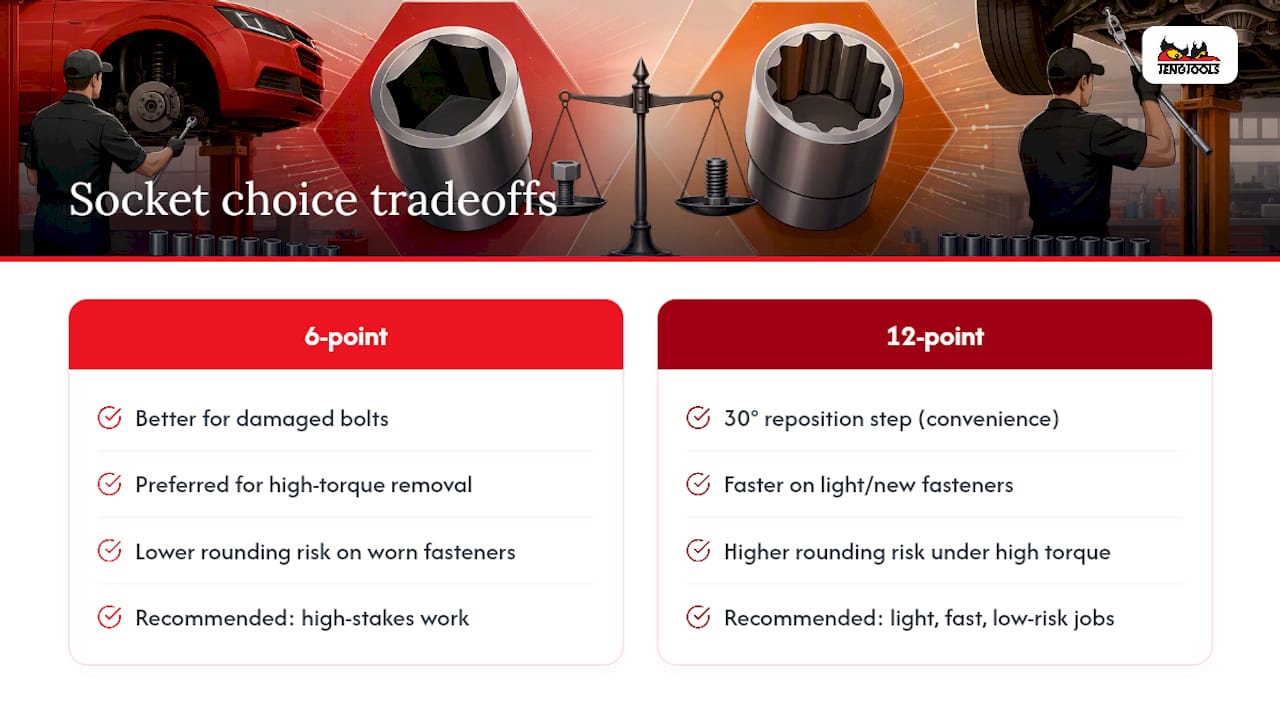
The conventional wisdom treats this as a simple upgrade question, as if 12-point is the modern version and 6-point is what you settle for when you don’t have a choice. That’s backwards. The 30-degree reposition step is a genuine convenience, not a performance upgrade, and mechanics who reach for 12-point out of habit on high-torque removal are the ones who round bolt heads and then blame the fastener.
What gets underrated is how much this decision depends on the condition of the fastener, not the job category. A brand-new bolt torqued to spec barely cares which socket you use. A bolt that’s been baking under an exhaust manifold for eight years cares enormously. If you’re going to prioritize one thing, prioritize matching socket to fastener condition, not socket to job title. Buy your kit assuming most of your high-stakes work will lean 6-point, and let 12-point earn its place on the light, fast, low-risk stuff where speed actually pays off.
— David
Which Teng Tools Set Fits Your Bench
If you’ve read this far, you already know the fix for rounding bolts and fumbling in tight spaces isn’t a better technique, it’s having the right pattern in the right size sitting in an organized tray instead of buried in a drawer. Teng Tools builds sets around exactly the tradeoffs covered above, so you’re not assembling 6-point and 12-point coverage piece by piece.
For heavy-duty removal work, the Teng Tools 1/2" Impact Socket Set FOAM6X6, 50 pieces (TELISK50) gives you impact-rated 6-point coverage built for stuck fasteners and high torque, organized in a foam tray so nothing goes missing mid-job.
| Buyer type | Recommended set | Why it fits |
|---|---|---|
| Professional bench, heavy-duty work | TELISK50 | Impact-rated 6-point sockets for high-torque removal and stuck fasteners |
| Mobile tech needing both drive sizes | TELSK76 handled by Teng Tools | Combined 1/4" and 1/2" coverage in one organized case |
| Shop tech building a comprehensive kit | TTESK116 handled by Teng Tools | Full 1/4" and 1/2" range with foam trays for complete organization |
Every set ships same-day from Fort Worth and carries Teng Tools’ lifetime warranty, so the sizing decisions you make today don’t turn into a repurchase down the road. Pick the set that matches how you actually work, and check the current build sheet on the TELISK50 product page before you order.
Sources
- 6‑Point vs 12‑Point Socket — Misumi (US)
- 6‑Point Sockets vs. 12‑Point Sockets | Family Handyman
- Socket drive patterns explained — Build & Construct
FAQ
Are 12-Point Sockets Better Than 6-Point?
Not universally. 12-point sockets are better for tight-access repositioning thanks to their 30-degree engagement step, but 6-point sockets handle higher torque with less rounding risk because they load the fastener’s flats instead of near its corners.
Do You Need Both 6-Point and 12-Point Sockets?
Yes, most working mechanics keep both. A 6-point set covers high-torque removal and stuck fasteners, while a smaller 12-point selection handles hand-ratchet work in tight spots where quick repositioning saves real time.
Will a 12-Point Socket Fit a 6-Point Fastener?
Yes, a 12-point socket fits over a 6-point hex head because six of its twelve points register on the fastener’s flats. The fit is looser than a matched 6-point socket, though, so it’s not the right choice under heavy torque or with an impact gun.
What Is the Disadvantage of 12-Point Sockets?
The main disadvantage is reduced torque capacity and higher rounding risk on stuck or damaged fasteners, since several of the twelve points sit closer to the fastener’s corners rather than its flats. That makes 12-point a poor choice for stubborn bolts or impact work.