
Sockets come in two systems, metric (millimeter) and SAE/imperial (inch), and the socket has to match the fastener’s own system to seat correctly. For general work, keep a 3/8" drive set within reach first, add 1/4" for small fasteners and tight spots, and step up to 1/2" for suspension bolts, lug nuts, and anything torqued hard. A handful of SAE and metric sizes look close enough to swap, but that small gap is exactly what rounds off a bolt head under real torque.
TL;DR:
- Matching the socket system (metric or SAE) is essential, as even slight differences can cause rounding or slipping under torque.
- Using the correct drive size (1/4", 3/8", 1/2", or larger) is critical for ensuring safe torque limits and avoiding tool damage.
- Six-point sockets are preferred for high-torque, rusted, or stubborn fasteners due to their grip and resistance to rounding.
- Near-matching sizes between SAE and metric sockets can be dangerous for critical fasteners, so verify sizes before use.
- Organizing sockets by size with foam trays or labels reduces the risk of using the wrong size and speeds up work.
Table of Contents
- Metric and SAE Socket Size Chart
- Bolt-Diameter to Socket-Size Mapping
- Which Drive Size Do You Actually Need?
- Should You Use 6-Point or 12-Point Sockets?
- When Is a SAE-to-Metric Socket Swap Safe?
- How Do You Measure and Pick the Right Socket?
- What Makes a Socket Set Worth Trusting?
- Materials and Coatings That Determine How Long a Socket Lasts
- How Do You Read the Numbers Stamped on a Socket?
- Safety Tips for Using Sockets and Socket Wrenches
- An Editorial Take on Getting the Socket Size Right
- Which Teng Tools Socket Set Fits Your Bench?
- Sources
- FAQ
Metric and SAE Socket Size Chart
Print this or bookmark it. It covers the sizes you’ll actually reach for on a bench, from small electronics screws to lug nuts, matched to the drive size that handles them best.
Metric sockets typically run from 4mm up through 24mm for everyday work, while SAE sockets cover fractional sizes from 1/4" to 1", according to HowStuffWorks. A ready reference like the one Misumi publishes pairs each size with a suggested drive and a typical use case, which is the format that actually saves time at the bench.
| Size | Drive | Common use |
|---|---|---|
| 4mm–6mm | 1/4" | Electronics, small appliances, interior trim |
| 7mm–10mm | 1/4" or 3/8" | Motorcycle work, valve covers, small brackets |
| 11mm–14mm | 3/8" | Engine accessories, general automotive |
| 15mm–19mm | 3/8" or 1/2" | Head bolts, suspension components |
| 20mm– | 1/2" | Lug nuts, heavy suspension, truck work |
| 1/4"–3/8" (SAE) | 1/4" | Small hardware, appliance repair |
| 7/16"–9/16" (SAE) | 3/8" | General automotive fasteners |
| 5/8"–3/4" (SAE) | 3/8" or 1/2" | Suspension, older domestic vehicles |
| 13/16"–1" (SAE) | 1/2" | Lug nuts, heavy equipment, agricultural gear |
Two things jump out once you line the systems up side by side. First, the jump from 3/8" drive to 1/2" drive lines up almost exactly with the jump from everyday fasteners to the ones that fight back, lug nuts, control arm bolts, anything a shop torque wrench cares about. Second, the metric mid-range is where American and imported vehicles overlap most, so that band gets more wear than any other size on the tray.
Bolt-Diameter to Socket-Size Mapping
The socket size is not the bolt’s thread diameter. It matches the width across the flats of the bolt head or nut, which is always larger than the thread measurement. A 1/4" bolt doesn’t take a 1/4" socket. It takes a 7/16" socket because the head is machined wider than the shank underneath it.
SAE mappings worth memorizing:
- 1/4" bolt → 7/16" socket
- 5/16" bolt → 1/2" socket
- 3/8" bolt → 9/16" socket
- 1/2" bolt → 3/4" socket
Metric mappings follow the same logic, with one wrinkle. According to WorkshopCalc, M6 bolts typically take a 10mm socket, M8 takes 13mm, and M10 can take either 16mm or 17mm depending on the head style the manufacturer chose. That dual-size quirk on M10, and often on M12 and M14 as well, is why experienced mechanics keep both sizes in the tray instead of assuming one will always fit.
Which Drive Size Do You Actually Need?
Drive size determines how much torque a socket can safely handle, not just what fits your ratchet. Undersizing the drive for the job is one of the fastest ways to snap a ratchet or strip a square drive.
- 1/4" drive: small fasteners, electronics, interior trim, low-torque work where access is tight.
- 3/8" drive: the general-purpose workhorse. Handles most engine bay and household fastener work without straining.
- 1/2" drive: lug nuts, suspension bolts, anything a torque wrench will be checking afterward.
- 3/4" and 1" drive: heavy equipment, truck and fleet work, fasteners well beyond typical DIY torque ranges.
Adapters let a 3/8" ratchet drive a 1/2" socket, or the reverse, but stepping a small drive up to high torque through an adapter is asking for a stripped square or a snapped extension. A practical starter set pairs 1/4" drive sockets for detail work with a 3/8" drive set as the daily driver, then a 1/2" drive set reserved for suspension and wheel work.
Should You Use 6-Point or 12-Point Sockets?
Six-point sockets grip the flats of a bolt head across a wider contact surface, which is exactly why they resist rounding on corroded, high-torque, or stubborn fasteners. Twelve-point sockets have twice the engagement points, which makes them faster to seat in tight spaces, but that thinner contact area gives up grip under real load.
- Use 6-point for anything torqued hard, rusted, or previously over-tightened.
- Use 12-point when speed and access matter more than raw grip, light trim fasteners, quick removal jobs.
- Shallow sockets fit open areas and give better clearance; deep sockets reach over studs and long bolts.
- Impact sockets are built from tougher, more forgiving steel to absorb shock loads, and 6-point impact sockets are the standard pairing with impact guns for that same reason.
Pro Tip: Always hand-seat a socket on the fastener before you pull the trigger on an impact gun. A socket that’s even slightly cocked will round the head the instant torque hits it, and you won’t feel it happen until the bolt is already ruined.
When Is a SAE-to-Metric Socket Swap Safe?
Some SAE and metric sizes sit close enough that one will slide onto the other’s fastener, but “close” is not “correct.” A 3/8" socket measures 9.525mm across, close to a 10mm fastener but not identical, and a 1/2" socket measures 12.700mm against a 13mm bolt head, according to WhatSizeBolt.
- 3/8" (9.525mm) is close to 10mm
- 1/2" (12.700mm) is close to 13mm
- 9/16" (14.288mm) is close to 14mm
This small gap might feel like a fit by hand, but it can cause a socket to slip and round the head under torque. Low-stakes tasks like loosening a hose clamp tolerate the swap. Suspension bolts, brake hardware, and anything with a torque spec printed next to it do not. Keep a printable SAE-to-metric chart nearby so you’re never guessing which near-equivalent you’re looking at.
How Do You Measure and Pick the Right Socket?
- Measure across the flats. Use calipers or a ruler across two opposite flat sides of the bolt head or nut, not corner to corner. This is your true socket size, not the thread diameter.
- Hand-fit before you commit. Slide the socket on by hand. It should seat snugly with no play. If it wobbles even slightly, you’re one size off, try the next size down before assuming a near-equivalent will do.
- Match drive and geometry to the job. Pick 6-point for torque and corrosion, 12-point for speed and access, and step up the drive size before you step up the force you’re applying.
- Free stuck fasteners before forcing anything. Penetrating fluid and heat loosen rust far more reliably than muscle, and they save the socket from taking damage meant for the bolt.
Watch for these red flags: a socket that spins loosely on the head, visible rounding starting at the corners, or a ratchet that clicks without the bolt moving. Any of those means stop and reassess the size before you finish rounding the fastener.
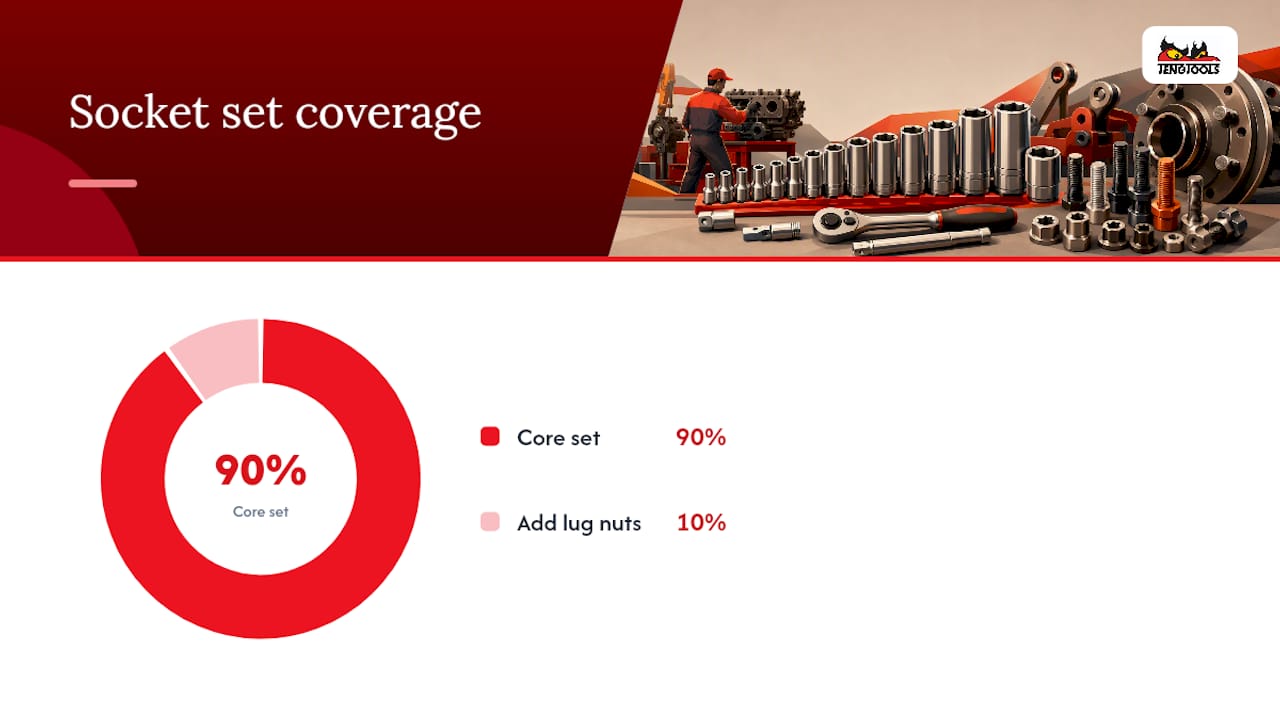
For roughly 90% of automotive and household jobs, a set covering metric 10mm, 12mm, 13mm, 14mm, 17mm, and 19mm alongside SAE 9/16" and 3/4" will get you through the bench, per WhatSizeBolt’s practical minimum list. Add 21mm and 22mm if lug nuts are part of your regular work.
Pro Tip: Keep a small notepad or phone note of every fastener size you encounter on a recurring job, your own vehicle’s lug nuts, your mower’s blade bolt. You’ll stop re-measuring the same bolt every single time.
What Makes a Socket Set Worth Trusting?
A socket that fits loosely or gets misplaced mid-job costs more than the tool itself. Teng Tools builds every set around the Get Organized™ system, foam trays that click together so each socket has one home and a missing tool is obvious at a glance, not discovered halfway through a brake job.
Every socket in the line meets ISO and DIN dimensional standards, backed by a lifetime warranty, and sets ship same-day from a U.S.-based warehouse. Foam-organized kits cut the time spent hunting for the right size and make it far less likely a socket gets left in an engine bay or a drawer somewhere else in the shop. Organization here matters as much as the sizes themselves.
Materials and Coatings That Determine How Long a Socket Lasts
Chrome vanadium steel is the standard for hand-drive sockets, valued for the balance it strikes between hardness and the flex needed to absorb repeated stress without cracking. Cheaper sockets often substitute plain carbon steel, which holds an edge less well and rounds internally faster under repeated use.
Chrome plating adds corrosion resistance and makes a socket easier to wipe clean, but it also adds a thin layer that can flake under heavy impact use, which is why plated sockets belong on hand tools, not impact guns. Impact sockets skip the shiny chrome finish entirely. They’re forged from a tougher alloy and given a black oxide or phosphate coating specifically because that finish flexes with shock loads instead of chipping.
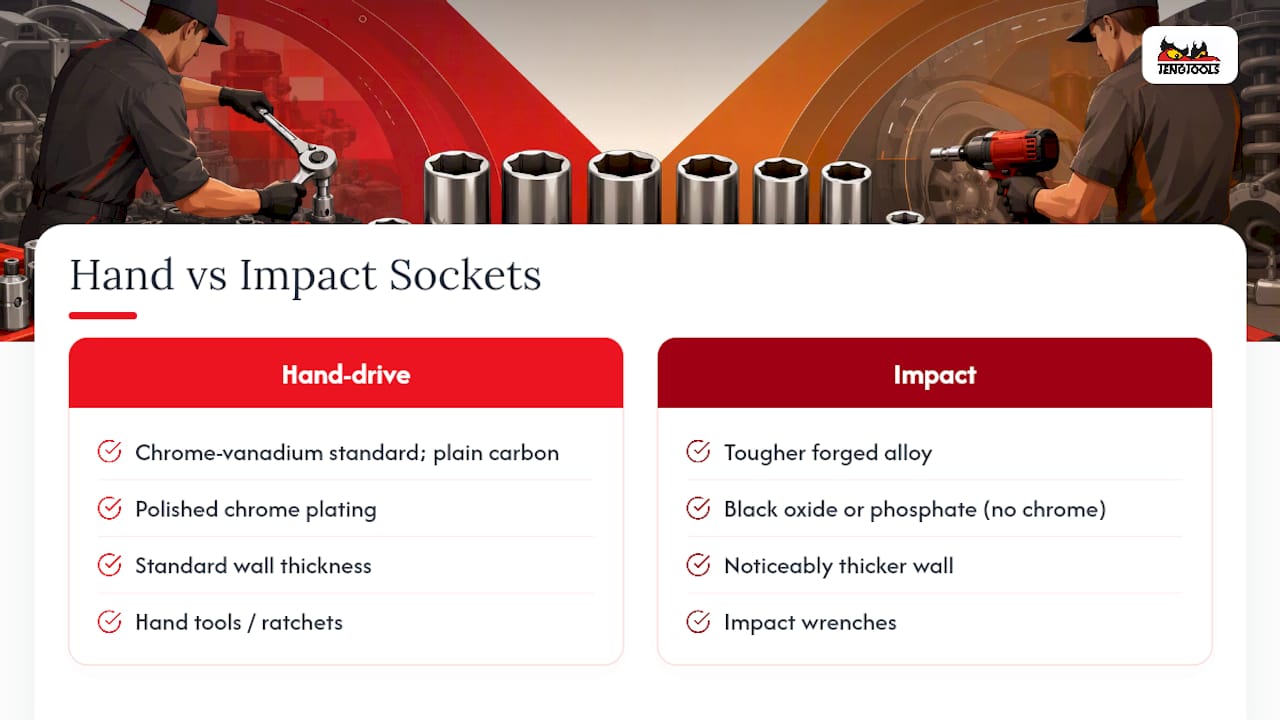
The coating also tells you something about intended use before you even pick the socket up. A satin or matte black finish signals impact-rated construction. A polished chrome finish signals hand-tool use only. Mixing the two, running a chrome-finished socket on an impact wrench, is a common way to crack a socket wall or send a fragment flying, since that plating and the softer steel beneath it were never engineered for shock loading.
Wall thickness matters just as much as the alloy. Impact sockets are noticeably thicker at the same nominal size because the material has to absorb sudden torque spikes rather than the smooth, steady load a hand ratchet applies. That’s also why impact sockets often look chunkier side by side with a hand socket of the identical size.
How Do You Read the Numbers Stamped on a Socket?
Every socket carries its size stamped on the side, usually the drive-facing end, and that’s the number to trust over a visual guess every time. Metric sockets show the size in millimeters, often with “mm” printed alongside it. SAE sockets show a fraction, sometimes with a small ditto-style mark rather than the word “inch.”
Beyond the size, look for a drive-size indicator, a small marking noting 1/4", 3/8", 1/2", 3/4", or 1", stamped near the square drive opening itself. Point count sometimes appears too, though 6-point and 12-point are usually obvious just from looking at the opening.
Manufacturer markings and standard compliance codes, referencing dimensional standards like ASME B18.3, show up on higher-quality sockets as a small logo or code near the size stamp, according to Amesweb’s dimensional guidance. That stamp is your assurance the socket was machined to a checked tolerance rather than cast to an approximate size, which matters more than it sounds like on any fastener carrying a real torque spec.
If a stamp has worn away entirely, across-flats measurement with calipers is the only reliable way back to the correct size. Never trust a worn socket’s fit by feel alone.
Safety Tips for Using Sockets and Socket Wrenches
Wrong-system mismatches, using a near-equivalent metric socket on an SAE bolt, are one of the most common causes of rounded fasteners and slipped tools, a caution echoed across both HowStuffWorks and WorkshopCalc’s reference guides. Confirm the system before you confirm the size.
Always seat the socket fully and squarely on the fastener before applying force. A cocked socket concentrates load on one edge instead of spreading it across all six or twelve points, and that’s when corners round or sockets crack.
Keep fingers clear of the ratchet’s swing path, especially when breaking loose a tight fastener that might suddenly give. A socket that slips off under load sends the ratchet handle into whatever’s nearby, often a knuckle.
Never use a hand-rated chrome socket on an impact wrench. The shock loading an impact gun generates can shatter a plated socket, sending fragments outward at speed. Match impact tools only with sockets rated for impact use.
Inspect sockets periodically for rounded corners, cracks, or worn size stamps. A socket that no longer grips a fastener cleanly is more dangerous than useful, since it’s likely to slip mid-turn under load. Retire it rather than forcing it through one more job.
Wear eye protection any time you’re using a breaker bar, impact wrench, or applying serious leverage. Fasteners and tools under high stress occasionally fail, and that failure happens fast.
An Editorial Take on Getting the Socket Size Right
Most socket guides treat the chart as the whole answer. It isn’t. The chart tells you what number to look for; it doesn’t tell you why your 17mm socket rounded a bolt head last Tuesday. That happened because the fastener was corroded, the socket was 12-point when it needed to be 6-point, or someone reached for a near-equivalent size instead of walking back to the tool chest for the exact one.
The conventional advice, “measure and match,” is correct but incomplete. It skips the part where half of all socket damage happens from geometry mismatches and drive-size overreach, not size errors at all. A perfectly sized 12-point socket on a rusted exhaust bolt will still slip and round that head, while a slightly loose 6-point often won’t.
If there’s one thing worth prioritizing over memorizing every conversion figure, it’s this: organize your sizes so the correct one is always the fastest one to grab, using tools like the Inventory Formulas Calculator | Findle Tools to optimize your tool organization. A scattered drawer of loose sockets pushes people toward the near-equivalent sitting on top, which is exactly the shortcut that strips fasteners. Foam-organized sets solve that problem at the source, not by making you smarter about conversions, but by making the right size the easy choice every single time.
— David
Which Teng Tools Socket Set Fits Your Bench?
Each socket set is designed to help users know the right size fast, without digging through a jumbled drawer of loose sockets. Many sets ship with foam trays, so each socket clicks into its own slot and a missing size is visible at a glance instead of discovered mid-job.
The 76-piece FOAM6X6 set (TELSK76) covers both 1/4" and 1/2" drives in one organized case, a solid pick if you want the full metric and SAE range covered without buying multiple kits. If bench space is tighter, the 75-piece FOAM4X4 set (TTESK75) delivers the same 1/4" and 1/2" drive coverage in a smaller footprint suited to a compact bench or mobile toolbox. Fleet techs and shops running through sizes daily get more headroom from the 116-piece FOAM4X4 set (TTESK116), which adds extra sizes for the jobs that don’t fit a standard 75-piece lineup.
Sockets in these sets meet ISO and DIN standards, carry a lifetime warranty, and are shipped from a U.S.-based warehouse. Pick the set that matches your bench, and check availability on the product page now.
Sources
The socket sizes, drive recommendations, and bolt mappings in this guide draw on the following references, worth bookmarking alongside your own chart:
- What is the size order of socket wrenches? — HowStuffWorks
- Socket Size Chart: SAE & Metric Socket Sizes by Bolt (2026) | WorkshopCalc
- Socket Size Chart - Misumi USA
- What Size Socket for My Bolt? — Wrench & Socket Size Chart | WhatSizeBolt
FAQ
What Are Socket Sizes in Order?
SAE sockets run in order from 1/4", 5/16", 3/8", 7/16", 1/2", 9/16", 5/8", 11/16", 3/4", 13/16", 7/8", 15/16", up to 1". Metric sockets run in order from roughly 4mm up through 24mm in whole-millimeter steps for most common sizes.
How Do I Figure Out What Size Socket I Need?
Measure across the flats of the bolt head or nut, not the thread diameter, using calipers or a ruler, then match that measurement to the closest metric or SAE socket. Hand-fit the socket before applying torque to confirm a snug, wobble-free fit.
Is 15/16 the Same as 24mm?
No. A 15/16" socket measures roughly 23.8mm, close to 24mm but not identical, and using one in place of the other risks slipping under torque. Always confirm the fastener’s actual system before substituting a near-equivalent size.
What Is the Order of SAE Socket Sizes?
The standard order for common SAE sockets is 1/4", 5/16", 3/8", 7/16", 1/2", 9/16", 5/8", 11/16", 3/4", 13/16", 7/8", 15/16", and 1", covering the range used across most automotive and household fasteners.