
For most workshop and assembly work, a T-handle wins on speed and hand comfort, while a compact L-key set earns its keep in tight clearances a T-handle can’t reach. The right pick comes down to three things: how much torque the fastener needs, how much room you have around it, and how many times you’re turning that same size today.
TL;DR:
- T-handles deliver higher torque and reduce hand fatigue during repetitive fastening, making them ideal for high-volume assembly work.
- L-keys excel in tight spaces and recessed bolts where a T-handle cannot reach, but they offer less leverage and generate less torque.
- Using ball-end tips for final tightening risks stripping, so they should only be used for initial alignment, not for high-torque turns.
- Steel quality and proper tool care, including avoiding extensions and inspecting tips, significantly extend the lifespan of hex tools.
- Buying a few key sizes in a high-quality set, and organizing tools with foam trays, ensures better durability and easier identification during work.
Table of Contents
- T-Handle vs L-Key: How Torque, Clearance, and Speed Stack Up
- Pros and Cons of T-Handles and L-Keys
- When to Use Each: Real-World Scenarios
- Ball-End, Ratcheting, and Alloy Choices That Actually Matter
- How to Care for Hex Tools So They Last
- Buying Checklist: What to Prioritize First
- Why Teng Tools Earns a Spot in Your Kit
- Common Brands and Quality Benchmarks
- Price Range and Value Considerations
- Safety Tips and Common User Mistakes
- Author’s Perspective: Building the Right Kit for Your Situation
- Grab the Right Tools for Your Kit
- Sources
- FAQ
T-Handle vs L-Key: How Torque, Clearance, and Speed Stack Up
The shape of each tool decides what it’s good at. A T-handle puts the crossbar directly over your palm, so you push down and rotate at the same time. That combination generates more torque than a standard L-shaped key and does it with less strain on your wrist, because your whole hand’s weight and grip strength go into the turn instead of just your fingers. An AutomationDirect buying guide backs this up directly: T-handles provide more comfortable grip and meaningfully more torque than L-shaped keys of the same size.
An L-key works differently. You’re gripping the short end and swinging the long end around a fixed pivot point, which is exactly why it can sneak into recesses, engine bays, and bracket corners where a T-handle’s crossbar will never fit. The trade-off is leverage. You’re relying on arm and wrist strength alone, and on a stubborn fastener, that runs out fast.
Here’s where each geometry actually wins:
- Torque under load: T-handle, because the palm-over-shaft grip lets you drive downward force and rotation together.
- Tight recesses and offset bolts: L-key, since its narrow profile slips past housings and fender wells that a T-handle’s crossbar can’t clear.
- Repetitive fastening (10+ of the same bolt): T-handle. Research on T-handle ergonomics shows the reduced hand fatigue adds up fast across a production run or a full brake job.
- Grab-and-go portability: L-key set, since a folding or ring-style set fits a pocket or a small pouch where a fistful of T-handles won’t.
- Bench work with a vise or fixture: T-handle, where you have room to work and want speed over a stack of identical fasteners.
Speed matters more than most people give it credit for. Contractors and assembly technicians who drive the same fastener size dozens of times a day tend to standardize around a single T-handle size, because the ergonomic edge compounds over hours, not just individual turns. Portability flips the equation. A field tech carrying a truck kit or a cyclist packing for a ride cares more about what fits in a bag than what turns fastest on a bench.
Pros and Cons of T-Handles and L-Keys
Weighing the two side by side makes the decision faster than reading paragraphs of theory.
- T-handle pros: Higher torque output, better grip comfort over long sessions, faster repetitive driving, less wrist fatigue on high-volume jobs.
- T-handle cons: Bulkier to carry, needs clearance around the fastener for the crossbar to swing, generally a single-size tool rather than a full range in one piece.
- L-key pros: Compact enough for a pocket, reaches into recessed bolts and tight brackets, a full metric or imperial set fits in one small case, and quality steel holds up to years of occasional use.
- L-key cons: Lower torque ceiling, more hand strain on high-volume driving, and the short end offers little leverage on a fastener that’s fighting back.
- Ball-end limitation, both formats: Ball-end tips let you approach a bolt at an angle, but they carry a thinner shaft profile than straight-cut tips. ToolGuyd’s comparison recommends using the ball end only to start or align a fastener, then switching to a straight-end tip for the final torque, since pushing full force through a ball tip risks twisting or rounding it.
That last point applies to both a ball-end L-key and a ball-end T-handle equally. Neither format’s rounded tip should be the one doing the final, high-torque turn.
When to Use Each: Real-World Scenarios
Matching the tool to the task avoids the two most common mistakes: fighting clearance with a T-handle, or fighting torque with an L-key.
- Automotive and assembly work: Reach for a T-handle on repetitive bolts like intake manifolds or panel fasteners, but finish critical torque specs with a straight-end key or a proper torque wrench adapter, not a ball tip.
- Bicycle maintenance: A ball-end T-handle handles angled access around derailleurs and brake calipers well, but you’ll still need a standard L-key for stem bolts and cage mounts tucked too close to the frame for a T-handle’s crossbar. Bottle cage bolts, for example, typically call for torque in the 2 to 6 Nm range, light enough that an L-key alone handles it without strain.
- Electronics and panel work: Long-reach L-keys are the better call in cramped enclosures, where a T-handle simply has nowhere to swing.
- Field service and truck kits: Compactness wins. A stubby L-key set or folding set beats a bag full of individual T-handles when you’re climbing in and out of a service vehicle all day.
None of this means owning both formats is overkill. It means each one has a job the other one struggles with.
Ball-End, Ratcheting, and Alloy Choices That Actually Matter
Tip geometry and steel quality decide how long a hex tool stays accurate and how much abuse it survives before rounding out.
- Ball-end vs. straight tips: Ball ends buy you angled access into recessed bolts; straight tips hold more torque without twisting. Use the ball end to get the fastener started, then finish with straight.
- Ratcheting and quick-release T-handles: These speed up high-volume work by cutting the number of full hand rotations needed per fastener, which matters most on production-style jobs with dozens of identical bolts.
- Material matters more than most buyers assume. S2 and chrome-vanadium steels resist twisting and wear far better than the soft alloy keys that come bundled free with flat-pack furniture. AutomationDirect’s guide notes that premium tip profiles reduce rounding and extend the usable torque range compared with generic keys.
- Proprietary hardened finishes on premium tools add another layer of wear resistance, which shows up most on seized or corroded fasteners that fight back every time you turn.
Pro Tip: Never extend an L-key with a length of pipe to force a seized bolt. The shaft will twist or snap before the fastener gives. Reach for a proper torque adapter or a half-inch drive hex bit socket instead.
A heat-treated alloy key isn’t overkill on a bolt that hasn’t moved in ten years. It’s the difference between the fastener breaking loose and the tool breaking first.
How to Care for Hex Tools So They Last
A rounded tip doesn’t just fail on its own. It ruins the next fastener it touches, too.
- Inspect the tip before every use. A slightly rounded hex profile slips under torque and chews up the bolt head, so retire that tool rather than keep forcing it.
- Wipe down and lightly oil tools after wet or corrosive work, and check T-handle swivel points periodically since grit works into the pivot faster than you’d expect.
- Store by size, not by pile. A junk drawer of loose keys is how the right size goes missing right when you need it.
Foam tray storage systems keep tips protected from chipping against each other and cut down the time spent hunting for the right size in a busy shop. That’s the entire logic behind Teng Tools USA’s Get Organized™ system: a designated slot for every tool means you spot a missing one at a glance instead of discovering it mid-job.
Buying Checklist: What to Prioritize First
Before you buy a full set of either format, narrow down what you’re actually going to use.
- Metric or imperial, decided first. Mixing the two invites forcing the wrong size onto a fastener, which is one of the fastest ways to round out a hex socket. Check a hex key size chart if you’re unsure which standard your equipment uses.
- Buy your three most-used sizes first, whether that’s in a T-handle, an L-key, or both, rather than a giant set of sizes you’ll rarely touch.
- Look for etched or stamped size markings that won’t wear off, plus a finish that resists rust in a humid shop or garage.
- Check the warranty terms before buying. A lifetime warranty on hand tools signals a manufacturer confident its steel and heat treatment will hold up.
- A practical starter combo: one T-handle in your most-used size, plus a compact L-key set for the sizes you only need occasionally.
Why Teng Tools Earns a Spot in Your Kit
Teng Tools USA designs its hand tools to ISO and DIN standards, backs them with a lifetime warranty, and ships same-day from its Fort Worth, Texas warehouse. That combination matters more than it sounds, because a warranty is only as good as the company standing behind it, and a same-day shipment means a broken tool doesn’t stall a job for a week.
The Get Organized™ tray system solves the exact clutter problem this article keeps circling back to: tools that vanish into a drawer and cost you ten minutes mid-repair. Every tool gets a designated foam cutout, trays click together, and a missing tool is obvious the moment you look at the tray.
- General shop coverage: a foam-organized general kit gives you both formats in one case, sized for a bench or rolling cart.
- Repetitive single-size work: buy a single T-handle in your most-used size rather than a whole set, and pair it with a compact L-key set for the odd sizes.
- Field or mobile work: a mobile tool panel kit keeps a curated selection portable without sacrificing the tray organization that keeps tips protected.
Common Brands and Quality Benchmarks
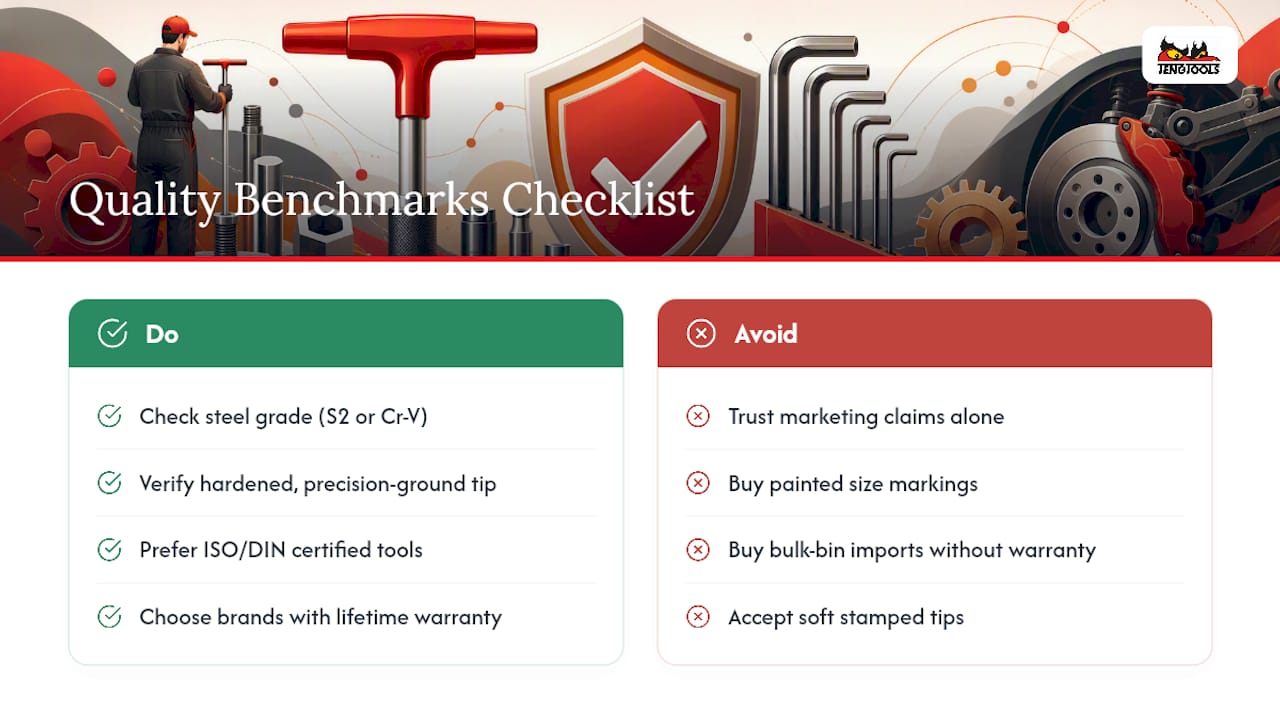
Quality in this category comes down to steel, heat treatment, and tip tolerance, not marketing claims. S2 tool steel and chrome-vanadium alloys are the two benchmarks worth checking for on a spec sheet, since both resist the twisting and rounding that ruins a cheap key within a few uses. A hardened, precision-ground tip holds its hex profile through hundreds of insertions; a soft stamped one starts rounding within a dozen.
ISO and DIN standards give you a reference point when comparing brands, since a tool built to those specifications has a documented tolerance for size and fit rather than an approximate one. Warranty terms are the other tell. A company willing to back a hand tool for its lifetime is making a statement about how confident it is in its own heat treatment and alloy choice. Cheaper import keys sold in bulk bins rarely carry that kind of guarantee, and there’s a reason for that: the manufacturer doesn’t expect the tool to survive long enough for a claim to matter.
For buyers comparing options, the practical benchmark is simple. Check the steel grade, check the warranty, and check whether the sizes are etched rather than painted on, since paint wears off within weeks of regular use.
Price Range and Value Considerations
A single L-key sells for just a few dollars, while a full metric and imperial set runs anywhere from around $15 for a basic set to $50 or more for a hardened, finished set with a case. T-handles cost more per piece since they use more material and a more complex crossbar assembly, typically running from around $8 to $20 per size depending on steel grade and whether it’s a ball-end or straight tip.
Full kits that bundle both formats, along with sockets, wrenches, and screwdrivers, cost more upfront but avoid the trap of buying individual tools piecemeal as each new job reveals a gap in your collection. The real value question isn’t the sticker price. It’s how many fasteners the tool survives before the tip rounds out and you’re buying a replacement anyway. A $6 import key that rounds after a month of light use costs more over a year than a $15 hardened key that’s still sharp five years later.
Buying a single high-quality T-handle in your most common size, rather than a cheap full set you’ll rarely open past the first three sizes, tends to be the better use of a limited budget.
Safety Tips and Common User Mistakes
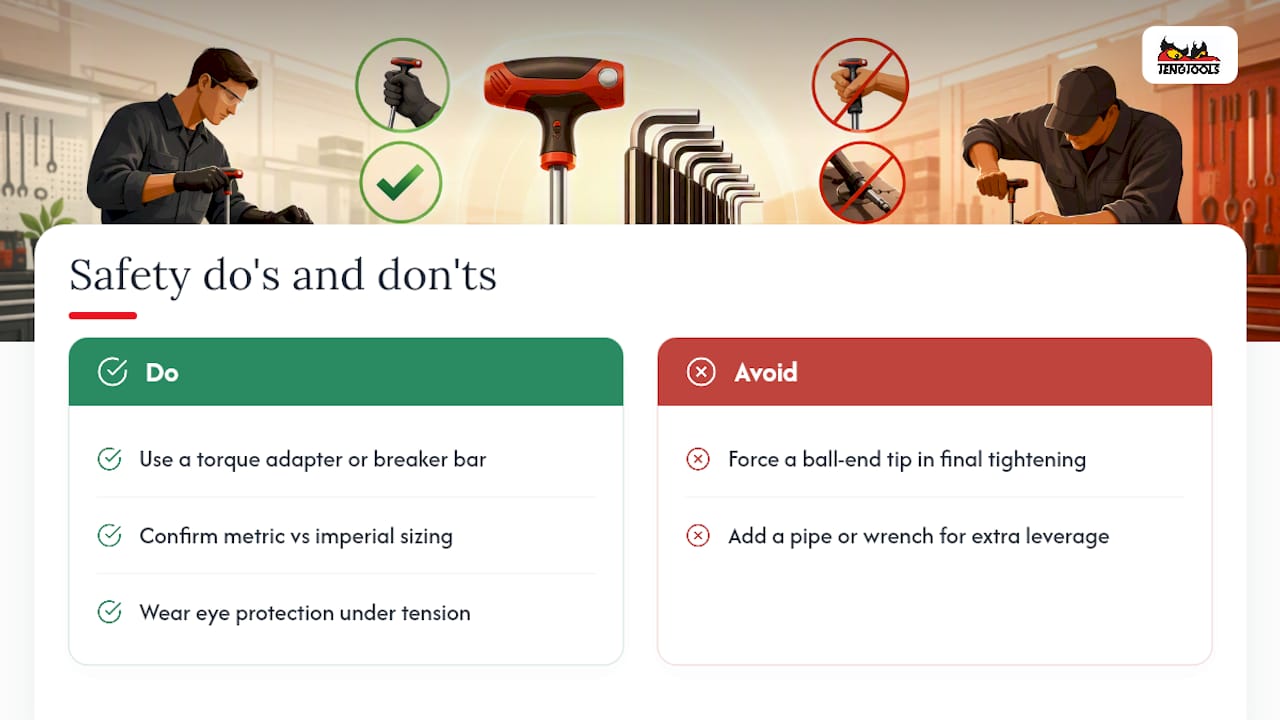
The single most common mistake is forcing a ball-end tip through a high-torque final tightening pass. The rounded profile transmits less rotational force than a straight tip, and pushing past that limit twists the tip or rounds the fastener’s hex socket, sometimes both at once.
The second mistake is using the wrong tool for leverage. Slipping a pipe or wrench over an L-key’s short end to add torque is a shortcut that ends badly: the shaft twists or snaps before a seized bolt gives way, and a snapped tool under load can send a sharp piece of steel flying. If a fastener doesn’t move with hand force alone, step up to a torque adapter or a hex bit socket on a breaker bar instead.
Mismatched sizing causes more quiet damage than either of those. A hex key one size too small rounds the fastener’s corners almost immediately under load, even if it seems to grip at first. Always confirm metric versus imperial before forcing a fit, since the two standards are close enough in several sizes to feel deceptively similar.
Wearing eye protection when working under tension or with a fastener that’s fighting back is a habit worth keeping regardless of which tool format is in your hand.
Author’s Perspective: Building the Right Kit for Your Situation
A mechanic doing the same handful of bolts all day should own one T-handle in their primary size and a full L-key set in a foam tray for everything else. A cyclist gets more mileage from a ball-end T-handle for common frame and component sizes, paired with a compact folding L-key set that survives being tossed in a saddle bag. A hobbyist starting from zero doesn’t need a T-handle at all yet. Start with a solid L-key set, and only add a T-handle once a specific project starts demanding the same size, over and over, on repeat.
— David
Grab the Right Tools for Your Kit
Once you know whether you need a T-handle, an L-key set, or both, the next step is picking a kit that doesn’t leave gaps. Some manufacturers build hand tools to ISO and DIN standards, back them with a lifetime warranty, and offer prompt shipping, so a missing tool doesn’t stall your week.
If you’re assembling a general shop kit, the Teng Tools General tool set FOAM4X4 18 pieces gives you a compact, organized starting point sized for a bench or small cart. Field techs who need mobility without losing the tray organization discussed above should look at the Teng Tools Mobile Tool Panel Tool Kit 33 Pieces. For shops that want full coverage across sockets, wrenches, and hex drivers in one case, the Teng Tools General Tool Set FOAM6X6 99 Pieces fills that role well. Browse the current lineup and pick the set that matches how you actually work, not how a generic bin of tools assumes you work.
Sources
The claims on torque, clearance, and tip limitations in this article draw from a small set of focused sources worth a closer read.
- Hex key — Wikipedia
- L-Keys & T-Handles Buying Guide — AutomationDirect (PDF)
- How T-Handle Hex Drivers Improve Torque Control and Reach Over Standard L-Keys — Build & Construct
- Ball hex vs straight hex tools — ToolGuyd
FAQ
Is an L-Key the Same Thing as an Allen Key?
Yes. “Allen key” and “L-key” both refer to the same hex key tool; “Allen” comes from the Allen Manufacturing Company, while “L-key” and “hex key” describe its shape and drive profile generically.
What Are T-Handles Good For?
T-handles are best for repetitive fastening and higher-torque driving, since the palm-over-shaft grip lets you apply downward pressure and rotation together, cutting hand fatigue on jobs with many identical bolts.
What Does an L-Key Look Like?
An L-key is a single bent rod of hardened steel shaped like the letter L, with a hex tip on each end so you can use the short end for tight clearance or the long end for extra reach and leverage.
What Is an L-Key Used For?
An L-key drives hex-drive fasteners in tight spaces where a T-handle’s crossbar won’t fit, and a full set covers a wide range of sizes in one compact case. For high-torque or high-repetition jobs, pairing an L-key set with a single T-handle, like those in Teng Tools USA’s T-handle hex key lineup, covers nearly every scenario a mechanic or hobbyist runs into.