
A product is TAA compliant if it’s wholly manufactured in the U.S. or a country the government has designated as a trade partner, or if it undergoes a real change in name, character, or use in one of those places. The rule lives in FAR clauses 52.225-5 and 52.225-6, and it applies item by item, not company by company. Certify a product that doesn’t meet this bar and you’re exposed to False Claims Act liability, not just a rejected bid.
TL;DR:
- Products manufactured or significantly transformed in designated countries must undergo real processes that create a new item with different name or use, not just repackaging or labeling.
- The list of TAA-designated countries depends on trade agreements and shifts over time, requiring vendors to check current sources rather than outdated lists.
- The substantial transformation test focuses on actual manufacturing actions, so keeping detailed records of final operations and manufacturing sites is crucial for compliance.
- TAA applies based on procurement dollar thresholds, with Schedule-listed products always treated as TAA-compliant regardless of order size.
- Miscertifying products as TAA compliant can lead to False Claims Act liability, contract termination, and debarment, making thorough documentation and regular audits essential.
Table of Contents
- TAA-Designated Countries: What Counts and Where to Check
- The Substantial Transformation Test, Explained With Examples
- When TAA Applies: Thresholds, the MAS Exception, and Buy American Act Overlap
- Item-Level Compliance Steps and Documentation Vendors Need
- What Happens if You Miscertify, and How to Reduce the Risk
- How Teng Tools USA Supports TAA Documentation for Government Buyers
- What the Compliance Rules Actually Reward
- Get TAA Documentation for Your Next Institutional Order
- Sources
- FAQ
TAA-Designated Countries: What Counts and Where to Check
Not every trading partner qualifies, and the list is built from several overlapping categories rather than one master roster. A country earns “designated” status by being a signatory to the World Trade Organization Government Procurement Agreement, a U.S. free trade agreement partner, a least-developed country, or a Caribbean Basin beneficiary.
That’s four separate legal pathways to the same outcome, which is exactly why vendors get tripped up. A country can qualify under one category and not another, and the designations shift as trade agreements get renegotiated.
The two places worth bookmarking:
- FAR 25.003 defines the designated country categories and cross-references the current list
- GSA’s vendor guidance and Schedule documentation track which countries apply to Multiple Award Schedule contracts specifically
China, India, and Vietnam, three of the world’s largest manufacturing hubs, are notably absent from the designated list. Products finished there almost never qualify, regardless of brand or design origin. Because these lists change without much fanfare, check the current source before finalizing a bid rather than relying on last year’s spreadsheet or a competitor’s product page.
The Substantial Transformation Test, Explained With Examples
This is where most vendors get it wrong, so it’s worth slowing down. TAA compliance doesn’t ask what percentage of a product’s cost came from where, that’s the Buy American Act’s test. TAA asks a qualitative question: did the manufacturing process in the U.S. or a designated country create a new article with a different name, character, or use than its component parts had going in?
The International Trade Administration’s guidance on rules of origin frames this as a transformation test, not a cost-accounting exercise. That distinction changes how you evaluate a supply chain.
Here’s how that plays out on the shop floor:
- Raw steel forged into a wrench in Texas — passes. The forging operation changes raw material into a distinct, usable tool.
- A finished wrench imported from a non-designated country and simply repackaged — fails. Repackaging isn’t transformation.
- Components from multiple countries assembled and heat-treated into a finished socket set in the U.S. — typically passes, if the assembly involves real manufacturing operations, not just screwing parts together.
- A tool head from China attached to a handle made in Sweden, with final grinding and calibration done in the U.S. — often passes, depending on how substantial that final U.S. operation is.
- Foreign-made hand tools relabeled with a U.S. brand name and no further processing — fails, every time.
- A pre-formed blank machined, tempered, and finished into a chisel in a designated country — passes.
Pro Tip: Keep a written record of your final manufacturing operation for every SKU, not just your bill of materials. If a customs ruling or contracting officer ever questions an origin determination, the process documentation is what defends it, not a supplier invoice. Vendors who conflate design location with manufacturing location run into trouble here; a product engineered in the U.S. but transformed overseas still fails the test.
When TAA Applies: Thresholds, the MAS Exception, and Buy American Act Overlap
Not every federal purchase triggers TAA scrutiny. The Trade Agreements Act generally applies once a procurement crosses a dollar threshold set in FAR guidance, and below that line, the Buy American Act’s domestic content rules typically govern instead. Above the threshold, TAA can override BAA entirely, which matters because the two use different tests, one qualitative, one percentage-based.
The exception every GSA vendor needs to know:
- Every product listed on a Multiple Award Schedule contract is treated as TAA-covered, regardless of the size of any individual order placed against it
- That means a $200 tool purchase off a Schedule can carry the same compliance obligation as a $2 million contract
- GSA’s Schedule guidance confirms that MAS listings require accurate country-of-origin data maintained continuously, not just at initial certification
Contracting officers rely on the clause language in the solicitation itself, so read FAR 52.225-5 in every RFQ before assuming BAA rules apply by default.
Item-Level Compliance Steps and Documentation Vendors Need
Treat every SKU as its own compliance case. Company-level assurances mean nothing if a contracting officer or auditor asks about one specific part number.
- Build a bill of materials per SKU that traces each component to its manufacturing site, not just its supplier’s headquarters.
- Collect supplier origin attestations in writing, tied to the actual factory location where final transformation occurs.
- Complete FAR 52.225-6, the Trade Agreements Certificate, accurately for every line item in an offer, disclosing any non-compliant products individually rather than certifying the whole order as compliant.
- Schedule recurring supplier audits, ideally quarterly for high-volume items, since manufacturing locations shift more often than procurement teams expect.
- Update GSA Advantage and Schedule listings immediately when an origin changes, before the next order ships.
GSA’s vendor support guidance makes the underlying risk plain: a product certified as compliant today can become non-compliant tomorrow if production moves, and the certification obligation doesn’t pause while you catch up on paperwork.
What Happens if You Miscertify, and How to Reduce the Risk
Certifying a non-compliant product as TAA compliant isn’t a paperwork error the government shrugs off. It can trigger False Claims Act liability, and penalties can compound per invoice or delivery rather than applying once to the whole contract. Beyond the financial exposure, a miscertification can mean contract termination and, in serious cases, debarment from future federal work.
A handful of controls make the difference between catching a problem early and finding out from a contracting officer:
- Build origin representations into your supplier contracts, not just your own certifications
- Run internal audits against your bill-of-materials records on a fixed schedule
- Keep documentation retention policies that outlast the contract period, not just the delivery date
- Disclose a known origin change immediately rather than waiting to see if anyone notices
If a product’s manufacturing location shifts mid-contract, stop shipping that item under the existing certification and update your representation before the next delivery goes out.
How Teng Tools USA Supports TAA Documentation for Government Buyers
Government buyers need documentation that holds up, not vague assurances. Teng Tools ships from a Fort Worth, Texas warehouse, which keeps origin tracking closer to home than suppliers relying on overseas drop-shipping.
A few specifics that matter to procurement teams building a compliance file:
- Every tool meets ISO and DIN standards, giving contracting officers a documented manufacturing benchmark beyond a vendor’s word
- The Get Organized™ system tracks tools at the tray and kit level, which supports SKU-level traceability when you need to map a specific part number to its origin file
- A lifetime warranty backs every tool, reducing the risk of a mid-contract quality dispute compounding an origin question
- Institutional buyers can request origin documentation for specific kits before finalizing a purchase order
That combination maps cleanly onto what FAR 52.225-6 actually asks for: proof tied to a specific item, not a general claim about the company.
What the Compliance Rules Actually Reward
Most compliance guidance treats TAA like a legal hurdle to clear once, then forget. That’s backward. The vendors who stay out of trouble are the ones who treat origin tracking as an ongoing operational habit, the same way they’d track inventory or calibration dates. The substantial transformation test isn’t a trick question. It’s a plain description of where real manufacturing work happens, and most vendors already know the answer for their own products, they just haven’t written it down in a form that survives an audit.
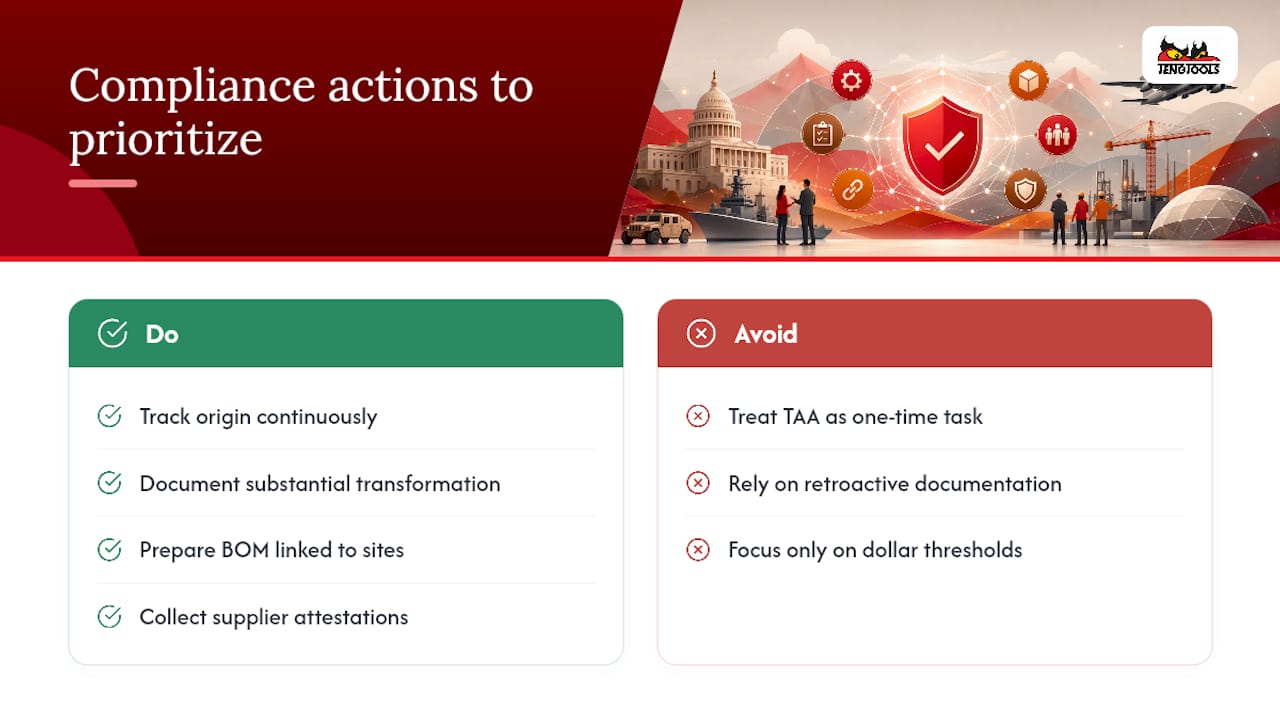
The overrated part of this conversation is the dollar threshold math. Vendors spend too much energy trying to calculate whether a given order falls under TAA or BAA, when the smarter move is building documentation that satisfies both tests from the start. A bill of materials tied to manufacturing sites, updated when production shifts, and backed by supplier attestations works regardless of which clause ends up governing a specific solicitation.
If you take one thing from this, prioritize the paperwork before the bid, not after the award. Contracting officers don’t have patience for retroactive documentation, and neither does the False Claims Act.
— David
Get TAA Documentation for Your Next Institutional Order
Teng Tools USA ships every kit from its Fort Worth, Texas warehouse the same day it’s ordered, which means procurement teams aren’t waiting on overseas freight to fill a contract deadline. Government buyers building a compliance file can pair that speed with origin documentation on request for specific SKUs.
Contractors and institutional buyers commonly stock the Teng Tools General Tool Set FOAM4X4 18 Pieces (TTEX18N) for smaller kits and the Teng Tools Mobile Tool Panel Tool Kit 33 Pieces (TPT01) for fleet maintenance work. Larger installations often turn to the Teng Tools General Tool Set FOAM6X6 99 Pieces (TELX99), the Teng Tools Mobile Tool Kit 36 Pieces Red (TKT11R36), or for full-shop buildouts, the Teng Tools 1033 Piece Tool Kit (TK-TOOLS1033T) and the Teng Tools 37" PRO35™ SITEMASTER FOAM Tool Kit 525 Pieces Red (TKW37R525FC). Specialty needs come up too, including the Teng Tools Hook & Pick Set 4 Pieces (TM149) and the Teng Tools Punch & Chisel Set Wall Rack 10 Pieces (WRPC10).
If you’re tracing a supply chain back to its manufacturing footprint, industry data from sources like Bizminer’s fabricated metal manufacturing reports can help confirm where a given product category is typically produced. Contact Teng Tools USA directly to request origin paperwork for an upcoming institutional order, or browse the current catalog to build a kit list before your next solicitation deadline.
Sources
- Trade Agreement Act (TAA) Compliance | Vendor Support Center
- FAR TAA compliance: requirements and penalties - LegalClarity
- Acquisition
FAQ
What is considered TAA compliant?
A product is TAA compliant if it’s wholly manufactured in the U.S. or a designated country, or if it underwent substantial transformation, a real change in name, character, or use, in one of those locations.
Which countries will be TAA compliant in 2026?
TAA-designated countries fall into four categories: WTO Government Procurement Agreement signatories, U.S. free trade agreement partners, least-developed countries, and Caribbean Basin beneficiaries; the specific list changes periodically, so vendors should check FAR 25.003 and current GSA guidance rather than rely on a static list.
How do I determine if a product is TAA compliant?
Trace the product to its final manufacturing operation and apply the substantial transformation test: if that operation happened in the U.S. or a designated country and created a genuinely new article, the product qualifies, and GSA’s vendor guidance recommends documenting that process at the SKU level.
What is the difference between TAA compliant and BAA compliant?
TAA uses a qualitative substantial-transformation test tied to country of origin, while the Buy American Act uses a percentage-of-cost calculation based on domestic content; above certain dollar thresholds, TAA rules typically govern instead of BAA.