
Torx sizes are labeled T1 through T100, and the rule is simple: the larger the T-number, the larger the point-to-point measurement across the driver tip. For many common jobs, especially in automotive, workbenches, or laptops, a small set of sizes including T10, T15, T20, and T25 usually suffices. External Torx uses a different E-numbering system independent of T-sizes, so E10 and T10 are not interchangeable.
TL;DR:
- Most work in electronics, automotive, and furniture calls for only T10, T15, T20, and T25 sizes, with larger sizes like T30 and T40 used on bigger machinery.
- External Torx (E-series) differs from internal T-series, requiring separate bits and sockets, and should be labeled distinctly to avoid confusion.
- Choosing the correct size involves testing fit without wiggle or gaps, and resizing up if the bit is too tight or slips under load.
- Impact-rated bits and torque-controlled screwdrivers prevent stripping and over-tightening, especially on stubborn or delicate fasteners.
- A minimal kit with impact-rated T10–T25 bits in a dedicated storage case covers most household, automotive, and light industrial projects.
Table of Contents
- Torx Size Guide: How to Read the Full Chart
- The Torx Sizes You’ll Actually Use Most
- Torx Plus, Security Torx, and External Torx: What Separates Them
- Choosing the Right Torx Bit Without Stripping the Head
- Why Teng Tools Tooling and Storage Help You Get Torx Work Right
- A Working Mechanic’s Shortcut for Torx Kits
- Recommended Teng Tools Torx Sets and Where to Buy Them
- Sources
- FAQ
Torx Size Guide: How to Read the Full Chart
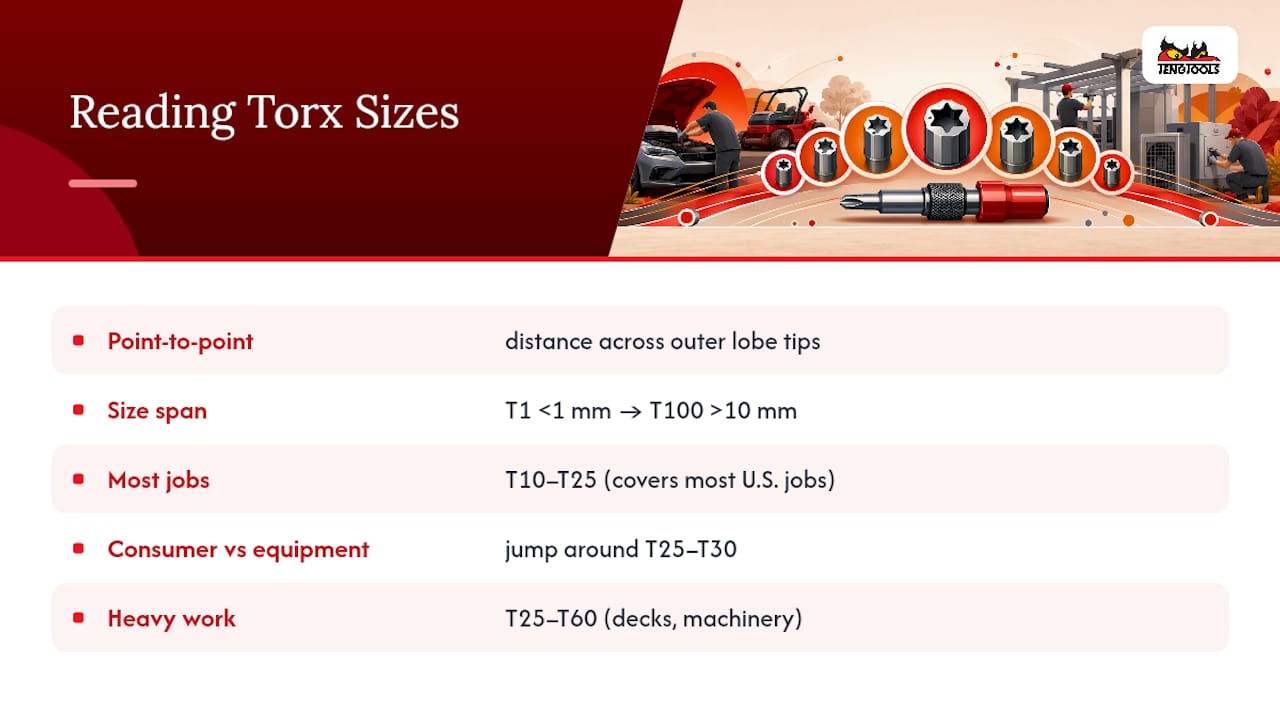
The number after the “T” doesn’t refer to a diameter in millimeters or a bolt thread pitch. It refers to a standardized point-to-point measurement across the six-lobed star pattern, defined under the hexalobular internal designation in ISO 10664. As the T-number climbs, so does the physical size of the recess and the torque the fastener can handle before the head strips.
That’s the whole system in a sentence, but the details matter once you’re standing in front of a parts bin trying to match a screw to a bit. “Point-to-point” measures the distance across the star shape from one outer lobe tip to the opposite one, not the width of the flat sides. A Torx head screwdriver size guide will show you this measurement growing steadily from under 1 millimeter at the T1 end up past 10 millimeters by T100.
Here’s a working reference built from published point-to-point figures for the sizes you’ll actually run into on the job.
The Electronics Hub Torx sizing chart is where most of these figures originate, and it’s worth bookmarking if you regularly cross-reference odd fasteners. Notice the jump between T25 and T30. That gap is roughly where consumer-grade fasteners end and equipment-grade fasteners begin. If you’re pulling apart a laptop, you’re staying under T10. If you’re working on a deck or a piece of heavy machinery, you’re living in the T25 to T60 range.
The Torx Sizes You’ll Actually Use Most
You don’t need all 30-plus sizes in your kit. Real-world work clusters around a handful of them, and knowing which cluster applies to your trade saves you from buying bits you’ll never touch.
- Electronics and small devices (T5–T10): Laptop hinges, phone backs, hard drive enclosures, and most consumer gadgets.
- Automotive interior and trim (T15–T20): Door panels, seat brackets, mirror housings, and dashboard fasteners.
- Automotive structural and engine work (T25–T40): Brake calipers, suspension bolts, engine covers, and alternator mounts.
- Furniture and cabinetry (T15–T25): Flat-pack furniture, cabinet hinges, and drawer slides.
- Decking and exterior construction (T25): Composite and wood decking screws almost universally spec T25 heads because it resists cam-out under repeated impact driving.
- Heavy machinery and industrial equipment (T40–T60): Access panels, guard rails, and structural brackets on commercial gear.
For general DIY and automotive use, T10, T15, T20, and T25 cover the overwhelming majority of jobs, with T25 doing most of the heavy lifting on wood screws and decking. A minimal pocket kit containing common internal Torx sizes like T10, T15, T20, and T25 can cover the majority of household and light automotive tasks. Adding sizes such as T30 and T40 is useful when working on vehicles or larger machinery.
Torx Plus, Security Torx, and External Torx: What Separates Them
Standard Torx isn’t the only game in town, and mixing up the variants is where most buying mistakes happen.
Torx Plus (IP) uses a squarer, more refined lobe geometry introduced in the 1990s to handle higher torque with less cam-out. A standard Torx driver will only fit Torx Plus loosely, and it won’t transmit full torque, which means you risk rounding out an expensive fastener if you grab the wrong bit. Torx Plus shows up mainly in aerospace and high-torque industrial assembly.
Security Torx (sometimes marked with an “S” suffix or “TR” prefix) adds a center pin in the recess specifically to block standard Torx bits from seating at all. You need a matching hole-through bit to drive these, and they’re common on public fixtures, electronics that manufacturers don’t want opened, and tamper-resistant enclosures. A tamper-proof Torx screwdriver size guide will walk you through matching the pin-in bit to the fastener.
External Torx (E-series) flips the geometry inside out. Instead of a female recess in the fastener head, the head itself is star-shaped and a socket fits over it. The E-numbering system runs independently of the T-numbering system.
- An E10 socket does not fit a T10 fastener.
- E-series sockets are common on engine bolts and automotive fasteners where a raised, machined head resists rounding better than an internal recess.
- Technicians working on vehicles often stock both 1/4 inch drive external Torx sockets and standard internal Torx bits specifically to avoid grabbing the wrong tool mid-job.
Pro Tip: Label your E-series sockets differently from your T-series bits the moment you unbox them. A dab of colored paint on the E-socket handles saves you from a five-minute bin search every time you’re under a hood.
Choosing the Right Torx Bit Without Stripping the Head
Getting the size right isn’t guesswork if you follow a fit test every time.
- Try the size you think is correct first, then check the fit before applying any torque.
- Look for rocking. If the bit wiggles side to side in the recess, it’s too small and will slip under load, rounding out the star pattern.
- Confirm full engagement. The correct bit seats flush with no visible gap between the bit shoulder and the fastener head.
- Go up one size if it’s tight or won’t seat. Forcing an oversized bit into a smaller recess cracks plastic housings and chips metal edges.
- Switch to an impact-rated bit for stubborn or corroded fasteners. Standard bits can shear under sudden torque spikes from impact drivers.
A driver with a torque-limiting clutch protects both the fastener and the bit on repetitive jobs like cabinet assembly or panel work, where over-torquing is the more common failure than under-torquing. One of the more overlooked buying mistakes is assuming an E-series number maps to the same T-series number at the parts counter. Worn bits cause the same rounding problem as undersized ones, so retire any bit with visibly rounded lobes rather than forcing it through one more job.
Why Teng Tools Tooling and Storage Help You Get Torx Work Right
Torx work goes faster when every bit has a fixed spot and you’re not digging through a junk drawer mid-job. Some Torx sets are built to ISO and DIN standards, with warranties and shipping options available from warehouses in Texas.
The Get Organized™ storage system snaps each bit into a dedicated foam cutout, so a missing T20 is obvious at a glance instead of a five-minute search.
- Full internal Torx coverage from T10 through T40 in a single case
- Torque-controlled screwdriver options for panels and cabinetry where over-tightening is a real risk
- Click-together trays that keep E-series sockets separate from T-series bits, preventing the mismatch error covered above
- Fast shipping options are available from Texas warehouses to minimize delays when a size is missing.
A Working Mechanic’s Shortcut for Torx Kits
Color-code your most-used bits (T10, T15, T20, T25) with a paint marker on the shank. Grab by color, not by squinting at tiny stamped numbers under a shop light. As a torque shortcut, if a bit rocks even slightly, don’t force it. Size up before you round the head. Security or Torx Plus bits only come out when a fastener actively rejects a standard bit.
— David
Recommended Teng Tools Torx Sets and Where to Buy Them
If you’ve read this far, you already know precision beats guessing when it comes to matching a bit to a fastener. That’s exactly the gap Teng Tools USA’s Torx lineup closes.
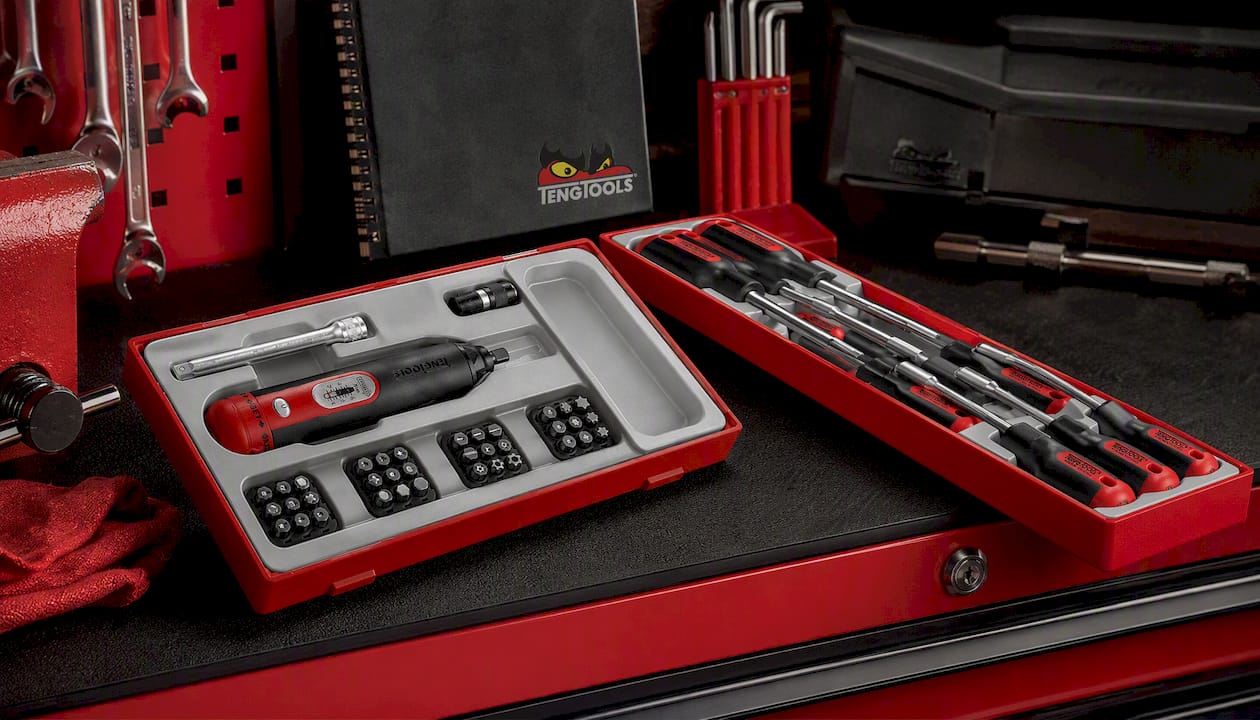
For a complete, torque-controlled setup, the Teng Tools Torque Screwdriver Set TT1 39 Pieces (TTSD39) covers the common internal Torx sizes plus torque control, which matters most on repetitive panel and cabinetry work where over-tightening strips heads. If you want something lighter for a bag or glovebox, the Teng Tools TX Screwdriver set TT1 4 pieces (TT904TXN) sticks to the T10 through T25 range that covers most household and automotive trim work. For larger fasteners that pair with Torx work on machinery and equipment panels, add the Teng Tools Nut Driver Set TTX4 9 Pieces (TTXMDN) to the bench.
Check set size against your typical jobs, confirm impact rating if you’re using a driver, and pick a case with dedicated storage so nothing goes missing. Browse the current Torx lineup on the Teng Tools USA product pages and get the right sizes shipped same-day from Texas.
Sources
- Torx — Wikipedia
- Torx Bit Sizes Chart & Guide — Electronics Hub
- Torx Bit Sizes Guide: T10–T50, Plus & Security Torx | AIMS
FAQ
How do I know what size Torx bit is needed?
Try the closest size bit first and check for rocking in the recess. If it wobbles or won’t seat flush, size up until the bit sits without play and drives cleanly.
What are the most common Torx sizes?
T10, T15, T20, and T25 cover the vast majority of electronics, automotive trim, and furniture jobs, with T25 dominating deck screws and heavy wood fasteners.
Do Torx bits come in SAE and metric?
Torx sizing isn’t split by SAE or metric standards. The T-number itself is the universal measurement, and the same driver series works across different thread systems regardless of whether the fastener is metric or imperial threaded.
Are Torx and star bits the same size?
“Star bit” is just a common nickname for Torx, so a T25 star bit and a T25 Torx bit are identical. The confusion usually comes from Torx Plus or security Torx, which look similar but require a different matching bit.