
For general hand tools, chrome vanadium (Cr‑V) is usually the better call thanks to its hardness and wear resistance. For impact-rated sockets and heavy-impact work, chrome molybdenum (Cr‑Mo) is typically the safer pick. The catch: alloy name only tells part of the story, since heat treatment often decides more than the SAE grade stamped on the tool.
TL;DR:
- Cr‑V tools are best for hand torque applications and precision work due to their higher hardness and wear resistance, but they are unsuitable for impact use.
- Cr‑Mo impact sockets are designed for repeated shock loading, offering better toughness and impact resistance, especially at elevated temperatures.
- Proper heat treatment is crucial; over-hardening Cr‑V reduces toughness, and improper treatment of Cr‑Mo diminishes its impact performance.
- Visual cues like black oxide or phosphate coatings indicate impact-rated tools, while bright chrome suggests hand-tool use only.
- Never assume that a shiny chrome finish means impact safety; always check markings and finish type before using impact tools.
Table of Contents
- Why Tool Steel Selection Matters: Hardness, Toughness, and Heat Treatment
- Chrome Vanadium (Cr‑V): What It Is and When to Pick It
- Chrome Molybdenum (Cr‑Mo): What It Is and When to Pick It
- Cr‑V vs Cr‑Mo: Side‑by‑Side Comparison and Decision Rules
- Impact Tool Safety: Avoid Unsafe Socket‑Tool Pairings
- Other Tool Steels Worth Knowing
- How Teng Tools Applies Alloy Choices Across Its Catalog
- Typical Failure Modes and Lifespan Differences
- A Buyer’s Checklist Worth Actually Using
- Where to Start Shopping Chrome Vanadium and Chrome Moly Tools
- Sources
- FAQ
Why Tool Steel Selection Matters: Hardness, Toughness, and Heat Treatment
Every socket or wrench in your box is a compromise between two properties that fight each other: hardness and toughness. Hardness is a material’s resistance to wear and deformation. Toughness is its ability to absorb a sudden shock without cracking. Push hardness too far and you get a brittle part that snaps under an impact wrench. Favor toughness too much and edges round off fast under a torque wrench.
Ductility and fatigue resistance matter too. A ductile tool bends before it breaks, giving you a warning sign. Fatigue resistance determines how many load cycles a part survives before microscopic cracks turn into a real failure.
Alloying elements shift these tradeoffs:
- Carbon raises hardness but can make steel brittle at high levels.
- Chromium improves hardenability and adds modest corrosion resistance.
- Molybdenum boosts toughness and helps steel hold strength at higher temperatures.
- Vanadium refines grain structure, which sharpens both hardness and wear resistance.
Two sockets stamped with the same alloy can still behave completely differently on the bench. Heat treatment (the quench and temper cycle a manufacturer chooses) determines the final hardness and toughness balance, which is why chromoly parts require careful pre and post weld heating to avoid cracking during fabrication.
Chrome Vanadium (Cr‑V): What It Is and When to Pick It
Chrome vanadium steel blends chromium for hardenability with a small addition of vanadium that acts as a grain refiner. That refined grain structure lets manufacturers push hardness and wear resistance higher without sacrificing as much toughness as plain high-carbon steel would. Vanadium also forms fine carbides that resist abrasion, which is one reason Cr‑V shows up so often in wrench and socket production.
That hardness makes Cr‑V a favorite for parts that need thin walls without losing strength, since tighter tolerances matter more in cramped engine bays than raw shock absorption.
Where Cr‑V shines:
- Combination wrenches and ratcheting wrenches used for hand torque.
- Thin-wall hand sockets that need to fit into tight bolt clusters.
- Precision tools like torque wrenches, where dimensional stability under repeated use counts.
- Screwdrivers and pliers that see twisting force but not hammer blows.
The tradeoff shows up when Cr‑V is over-hardened during manufacturing. Push hardness too far and impact toughness drops, which is exactly why Cr‑V hand tools carry warnings against pneumatic or impact gun use.
Pro Tip: If a socket feels unusually light and has a mirror-bright chrome finish, assume it’s built for hand torque only. Bright plating and thin walls are hallmarks of a Cr‑V hand socket, not an impact-rated one.
Chrome Molybdenum (Cr‑Mo): What It Is and When to Pick It
Chrome molybdenum steel, often called chromoly, swaps vanadium’s grain-refining role for molybdenum’s toughness boost. The 41xx family of SAE grades (4130, 4140, and similar designations) defines most chromoly used in tools and structural applications, and this family is known for a strong strength-to-weight ratio alongside good performance at elevated temperatures.
Molybdenum slows grain growth during heat treatment and helps the steel retain strength even as friction generates heat during repeated impact cycles. That translates directly to better impact resistance, which is why chromoly dominates the impact socket category.
The tradeoff runs the other direction from Cr‑V: chromoly typically trades some outright hardness and wear resistance for toughness. A chromoly socket may show wear on its corners slightly sooner than a Cr‑V equivalent under pure hand-torque use, but it won’t shatter when a 1/2 inch impact gun hammers it at high torque.
Cr‑Mo earns its keep in:
- Impact sockets used with pneumatic or electric impact guns.
- Heavy-duty drive tools like breaker bars and impact extensions.
- Suspension and drivetrain work where seized fasteners demand repeated shock loading.
- Applications with elevated operating temperatures, such as exhaust or turbo fastener removal.
Material data ranges for chromoly show chromium content at moderate levels, enough to aid hardenability but not providing stainless steel levels of corrosion resistance.
Cr‑V vs Cr‑Mo: Side‑by‑Side Comparison and Decision Rules
Here’s how the two alloys stack up across the criteria that actually matter when you’re standing at a parts counter or scrolling a catalog.
| Dimension | Chrome Vanadium (Cr‑V) | Chrome Molybdenum (Cr‑Mo) |
|---|---|---|
| Best for | Hand tools, precision work | Impact tools, heavy-duty drive |
| Typical hardness range | Higher | Moderate |
| Toughness / impact resistance | Lower under repeated shock | Higher |
| Wear / abrasion resistance | Higher | Moderate |
| Typical applications | Wrenches, hand sockets, screwdrivers | Impact sockets, breaker bars, drivetrain work |
| Heat treatment sensitivity | Over-hardening reduces toughness | Improper treatment cuts toughness gains |
A few decision rules simplify the choice:
- Impact gun in regular use? Choose Cr‑Mo impact sockets specifically rated for impact use, not a generic chrome-finished socket.
- Mostly hand-torquing in tight spaces? Cr‑V hand sockets and wrenches usually fit better thanks to thinner walls and higher wear resistance.
- Working at elevated temperatures or on stubborn, corroded fasteners? Lean toward Cr‑Mo, since molybdenum helps retain strength as friction heat builds.
- Uncertain about a part’s rating? Check the finish and markings before trusting the alloy name alone. As Tekton points out, well heat-treated Cr‑V and Cr‑Mo can perform similarly, and poorly treated versions of either can underperform expectations.
Manufacturing quality can override alloy choice entirely. A premium Cr‑V socket from a reputable maker may outlast a cheap, poorly heat-treated Cr‑Mo socket, even in moderate-impact use.
Impact Tool Safety: Avoid Unsafe Socket‑Tool Pairings
Chrome-plated Cr‑V sockets look identical to impact-rated Cr‑Mo sockets at a glance, and that visual overlap causes real injuries. Bright chrome plating combined with thinner walls signals a hand tool. Impact guns generate rotational shock loads that a hand socket’s hardness profile isn’t built to absorb, and the result is a socket that can crack or shatter, sometimes sending fragments flying.
Black oxide or phosphate finishes are the visual cue for impact-rated parts, since that dark, matte coating typically points to a Cr‑Mo impact socket built for shock loading rather than a hand socket in disguise.
Before you chuck a socket onto an impact gun, run this quick check:
- Confirm “impact” markings stamped on the socket wall.
- Look for a black oxide or phosphate finish rather than bright chrome.
- Feel the wall thickness. Impact sockets are noticeably beefier than thin-wall Cr‑V equivalents.
- Inspect regularly for hairline cracks, especially near the drive square.
Pro Tip: Never assume “chrome” in a product name means impact-safe. Chrome plating is largely cosmetic and tied to corrosion resistance, not toughness, so read the finish and markings, not the name.
Other Tool Steels Worth Knowing
Cr‑V and Cr‑Mo cover most sockets and wrenches, but a few specialized steels handle jobs neither alloy suits well.
- S2 tool steel shows up in screwdriver bits and impact driver bits, where shock resistance at a small cross-section matters more than wear resistance.
- Hardened tool steels built specifically for punches and chisels need extreme surface hardness at the striking face paired with enough shank toughness to survive hammer blows.
- Plain carbon or forged steel still works fine for low-stress applications like basic pry bars, where alloy sophistication adds cost without adding benefit.
When a task involves striking, repeated shock at a small tip, or extreme wear at one localized point, a purpose-built tool steel usually outperforms either general-purpose Cr‑V or Cr‑Mo.
How Teng Tools Applies Alloy Choices Across Its Catalog
Teng Tools designs its hand tools and impact tools in Sweden to meet ISO and DIN standards, backing its tools with a lifetime warranty and offering shipping from a warehouse in Texas. Those standards matter here because ISO and DIN specifications set consistent expectations for hardness, dimensional accuracy, and material performance across an entire product line, not just a single batch.
Within the catalog, the alloy logic tracks the same pattern covered above:
- Thin-wall hand sockets and many wrenches lean on Cr‑V for hardness and wear resistance in everyday torque work.
- Impact sockets and heavy-duty drive tools lean on Cr‑Mo, finished and heat-treated for repeated shock loading.
- Striking tools like punches and chisels fall outside both categories, built instead from hardened tool steel suited to hammer impact.
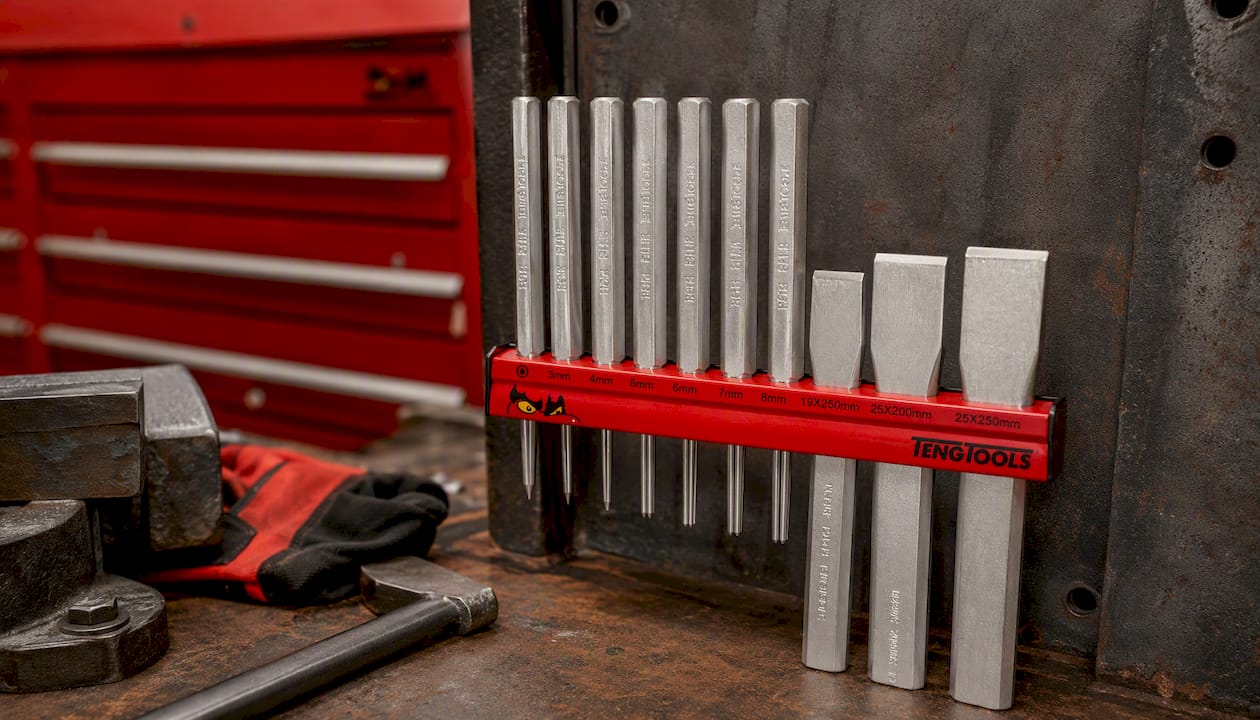
That last category shows up in sets like the Teng Tools Punch & Chisel Set Wall Rack 10 Pieces, which pairs striking-grade steel with a wall rack so the whole set stays organized instead of scattered across a drawer.
Typical Failure Modes and Lifespan Differences
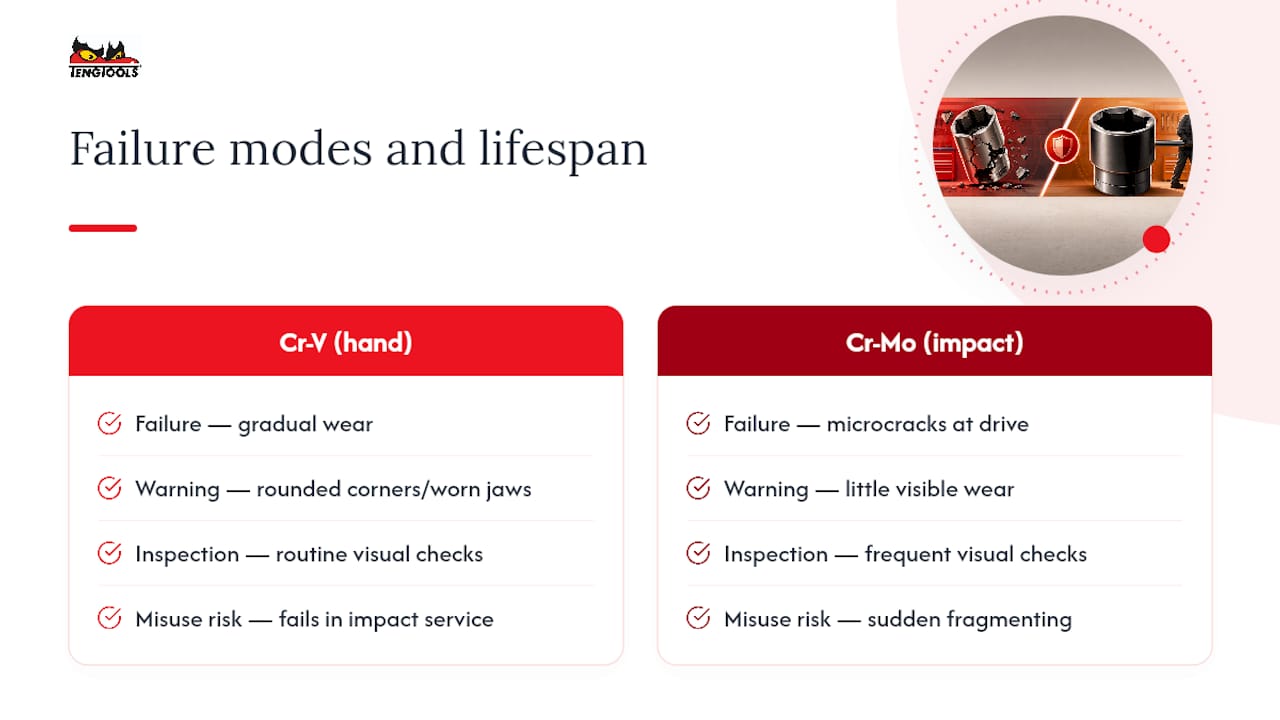
Cr‑V hand tools that fail usually show wear first: rounded socket corners, worn wrench jaws, or a screwdriver tip that no longer bites cleanly. That gradual wear pattern gives you a visible warning long before outright failure, and a well-treated Cr‑V tool used within its intended hand-torque range can last for years without cracking.
Cr‑Mo impact sockets fail differently when pushed past their limits. Instead of gradual wear, overloaded or fatigued Cr‑Mo parts tend to develop microcracks near the drive square that spread under repeated shock until the part splits. That’s a more sudden failure mode, which is exactly why regular visual inspection matters more for impact sockets than for hand tools.
The alloy that gets misused the most is Cr‑V pressed into impact service. A thin-wall Cr‑V socket forced onto a high-torque impact gun doesn’t wear down first. It cracks and can send fragments outward at speed, which is the core safety argument for keeping the two categories separate rather than treating “chrome” tools as interchangeable.
Lifespan also depends heavily on maintenance. Neither alloy holds up well to prolonged moisture exposure, since chromium content in these steels sits well below stainless steel levels, leaving both vulnerable to surface corrosion if stored wet. Wiping tools dry and applying light oil before long-term storage extends service life regardless of which alloy you’re using.
A Buyer’s Checklist Worth Actually Using
The biggest mistake I see buyers make is trusting a shiny chrome finish as proof of quality, then ignoring the markings that actually tell you what a part is rated for. Three checks fix that: identify the task first, confirm the impact-rated marking and finish match that task, and buy from suppliers who publish their standards rather than guessing from a photo.
— David
Where to Start Shopping Chrome Vanadium and Chrome Moly Tools
Once you know which alloy fits your work, the shopping decision gets simple. Teng Tools USA organizes its catalog around exactly this split, so you’re never guessing whether a socket belongs on a ratchet or an impact gun.
If most of your work is hand-torquing bolts in engine bays or tight equipment panels, browse Teng Tools’ Cr‑V hex bit sockets built for precision fit and long-term wear resistance. If your bench runs impact guns daily, the 1/4 inch drive impact sockets and 3/8 inch drive impact sockets are built and finished for that shock loading, not just labeled for it.
For striking work like driving out pins, bushings, or seized hardware, the Teng Tools Punch & Chisel Set Wall Rack 10 Pieces gives you a full set of hardened punches and chisels with a wall rack that keeps every piece visible and accounted for. Teng Tools offers a lifetime warranty and ships tools from a warehouse in Texas, so picking the right alloy today doesn’t turn into a repeat purchase next year.
Sources
- Chrome-molybdenum steel — Wikipedia
- Overview of materials for Chrome-moly Steel - MatWeb
- Engineerskill
FAQ
Is Chrome Moly Stronger Than Chrome Vanadium?
Neither alloy is universally stronger. Cr‑V typically has an edge in hardness and wear resistance, while Cr‑Mo typically has an edge in toughness and impact resistance, and proper heat treatment often matters more than the alloy choice itself.
What’s Better, Cr‑V or Cr‑Mo?
It depends on the tool’s job: Cr‑V generally suits hand tools like wrenches and hand sockets, while Cr‑Mo generally suits impact sockets and heavy-duty drive tools that face repeated shock loading.
Is Chrome Vanadium Good Quality?
Yes, when properly heat-treated. Cr‑V’s vanadium content refines grain structure and boosts hardness and wear resistance, making it a solid, widely used choice for hand tools, though it isn’t intended for impact gun use.
What Grade Is Chrome Moly?
Most chromoly tools and components fall under the SAE 41xx grade family, with 4130 and 4140 among the most common designations used across tools, tubing, and structural parts.