
Hose clamp pliers split into two functional families: cable-operated pliers that reach deep into cramped engine bays, and non-cable rigid or swivel-tip pliers that give you more leverage where your hand can actually reach the clamp. For most shop work, a swivel-tip locking plier handles the majority of jobs, while a long-reach cable plier earns its place for buried heater core and firewall clamps. The right pick always comes down to the clamp itself: spring, worm gear, or ear clamp.
TL;DR:
- Long-reach cable pliers excel at accessing clamps behind engine components, extending up to 24 inches for deep-reach jobs.
- Swivel-tip rigid pliers provide higher leverage and are preferred for radiator, fuel line, and general hose work due to their solid connection.
- Locking pliers help reduce hand fatigue during multi-clamp jobs by maintaining pressure without continuous grip.
- Specific clamp types require matching tools: spring clamps with compression pliers, worm-gear with flat-jaw pliers, and ear clamps with crimping tools.
- A versatile plier kit is more practical for occasional users, while shops handling various clamps daily should invest in specialized or multiple tools.
Table of Contents
- Hose Clamp Pliers Types Every Mechanic Should Know
- Matching Clamp Types to the Right Plier Design
- How to Use Hose Clamp Pliers Without Wrecking a Hose
- What to Look for When Buying Hose Clamp Pliers
- Workshop-Grade Pliers Built for Real Clamp Work
- Specialty Tools or an All-in-One Kit?
- Get Your Next Clamp Job Done Right
- Sources
- FAQ
Hose Clamp Pliers Types Every Mechanic Should Know
Every hose clamp plier on the market falls into a handful of working categories, and knowing which one you’re holding changes how fast a job goes. Here’s what actually separates them on the bench and under the hood.
Long-reach cable pliers run a flexible steel cable from the handle to a small capture jaw at the tip, letting you compress a spring clamp that’s buried behind an alternator, tucked under an intake manifold, or hiding at the back of a heater core connection. You squeeze the handle, the cable pulls the jaw closed, and you can work the clamp loose without ever getting your knuckles into the gap. McMaster-Carr catalogs cable variants with lengths up to 24 inches, specifically for this kind of blind reach.
Swivel-tip rigid pliers trade reach for muscle. The jaws sit directly on solid handles, and a rotating capture insert at the tip lets you align the jaw to the clamp’s ear angle instead of fighting an awkward wrist position. Mechanics favor these for everyday radiator and fuel line work because the direct linkage gives more closing force than a cable ever will, and Rick’s Free Auto Repair Advice points to rotatable inserts as the single biggest reason pros reach for this style first.
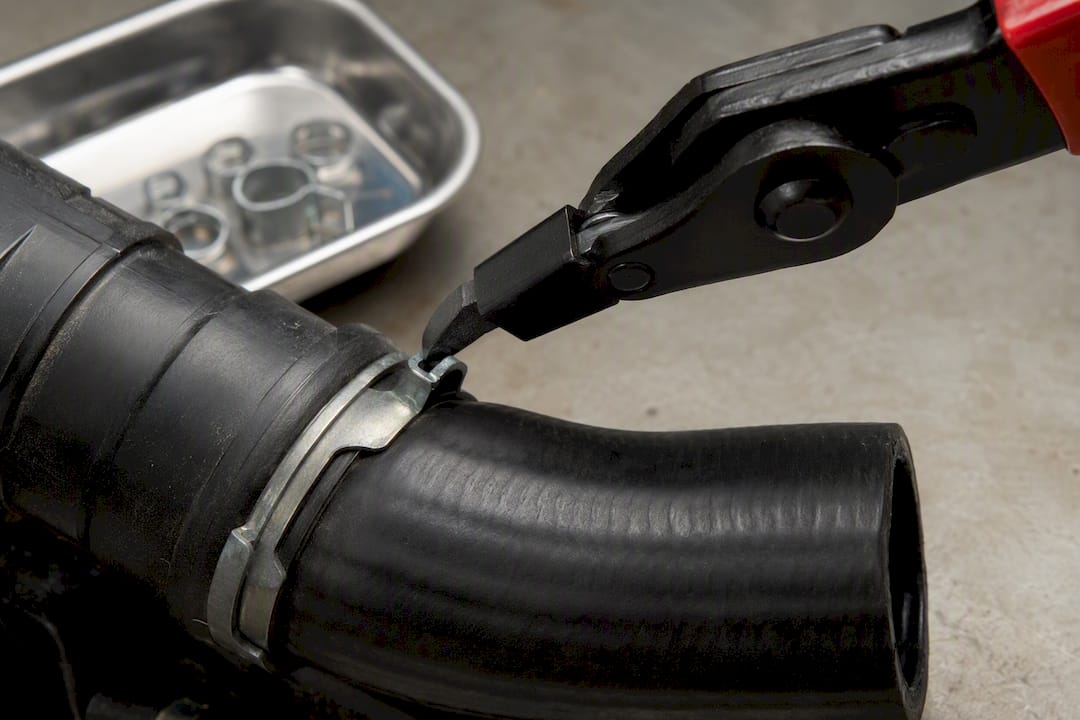
Locking or ratcheting pliers clamp down and stay closed without you maintaining hand pressure, which matters more than it sounds on a job where you need one hand free to slide a hose or reposition a clamp. That hands-free hold cuts fatigue on multi-clamp jobs like a full coolant system flush.
Angled-head and offset pliers bend the jaw geometry so the handles clear obstructions while the tip still lines up square on the clamp, a common fix for low-clearance transverse engine bays where a straight-jaw plier simply won’t fit.
Pinch and crimp pliers, including dedicated ear crimpers, serve a narrower purpose: closing or reopening single-use ear clamps common on fuel lines and OEM factory hose connections. These aren’t reusable in the same way, and using the wrong tool here usually damages the clamp beyond reuse.
Multi-piece plier kits matter for anyone who touches more than one clamp family in a week. A tech doing spring clamps on one car and worm-gear band clamps on the next needs different jaw geometry for each, and a kit means you’re not stopping mid-job to hunt for the right tool.
- Long-reach cable pliers: recessed spring clamps, heater core lines
- Swivel-tip rigid pliers: general radiator, fuel, and vacuum hose work
- Locking/ratcheting pliers: multi-step installs, hands-free holds
- Angled-head pliers: low-clearance engine bays
- Ear crimpers: single-use ear clamp install and removal
- Multi-piece kits: shops handling varied clamp types daily
Matching Clamp Types to the Right Plier Design
Grabbing the wrong plier for a clamp is how hoses get nicked and clamps get mangled. SAE J1508 catalogs the major U.S. clamp designs, and each one pairs with a specific tool logic.
- Spring clamps respond best to spring-band pliers or long-reach cable pliers, both built to compress the coiled band evenly without deforming it.
- Worm-gear (band) clamps work with flat-jaw or adjustable-tip pliers that grip the screw head squarely; a standard screwdriver is fine when access is open, but pliers win once the screw head is corroded or angled awkwardly.
- Ear clamps need dedicated ear crimping pliers or specialist ear tools, since these are largely one-time-install fasteners and standard pliers tend to crush rather than crimp cleanly.
- T-bolt and high-pressure clamps call for heavy-duty pliers or a torque tool matched to the manufacturer’s spec, because these clamps hold pressure that a light-duty tool can’t safely manage.
- Wire clamps and specialty clamps usually need dedicated pliers or a securing technique specific to that hardware, since generic jaws often slip off the thin wire profile.
Guides like Advance Components’ clamp plier breakdown make the same point: mismatching plier to clamp family is the fastest way to damage either the hose or the clamp itself.
How to Use Hose Clamp Pliers Without Wrecking a Hose
Removing and reinstalling clamps follows a different rhythm depending on the clamp family, but the core sequence stays consistent across most automotive jobs.
- Spring clamps: compress the ears with your pliers, lock the jaw if your tool allows it, then slide the clamp back along the hose before pulling it free.
- Worm-gear clamps: back the screw off fully with pliers or a driver, then rotate the band to reposition it rather than forcing the hose off with the clamp still tight.
- Ear clamps: cut or unbend the ear with side cutters for removal, or use a proper ear crimper for a fresh install.
- Tight spaces: switch to cable pliers or an angled-head tool, and slide a rag or small pry bar between the hose and metal to protect the hose surface.
- Before you start: relieve system pressure, let the engine cool, wear eye protection, and keep spark sources clear of any fuel line work.
Pro Tip: Wipe down and lightly oil the cable and pivot points on your pliers after every job involving coolant. Dried coolant residue stiffens cable action fast, and a sticky cable is the number one reason long-reach pliers get retired early.
What to Look for When Buying Hose Clamp Pliers
The feature list that actually matters depends on how often you’re in the engine bay and what kind of clamps you’re fighting most.
- Swivel or rotating tips let the jaw self-align to the clamp angle instead of forcing your wrist into an awkward position.
- A locking mechanism holds the clamp compressed without continuous hand pressure, which Family Handyman’s testing flags as one of the top differentiators between casual and pro-grade pliers.
- Tip hardness determines how many cycles the jaw survives before it rounds off and starts slipping on the clamp ear.
- Cable length and adjustability matter most if you regularly work recessed clamps behind manifolds or firewalls.
- Angled heads solve clearance problems that straight jaws can’t.
- Handle ergonomics, meaning grip diameter and TPR coating, cut fatigue on jobs running more than a few clamps.
A full plier kit earns its cost if you’re touching spring, worm, and ear clamps in the same week. Occasional DIYers usually get more value from one well-built swivel-tip plier than a full set they’ll rarely open past two of the pieces. Heavy shop users should weight their budget toward locking mechanisms and tip hardness; weekend mechanics get more mileage prioritizing reach and jaw shape for the specific clamps on their own vehicle.
Workshop-Grade Pliers Built for Real Clamp Work
Workshop-grade pliers often meet ISO and DIN standards, come with lifetime warranties, and ship promptly from local warehouses, providing the reliability needed when a clamp job can’t wait for a tool that fails mid-task. The Get Organized™ tray system also means your clamp tools have a fixed spot instead of drifting to the bottom of a drawer.
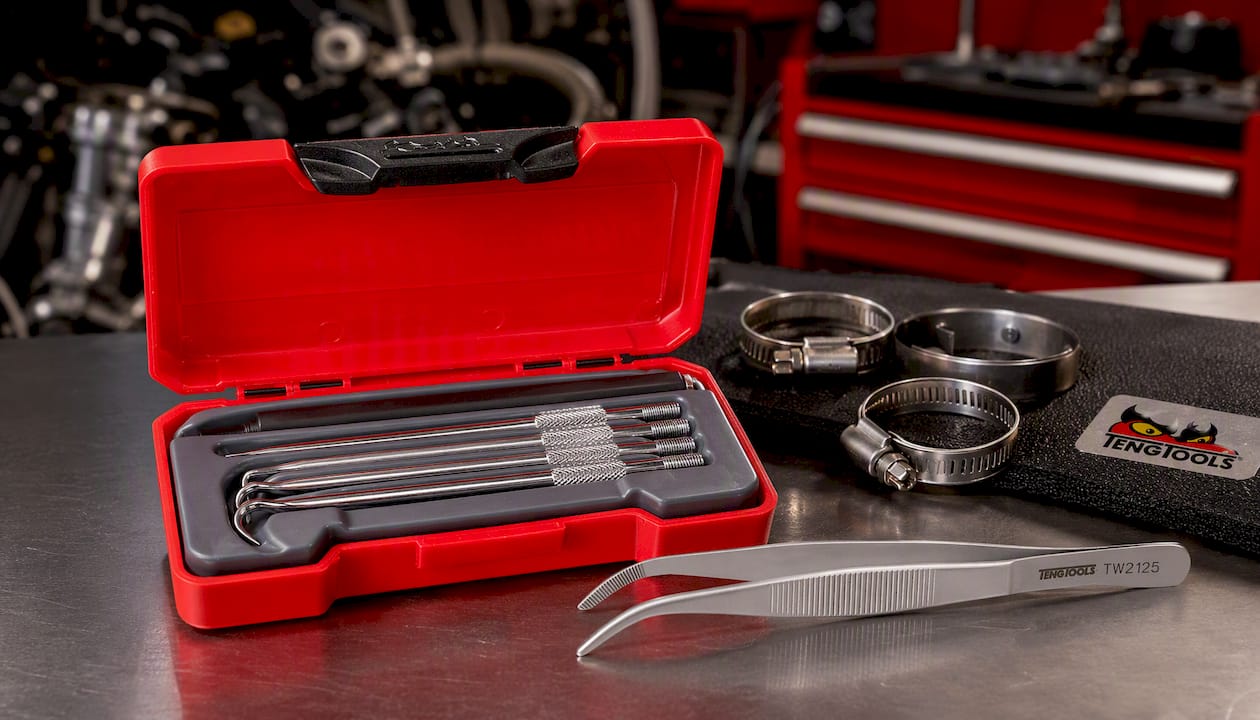
- The Teng Tools Tweezer 125mm Bent/Serrated (TW2125) handles small fittings and delicate hose adjustments where standard pliers are too blunt.
- The Teng Tools Hook & Pick Set (TM149) helps pry seals, route hose lines, and reposition clamps in cramped spaces.
- The Teng Tools Plier Set TPR Grip TT2 Q, 8 Pieces (TTD441-TQ) covers the bulk of everyday clamp removal and installation work in one case.
Specialty Tools or an All-in-One Kit?
Buying a dedicated long-reach or locking plier only pays off when frequency and access difficulty both stack up: a shop pulling heater core clamps weekly justifies the specialty tool, while an occasional DIYer is better served by a versatile plier set that handles most clamps without crowding a toolbox with single-purpose gear.
— David
Get Your Next Clamp Job Done Right
A worn-out plier or the wrong jaw shape turns a five-minute clamp swap into a fight with a rounded-off screw head or a slipped tip. Teng Tools USA stocks the pliers that solve that problem directly, from precision tweezers for delicate fittings to a full plier set built for daily clamp work.
The Teng Tools Plier Set TPR Grip TT2 Q, 8 Pieces (TTD441-TQ) covers spring, worm, and general clamp work in one case, backed by a lifetime warranty and shipped same-day from the Fort Worth warehouse. If your bench also needs finer control, add the Hook & Pick Set (TM149) for prying and routing work the pliers can’t reach. Check the product pages now and get the right tool on its way before your next clamp job stalls out.
Sources
- 8 Best Hose Clamp Pliers | Family Handyman
- Hose Clamp Pliers: A Must-Have Tool for Spring Band Clamps — Ricks Free Auto Repair Advice
- Hose Clamp Pliers: The Complete Guide – Advance Components
FAQ
What are the best pliers to remove hose clamps?
For most automotive spring clamps, a swivel-tip locking plier gives the best combination of grip and leverage; for clamps buried deep in the engine bay, a long-reach cable plier is the better fit.
What is the best hose clamp pliers set?
A multi-piece set like the Teng Tools Plier Set TPR Grip TT2 Q, 8 Pieces (TTD441-TQ) covers spring, worm, and general clamp jobs without forcing you to buy single-purpose tools for each clamp family.
What are the three main types of hose clamps?
Screw or worm-gear (band) clamps, spring clamps, and ear clamps are the three most common types on U.S. vehicles, alongside less common wire and t-bolt designs cataloged under SAE J1508.
How do I use hose clamp pliers on a spring clamp?
Compress the clamp’s ears with the plier jaws, lock the tool if it has that feature, then slide the clamp back along the hose before pulling the hose free.
Are cable-operated pliers better than rigid pliers?
Neither style is universally better. Cable pliers win on reach into recessed spots like heater cores, while rigid swivel-tip pliers give more closing force for everyday clamps you can reach directly.