
Use impact sockets with impact wrenches and impact drivers; use chrome sockets with hand ratchets and breaker bars. Impact sockets are forged from chrome-molybdenum steel and heat-treated to flex under shock, while chrome sockets use harder, more brittle chrome-vanadium steel that resists wear but can crack apart under sudden torque. The one exception worth remembering: impact sockets work fine on hand tools too, so when in doubt, grab the impact-rated one.
TL;DR:
- Impact sockets are made from chrome-molybdenum steel, which is designed for toughness and can deform safely under extreme impact, unlike chrome-vanadium sockets that crack or shatter without warning.
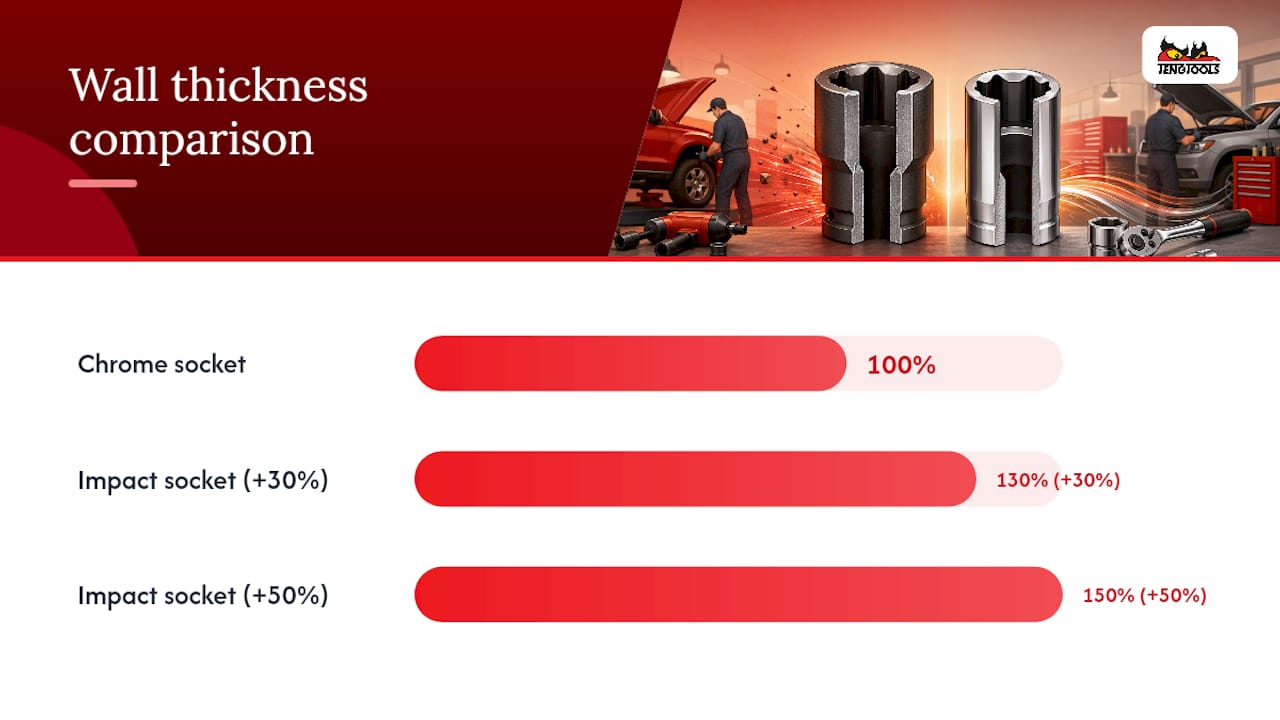
- Impact sockets are approximately 30 to 50% thicker in walls and heavier than chrome sockets, which helps distribute shock loads and prevents cracking during repeated impacts.
- Using chrome sockets on impact wrenches risks catastrophic failure and flying shrapnel because the brittle alloy cannot handle sudden torque spikes, but impact sockets are safe on hand tools.
- When choosing impact sockets, look for a black oxide or phosphate finish, stamped “IMPACT,” thicker walls, and a retention groove; size coverage depends on your specific tool and fastener needs.
- For most workshop scenarios, impact sockets are essential on power tools like impact wrenches, whereas chrome sockets are suitable for precise, low-impact work in tight spaces or with torque wrenches.
Table of Contents
- Cr-Mo vs Cr-V: The Metallurgy Behind Impact Sockets vs Chrome
- Wall Thickness, Mass, and Finish: Why Impact Sockets Feel Bulkier
- Why Chrome Sockets Are Dangerous on Impact Tools
- When to Reach for Impact vs Chrome: Real Workshop Scenarios
- Buying and Maintaining Impact Sockets: What Actually Matters
- What Teng Tools Product Pages Show About Build Quality
- Why This Rule Rarely Gets Broken Twice
- Get the Right Impact Sockets Without Guessing on Specs
- Sources
- FAQ
Cr-Mo vs Cr-V: The Metallurgy Behind Impact Sockets vs Chrome
The difference between impact sockets vs chrome comes down to two alloys that behave nothing alike once torque spikes hit them. Impact sockets are made from chrome-molybdenum (Cr-Mo) steel, then heat-treated specifically for toughness rather than raw hardness. That toughness means the metal absorbs a shock by flexing microscopically instead of holding rigid until it snaps. Chrome sockets, by contrast, are typically chrome-vanadium (Cr-V) steel, a harder alloy that resists scratching and wear beautifully under the slow, steady torque of a hand ratchet.
Hardness and toughness pull in opposite directions during heat treatment. Push an alloy toward maximum hardness and you get a socket that shrugs off scoring and holds a crisp edge for years of manual use. Push it toward toughness instead, and you get a socket that can absorb the hammering blows of an impact wrench without splitting.
That tradeoff explains the two failure modes you see in real shops:
- Cr-Mo impact sockets deform before they fail. A socket under extreme, sustained abuse might eventually crack, but it typically shows visible wear or slight distortion first.
- Cr-V chrome sockets shatter without warning. Chrome sockets are harder but can crack or shatter under impact loading, often with no visible warning sign beforehand.
Pro Tip: If a socket ever looks slightly “sprung” or oval instead of round, retire it. That’s Cr-Mo doing exactly what it’s designed to do: fail safely by deforming instead of exploding.
The takeaway for anyone comparing chrome sockets pros and cons against impact-rated ones isn’t that one alloy is “better” in some universal sense. It’s that each one is engineered for a completely different kind of stress.
Wall Thickness, Mass, and Finish: Why Impact Sockets Feel Bulkier
Pick up an impact socket next to a chrome socket of the same size and the weight difference is obvious immediately. Impact sockets often run 30 to 50% thicker in the wall than their chrome counterparts, and that extra steel isn’t wasted bulk. It spreads the shock load from each hammer strike across more material, which is exactly what keeps the socket from cracking under repeated impacts.
That added mass does double duty. It’s not just armor against the blow, it’s part of the energy transfer itself, since a heavier socket carries more of the impact wrench’s hammering force into the fastener rather than losing it to vibration and flex.
A few other design differences separate the two socket types:
- Retention grooves. Impact sockets usually include a groove or detent near the drive end that locks onto a friction ring or pin, keeping the socket seated at high RPM instead of flying off the anvil.
- Finish. Impact sockets wear a black oxide or phosphate coating rather than plating. That finish holds up under vibration, while chrome plating can chip and flake under repeated impact strikes, sending small metal fragments outward.
- Access. All that extra wall thickness comes at a cost in tight spaces. A chrome socket’s thinner profile can slip into a cramped bolt pocket where an impact socket simply won’t fit.
That last point matters more than most buying guides admit. Engine bays with tight header bolts or manifold studs sometimes force a choice between the “correct” impact socket and the one that physically reaches the fastener at all.
Why Chrome Sockets Are Dangerous on Impact Tools
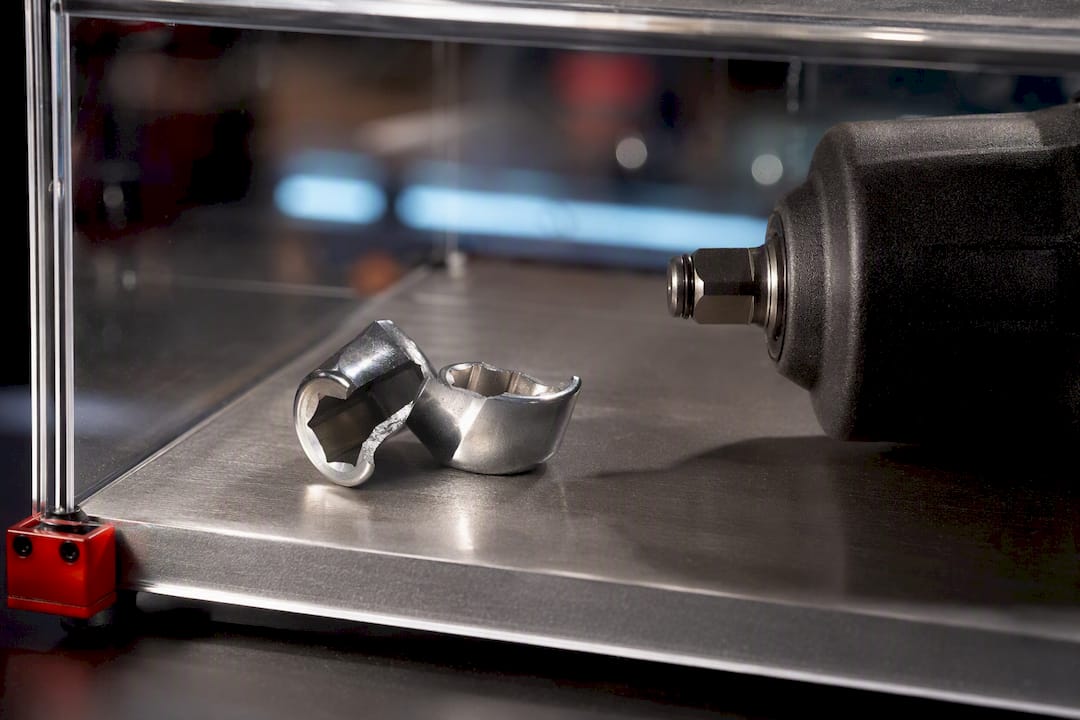
The real risk with impact sockets vs chrome isn’t cosmetic wear, it’s flying metal. When a brittle chrome socket meets the sudden torque spikes of an impact wrench, it can crack or shatter, and that failure can send shrapnel outward at speed while also damaging the wrench’s anvil. That’s not a rare fluke. It’s the predictable result of putting a hardened, low-flex alloy under a load it was never heat-treated to handle.
The good news runs the other direction: impact sockets are safe to use on hand tools. Cr-Mo steel doesn’t care whether the torque comes from a ratchet or a wrench, it just handles both. The only downside is convenience. Impact sockets are heavier and bulkier, so a full set can feel like overkill for light hand work, and the thicker walls sometimes won’t clear a tight recess the way a slimmer chrome socket will.
Here’s a quick way to tell them apart before you ever chuck one onto a wrench:
- Check the finish. Dull black oxide or phosphate coating signals impact-rated; shiny, mirror-like plating signals chrome.
- Look for the stamp. Reputable manufacturers mark impact sockets with “IMPACT” stamped directly on the socket body.
- Feel the wall thickness. Impact sockets are noticeably heavier and thicker walled than a chrome socket of the same size.
- Look for a retention groove. A visible groove or detent pin near the square drive almost always means impact-rated.
Pro Tip: Keep a pair of safety glasses within arm’s reach of every impact wrench in the shop, even for “quick” jobs. A cracked chrome socket doesn’t give a warning shot, it just goes.
Beyond eye protection, treat any socket you can’t positively identify as chrome until proven otherwise, and keep a physical separation between your impact and chrome socket trays so a rushed grab doesn’t put the wrong one on the gun.
When to Reach for Impact vs Chrome: Real Workshop Scenarios
The decision tree here is short: figure out which tool is driving the socket first, then worry about access and precision second. Power tool means impact socket, full stop. Hand tool opens up both options, and that’s where access and feel start to matter.
A few scenarios come up constantly in real bays:
- Lug nuts with an impact wrench. Impact socket, no exceptions. This is the single most common place chrome sockets fail catastrophically under repeated impact loading, because lug nuts see the highest torque spikes of any routine job.
- Seized or rusted bolts. Impact socket, even if you’re breaking it loose with a breaker bar rather than a power tool. The unpredictable load spikes on a stuck fastener behave more like impact stress than steady hand torque.
- Engine bay work in tight quarters. Chrome socket, when access is the bottleneck and you’re using a hand ratchet anyway. The thinner wall can be the difference between reaching a bolt and not.
- Precision assembly, like torquing head bolts to spec. Chrome socket with a torque wrench. You want a snug, predictable fit and minimal added mass between the wrench and the fastener.
- Low-clearance fasteners on hand tools. Chrome, provided you’re not swapping to a power tool later in the same job.
One nuance that trips up a lot of DIYers: cordless impact drivers, the compact ones used mostly for driving screws and light fasteners, still generate rotational hammering even at lower torque than a full-size impact wrench. Treat them like any other impact tool and stick with impact-rated sockets and bits, not chrome.
Point count matters too, separate from the material question entirely. Six-point sockets grip a fastener’s flats more fully and resist rounding worn bolt heads, which makes them the safer default for stubborn or corroded hardware. Twelve-point sockets seat faster on clean fasteners in open access, which is why you’ll see them more often in general assembly work than in rusted undercarriage jobs. Either point count comes in both impact and chrome versions, so that choice runs independently of the Cr-Mo vs Cr-V decision.
Practical guidance on matching tool type to socket type consistently lands on the same rule: when access allows either socket to physically fit, let the tool decide, not personal preference.
Buying and Maintaining Impact Sockets: What Actually Matters
Shopping for impact sockets, best impact sockets or otherwise, comes down to five checkpoints: alloy marking, an “IMPACT” stamp, a visible retention groove, wall thickness you can feel by hand, and a finish that’s clearly black oxide or phosphate rather than polished chrome. Drive size coverage matters too. A set that only covers 3/8 inch drive isn’t much use if your impact wrench takes 1/2 inch.
Whether a full impact set makes sense versus buying a handful of key sizes depends on how often you’re reaching for the impact wrench. For most home users with a single impact driver or wrench, a compact impact socket set covering common lug and bolt sizes delivers better long-term value than assembling a full chrome set piece by piece. Working mechanics who see a wider range of fastener sizes daily are better served by a complete set from the start.
Inspection should be a habit, not an afterthought:
- Visible cracks or chips. Retire the socket immediately, no exceptions.
- Rounded or ovaled openings. A socket that no longer grips a fastener’s flats cleanly is rounding out and losing its bite.
- Worn drive squares. If a socket wobbles noticeably on the wrench’s anvil, the drive end has worn past safe tolerance.
Pro Tip: Rotate through your impact sockets rather than always reaching for the same size first. Even distribution of wear across a set beats concentrated fatigue on your two or three most-used sizes.
Budget guidance is straightforward. DIYers doing occasional lug nut and suspension work can get by with a handful of common 1/2 inch drive sizes in impact-rated steel. Pros running an impact wrench daily are better off treating a full impact socket set as a baseline tool rather than an occasional purchase, since impact sockets work on both power and hand tools while chrome sockets stay restricted to hand use only.
What Teng Tools Product Pages Show About Build Quality
Teng Tools USA publishes material and construction specs directly on its impact socket product pages, including wall thickness, drive fit, and ANSI/metric compliance rather than leaving buyers to guess at alloy quality from a photo. That level of documentation matters because chrome vs impact sockets confusion usually stems from vague listings that never mention heat treatment or alloy grade at all.
Three specific sets illustrate different workshop needs. The Teng Tools 1/2" Impact Socket Set FOAM6X6 50 Pieces (TELISK50) covers a full range of common sizes in a click-together foam tray, making it a practical baseline for shops running impact wrenches across varied job sizes. The Teng Tools Hook On Impact Bit Set Mixed 22 Pieces (THBSI22) rounds out driver-end coverage for impact drivers handling mixed fastener types. The Teng Tools Impact Bit Set Mixed 10 Pieces (TM010) fits a smaller kit or a mobile bag where a compact bit selection covers the fasteners seen most often.
Why This Rule Rarely Gets Broken Twice
The impact sockets vs chrome question isn’t really a debate once you’ve seen a chrome socket fail on a wrench. The metallurgy backs up the simple rule every time: match the socket’s toughness to the tool’s actual load. Buy a few impact sockets before you need them. They’ll outlast the moment you almost reached for the wrong one.
— David
Get the Right Impact Sockets Without Guessing on Specs
You now know exactly what separates a socket built for hammering from one built for hand torque, and choosing the right set comes down to matching that checklist to what’s actually in the box. Teng Tools USA lists alloy, wall thickness, and drive specs directly on every product page, so you’re buying against real numbers instead of a stock photo and a size chart.
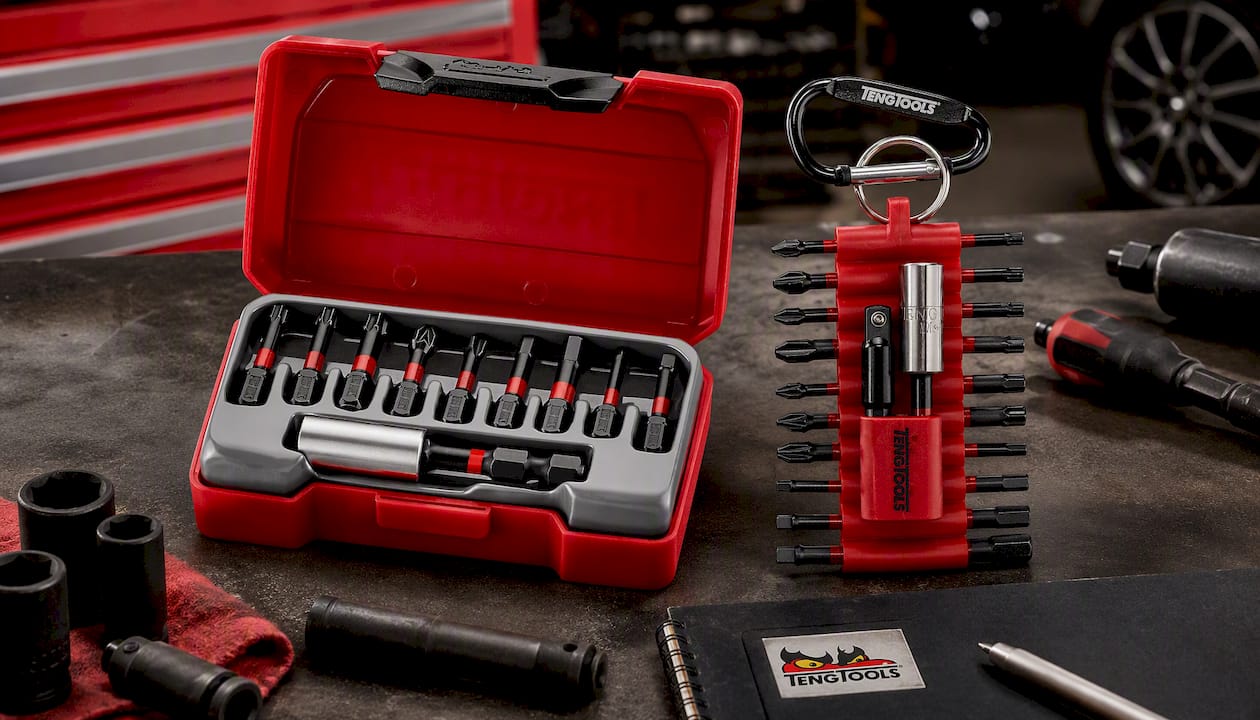
The Teng Tools 1/2" Impact Socket Set FOAM6X6 50 Pieces covers the bulk of common lug and bolt sizes in a click-together foam tray built around the Get Organized™ system, so nothing goes missing between jobs. Pair it with the Teng Tools Hook On Impact Bit Set Mixed 22 Pieces for driver-end coverage, or grab the compact Teng Tools Impact Bit Set Mixed 10 Pieces if you just need the common sizes in a smaller kit. All three ship rapidly from a U.S.-based warehouse and carry a lifetime warranty, so replacing a worn socket down the line never means starting over. Check sizes and place your order directly on each product page.
Sources
- Impact vs Chrome Sockets: Why Using the Wrong One is Dangerous - Auto Median
- Impact vs regular ratchet/breaker bar sockets? - Mechanics Stack Exchange
- Difference Between Regular Sockets And Impact Sockets - schmidt tools
FAQ
Why don’t you use chrome sockets on an impact wrench?
Chrome sockets are made from harder, more brittle Cr-V steel that can crack or shatter under the sudden torque spikes an impact wrench produces, sending metal fragments outward.
Can I use impact sockets for everything?
Yes. Impact sockets work safely on both impact tools and hand ratchets, though their extra wall thickness and weight can make them bulkier than needed for light, tight-access hand work.
Can I use a chrome socket on an impact wrench?
No. Doing so risks the socket cracking or shattering under load, which can throw shrapnel and damage the wrench’s anvil.
What is the best material for sockets?
Chrome-molybdenum (Cr-Mo) is the standard for impact-rated sockets because it flexes under shock instead of cracking, while chrome-vanadium (Cr-V) suits hand tools where hardness and wear resistance matter more than shock absorption.