
Grab a 5/8" (16mm) socket first. That covers the majority of modern vehicles on the road. If it doesn’t seat snug on the hex, try 13/16", the other workhorse size. Still no luck? Check your owner’s manual, look up the plug’s part number, or measure the hex flat to flat before you force anything.
TL;DR:
- Most modern vehicles require a 5/8" or 16mm spark plug socket, but always confirm with the owner’s manual or measure the plug directly.
- Deep-well or thin-wall sockets are essential for reaching recessed plugs, while magnetic or rubber-insert retention improves removal without damage.
- Use a 3/8" drive for torque control, and choose the appropriate socket style based on the plug’s recess and surrounding components.
- Avoid forcing mismatched socket sizes, especially between imperial and metric measurements, to prevent damaging the plug or head threads.
- Pros prefer dedicated socket sets built to exact standards, with retention features and full organization, for reliability and efficiency during repairs.
Table of Contents
- What Are the Common Spark Plug Socket Sizes?
- Socket Types, Drives, and Retention: What Actually Fits Your Engine
- How to Choose the Right Spark Plug Socket
- What Pros Reach for When the Size Chart Isn’t Enough
- Removing and Installing Spark Plugs Without Damage
- Why the Right Socket Kit Changes Your Workflow
- Get the Right Sockets Without the Guesswork
- Sources
- FAQ
What Are the Common Spark Plug Socket Sizes?
Spark plug sockets come in a narrower range than you’d think, but the variations matter enough to strip a hex if you guess wrong. The most common spark plug socket sizes are 5/8" (about 16mm) and 13/16", with a handful of other sizes showing up depending on the engine and era.
Here’s a quick spark plug socket size chart covering what you’ll actually run into:
A few patterns hold up across most driveways and garages:
- Modern passenger cars built after 2000 usually take a 5/8" or 16mm socket, since manufacturers standardized around this hex for smaller, tighter combustion chambers.
- Older V8s and larger domestic engines lean toward 13/16", a holdover from bigger plug bodies designed for higher cylinder volumes.
- Motorcycles and small engines, including lawn equipment, often use 13/16" or 5/8" as well, though some outliers run 3/4".
- Some Ford models use 9/16", and many European and Asian vehicles specify 14mm instead of the more common 16mm.
None of these patterns are guarantees. Manufacturer quirks are common enough that you should treat the chart as a starting point, not a substitute for checking your specific plug.
Socket Types, Drives, and Retention: What Actually Fits Your Engine
Size is only half the equation. The socket’s construction determines whether it reaches the plug at all, let alone turns it without cracking the ceramic insulator.
Drive size for spark plug work is almost always 3/8". It offers the torque control you need without the bulk of a 1/2" drive, which can be too wide to clear surrounding components on tightly packed engines. A 1/4" drive occasionally shows up on small engines or motorcycles where access is even tighter, and some shops keep a 1/2" option for older, roomier engine bays.
Deep-well versus standard matters because most plugs sit recessed below the surface of the cylinder head, sometimes several inches down inside a narrow well. A standard socket won’t reach the hex at all in these cases. Thin-wall sockets solve a different problem: they shave down the outer wall thickness so the socket can slide into a well that’s barely wider than the plug itself, which is common on overhead cam engines with tightly spaced plug tubes.
Retention matters more than most DIYers expect. A socket without a way to grip the plug lets it drop into the well, and fishing a spark plug out of a spark plug tube with a magnet on a stick is not how anyone wants to spend a Saturday.
- Magnetic inserts hold the plug via a magnet embedded in the socket, ideal for most gas engines with steel-bodied plugs.
- Rubber sleeves grip the plug’s insulator with friction, useful when a strong magnet risks catching metal debris inside the well.
- 6-point sockets offer a tighter grip on the hex and reduce rounding risk, generally preferred for plug removal.
- 12-point sockets are sometimes required by design, not preference. Certain BMW engines call for a thin, 12-point socket specifically because of tight clearances around the plug well.
Pro Tip: Keep both a magnetic and a rubber-insert deep socket in your kit. Some plugs, especially ones with worn or oily threads, resist a magnet but seat perfectly in a rubber sleeve.
How to Choose the Right Spark Plug Socket
Skip the guesswork with a short checklist before you ever touch a wrench to the plug.
- Check the owner’s manual or the plug’s part number. This is the fastest way to confirm the exact hex size without measuring anything.
- Measure an old plug if the manual is unavailable. Use a caliper or wrench across the flats of the hex, or search the plug manufacturer’s spec sheet using the part number stamped on the plug body.
- Keep 5/8" (16mm) and 13/16" on hand. These two cover most vehicles, so a small kit built around them handles the majority of jobs without extra purchases.
- Match the socket style to the plug’s recess. Deep wells need deep-well or thin-wall sockets, and tight, angled access often calls for a swivel adapter or a wobble extension.
- Never force a poor fit. If the socket wobbles on the hex or won’t fully seat, stop. A loose fit rounds the corners fast, and a rounded plug is far harder to remove.
What Pros Reach for When the Size Chart Isn’t Enough
Working technicians don’t guess at spark plug sockets, and they don’t dig through a mixed drawer of mismatched sizes either. They reach for a dedicated set built around the sizes that actually show up on the vehicles crossing the lift, with retention features that keep a $12 plug from disappearing down a well.
The Teng Tools 3/8" T Bar Spark Plug Socket Set TTX4 (TTXTB05) covers this exact need. It’s a 5 piece set built on a 3/8" drive with a T bar handle for fast spinning once the plug breaks loose, designed for the deep-well, thin-wall access most modern engines demand.
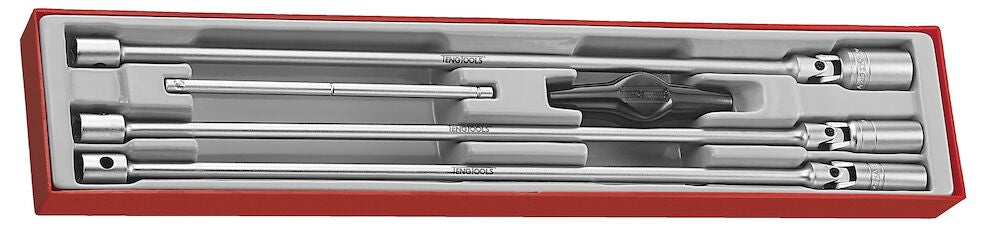
For shops or serious DIYers who want broader coverage in one purchase, the Teng Tools Socket Set FOAM6X6 (TELSK76) rounds out a 76 piece 1/4" and 1/2" collection, giving you the drive-size flexibility to handle spark plugs alongside everything else on the job.
A few reasons pros default to sets like these:
- Sockets built to ISO and DIN standards ensure consistent fit and tolerance across sets.
- Some tool providers back their hand tools with lifetime warranties, which matters on tools that see daily torque loads.
- Foam tray systems help show at a glance when a socket is missing, so you’re not mid-job realizing a socket walked off with another technician.
- Same-day shipping from warehouses can help ensure a missing size doesn’t stall a repair for an extended period.
Removing and Installing Spark Plugs Without Damage
The socket is only as good as the technique behind it. Rushed removal cracks ceramic insulators and rounds hexes just as often as an undersized tool does.
- Break the plug loose slowly, especially on an engine that’s been running hot. Thermal expansion can make plugs bind, and forcing a fast turn risks snapping the porcelain.
- Keep extensions and swivels in line with the plug, not angled. Side load on an extension transfers uneven torque to the hex and can shear it or crack the insulator.
- Torque new plugs to spec on installation. Over-torquing is one of the most common causes of stripped threads in aluminum cylinder heads, and manufacturer guidance exists precisely because the wrong socket or excess force damages threads and ceramic alike.
- If you’re stuck without a plug socket, a correctly sized deep socket paired with a separate magnetic retrieval tool can work in a pinch. Avoid pliers or vice-grips entirely. They round the hex almost immediately and often crack the porcelain shell.
- Consult a repair manual or a technician when access is unusually tight or torque specs aren’t printed anywhere obvious, particularly on engines with plugs buried under intake manifolds.
Why the Right Socket Kit Changes Your Workflow
Most guides treat socket size like a trivia question. In practice, it’s a workflow problem. Every minute spent digging through a junk drawer for the one deep socket that fits is a minute you’re not fixing the car.
If you work across multiple vehicle types, from a customer’s German sedan to your own small-engine mower, a compact kit spanning 14mm to 21mm eliminates most of that guesswork before it starts. Buy once, organize it, and stop treating spark plug sockets as an afterthought.
— David
Get the Right Sockets Without the Guesswork
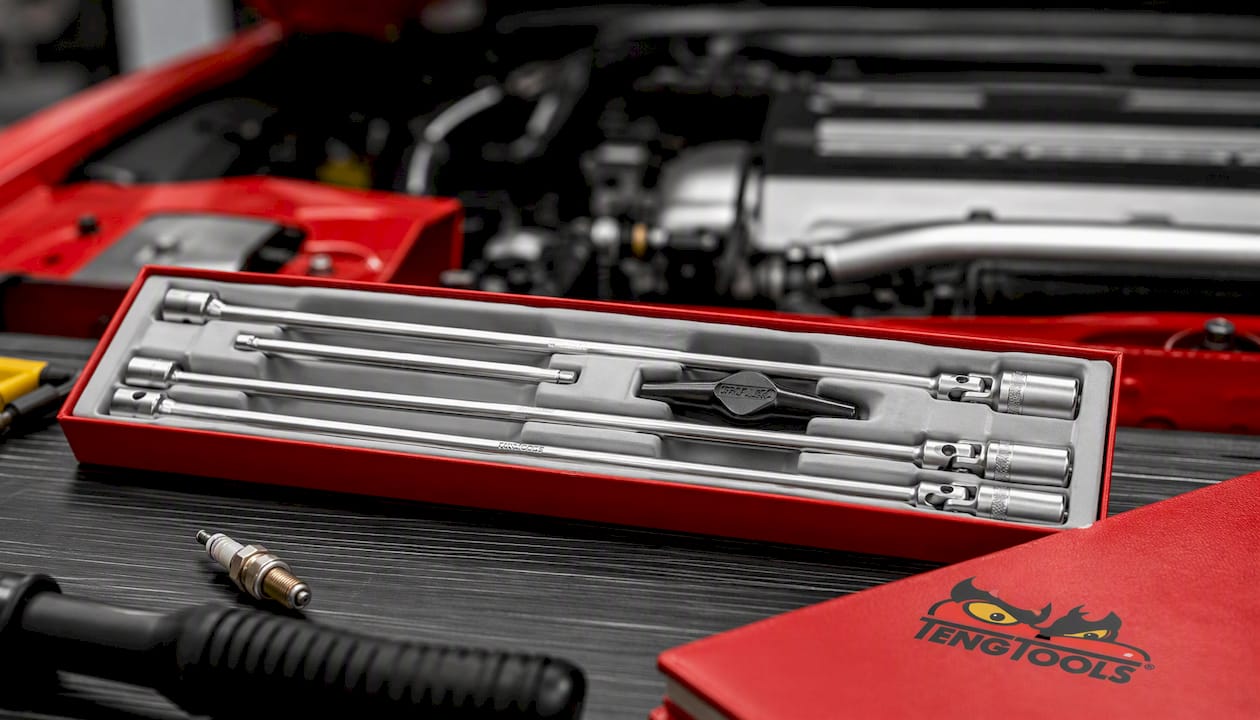
You’ve seen the size chart. Now skip the trial and error of buying sockets one at a time and hoping the next one fits. The Teng Tools 3/8" T Bar Spark Plug Socket Set TTX4 (TTXTB05) puts the common sizes in one dedicated set, built for the deep-well, thin-wall reach most engines require.
If your work spans more than just spark plugs, the Teng Tools Socket Set FOAM6X6 (TELSK76) gives you 76 pieces across 1/4" and 1/2" drives, organized in click-together foam trays so a missing socket is obvious before it derails a job. Every piece carries a lifetime warranty and ships same-day from our Fort Worth, Texas warehouse. Check the product pages for full kit contents and pick the set that matches how you actually work.
Sources
For deeper specs, check Carparts, NGK’s hex size guidance, and always cross-reference your vehicle’s owner’s manual.
- Carparts
- What Socket Size Is A Spark Plug? Complete Socket Guide - Vehicle Pick
- What size sockets are needed for spark plugs? - AutoZone
- Does a spark plug’s hex size matter? - NGK
FAQ
What are the three sizes of spark plug sockets?
The three you’ll use most often are 5/8" (16mm), 13/16", and 9/16" (14mm), covering the bulk of passenger cars, older V8s, and select Ford and European models.
Can I use 9/16" instead of 14mm for spark plugs?
No. 9/16" and 14mm are close but not identical, and forcing a mismatched imperial socket onto a metric hex risks rounding the corners. Confirm the exact spec before substituting.
What can I use if I don’t have a spark plug socket?
A correctly sized deep socket combined with a separate magnetic retrieval tool can work as a stand-in, but avoid pliers or vice-grips since they round the hex and can crack the plug’s ceramic shell.
What is the most common spark plug size?
5/8" (approximately 16mm) is the most common size on modern passenger vehicles, though the two measurements differ slightly at 15.875mm versus 16.000mm, so using the exact specified size is best when it’s known.