
Security (tamper-resistant) Torx screws have a center pin inside the recess. Standard Torx screws don’t. That single difference decides whether a bit fits or jams.
The practical rule: a hollow-centered security Torx bit clears that pin and drives both security and standard Torx screws. A solid standard Torx bit never seats in a security head, because the pin blocks it before the lobes engage. That’s the whole compatibility question settled in two sentences.
The tradeoff you’re accepting:
- Security bits are hollowed out, which makes them mechanically weaker than solid Torx bits of the same size, according to Pro Tools Guide.
- A one-way street: security bits cover both fastener types, but standard bits only cover standard screws.
- For pure torque work with no tamper resistance involved, a solid Torx bit still outperforms its hollow security counterpart.
Key Takeaways
Security Torx screws use a center pin that only a hollow security bit can clear, while standard Torx bits work exclusively on standard screws.
| Point | Details |
|---|---|
| Compatibility is one-directional | Hollow security bits drive both screw types; solid standard bits only drive standard screws. |
| Strength has a cost | Hollow security bits are weaker than solid Torx bits of the same size, so save solid bits for high-torque work. |
| Sizes stay consistent | Security and standard Torx share the same T-number scale, from T8 up through T30 and beyond. |
| Watch for lookalikes | Torx Plus and pentalobe heads resemble security Torx but need entirely different bits. |
| Build a three-tier kit | Teng Tools’ TMTX10, TTSD39, and TTX4 cover field, precision, and heavy-duty jobs respectively. |
Table of Contents
- Security Torx vs. Torx: The Drive Geometry Explained
- When to Reach for Security Torx vs. Standard Torx
- How to Spot Security Torx and Which Sizes to Carry
- Which Torx Bit Sets to Buy for Field and Bench Work
- How to Remove a Security Torx Screw Without Stripping It
- Why Teng Tools Backs These Recommendations
- What Most Guides Get Wrong About Security Torx
- Get the Right Bits Before You Need Them
- Sources
- FAQ
Security Torx vs. Torx: The Drive Geometry Explained
Both fastener types use the same six-lobe hexalobular star pattern. The lobes are what actually transmit torque. On a standard Torx screw, the center of that star is just open recess, and a solid driver tip fills it completely.
Security Torx adds a small metal pin standing up in the center of that recess. A solid Torx bit has a solid tip, so it hits the pin before the lobes can seat. That’s why forcing a standard bit into a security head just strips the drive or cams out. Flip it around, and a security bit (with a hole drilled through its tip to clear the pin) slides right past that obstacle on a standard screw, because there’s nothing there to interfere with.
Here’s the sequence that matters when you’re facing an unfamiliar fastener:
- Look at the recess before you touch a driver to it.
- If you see a raised pin in the center, you’re dealing with security Torx (often marked TR or with an “S” suffix on the packaging).
- Grab a hollow security bit, not a solid one.
- If the lobes look star-shaped but slightly rounded or offset instead of straight, stop.
That last step matters because not every “security” star fastener is the same animal. Torx Plus, external Torx, and pentalobe heads look similar at a glance but use different lobe geometry entirely, and no 6-point security bit will clear them.
Pro Tip: Keep a cheap lighted inspection mirror or your phone camera in the toolbox. A quick close-up photo of the recess before you commit to a bit saves you from stripping a screw head you’ll never get a clean grip on again.
When to Reach for Security Torx vs. Standard Torx
Manufacturers choose security Torx specifically to keep casual users out. You’ll find it on:
- Consumer electronics, game console housings, and laptop battery covers
- Public fixtures like playground equipment, elevator panels, and vending machines
- Retail security displays and some automotive interior trim
- Appliance panels where the manufacturer wants a service-only barrier
Standard Torx dominates anywhere torque and repeat access matter more than tamper resistance:
- High-torque structural fasteners in machinery and equipment frames
- Automotive components that see frequent service, like brake calipers and suspension parts
- Furniture and cabinet hardware assembled and disassembled routinely
- Bench work where you want maximum bit strength and don’t need the hollow tip
The pattern is straightforward once you see it: security Torx trades some driver strength for tamper resistance, so it shows up where manufacturers want to slow down unauthorized access. Standard Torx keeps the solid tip for jobs that get serviced often or need higher torque without wearing out your bit.
For field kits, that means carrying a security set as your default, since it handles both types. Reserve a dedicated standard set for the bench, where you know exactly what you’re opening and want the sturdier tip for stubborn or high-torque fasteners.
How to Spot Security Torx and Which Sizes to Carry
You can identify a security Torx screw without a magnifying glass in most cases. Look for the raised pin sitting dead center in the star-shaped recess. Packaging or spec sheets often label the fastener with a “TR” prefix or an “S” suffix after the T-number, distinguishing it from plain Torx.
The sizing itself doesn’t change between the two types. Standard and security Torx share the same T-number scale, so a T15 security screw takes a T15 security bit, same as a T15 standard screw takes a T15 standard bit.
A compact carrying list covers most jobs you’ll run into:
- T8 and T10: laptops, game controllers, small electronics enclosures
- T15 and T20: automotive trim panels, appliance access covers
- T25 and T27: mid-size automotive fasteners, some furniture hardware
- T30: heavier automotive and equipment applications
Small electronics increasingly rely on security Torx in the T8 and T10 range, so if you service phones, tablets, or laptops, don’t skip those sizes.
Before you apply any real force, check the lobe shape against a size chart. Teng Tools maintains a Torx head screwdriver size guide and a dedicated tamper-proof Torx size guide that map bit sizes to common devices, so you’re not guessing at the bench.
Which Torx Bit Sets to Buy for Field and Bench Work
If you’re only buying one set, buy security Torx bits. They cover standard screws too, so you’re never caught without the right tip. The one exception: dedicated high-torque power driving, where a solid standard bit holds up better under repeated impact stress.
A balanced setup looks like this:
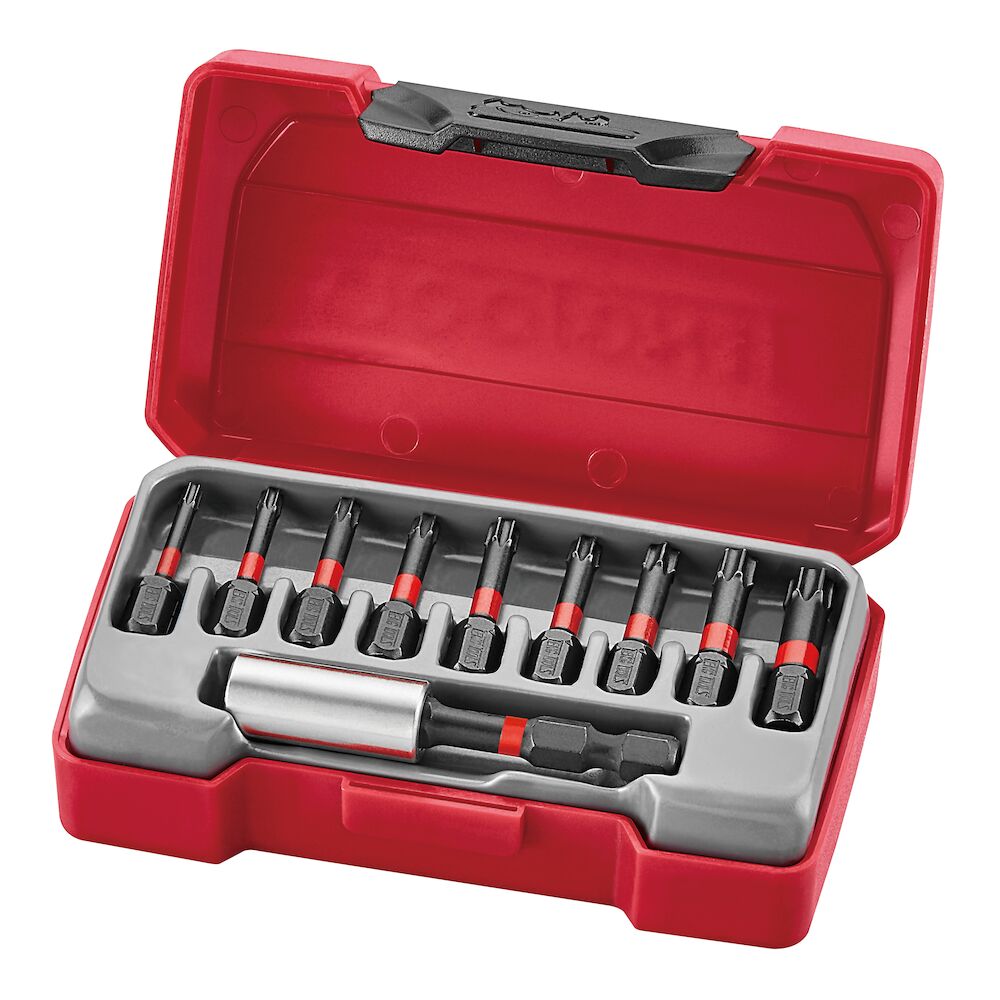
- A compact, impact-rated security TX set for field calls and mixed fastener types
- A precision torque driver set for electronics and torque-sensitive assemblies
- A heavy-duty ratchet and socket set for workshop jobs that need real leverage
Losing a T8 security bit mid-job costs you more time than the bit is worth, which is why organizing bits into labeled trays rather than tossing them into a junk drawer pays off fast. Teng Tools built its Get Organized™ system around exactly this problem, giving every bit a dedicated slot so a quick glance tells you what’s missing before you’re mid-job and short a size.
For actual product picks: the Teng Tools Impact Bit Set TX 10 Pieces handles compact field work, the Teng Tools Torque Screwdriver Set TT1 39 Pieces covers torque-critical precision jobs, and the Teng Tools 3/4" Ratchet & Accessories Set TTX4 handles the heavy drive work standard Torx bits are built for.
| Point | Details |
|---|---|
| Default to security bits | A hollow security bit drives both fastener types; a solid bit only drives standard screws. |
| Reserve solid bits for torque | High-torque, frequently serviced parts hold up better with solid standard Torx bits. |
| Match kits to environment | Carry a compact security set in the field, a torque set for electronics, a ratchet set for the bench. |
How to Remove a Security Torx Screw Without Stripping It
Start with the correct hollow security bit and a torque-controlled driver. Most stuck screws respond to patience before they respond to force.
- Apply a drop of penetrating oil and let it sit a few minutes if the screw hasn’t moved in a while.
- Tap the screw head gently to break loose any corrosion, then apply steady, incremental torque rather than one hard twist.
- If the head is already rounded, try a screw extractor or a left-handed bit designed to bite into a stripped recess as you turn.
- Drilling out the screw is a last resort. It works, but you’re committing to replacing the fastener and possibly repairing the surrounding material.
One real caution here: forcing out a security fastener on equipment still under warranty can void that coverage, since manufacturers use these screws specifically to flag unauthorized entry. If you’re not certain whether opening the housing is sanctioned, check the warranty terms before you drill anything.
Pro Tip: Left-handed extractor bits bite into a stripped recess as you turn counterclockwise, which is often faster and less destructive than jumping straight to drilling.
Why Teng Tools Backs These Recommendations
Teng Tools has designed hand tools in Sweden since 1985, building its catalog to ISO and DIN standards across more than 3,000 tools. That standards compliance matters directly here: a bit that’s actually machined to spec is what keeps a security Torx recess from rounding out on the second or third removal.
Each recommended set maps to a specific job:
- TMTX10 handles compact field calls where space and impact resistance matter most.
- TTSD39 covers torque-critical precision work on electronics and delicate assemblies.
- TTX4 takes on heavy drive and ratchet work in the workshop.
Every set ships same-day from the Fort Worth, Texas warehouse and carries a lifetime warranty, so a bit failure doesn’t turn into a repeat purchase. For exact bit-to-device matches, the Torx-type socket size list fills in specs these summaries skip.
What Most Guides Get Wrong About Security Torx
Most advice on this topic treats security Torx as a niche problem you’ll rarely encounter. That’s outdated. Security Torx has become the default fastener on consumer electronics, and technicians who don’t carry small security sizes are the ones stuck improvising with a flathead and a prayer.
The bigger blind spot is the strength tradeoff. Plenty of guides tell you to “just buy a security set and you’re covered,” without mentioning that the hollow tip is measurably weaker than a solid bit. That’s fine for a battery cover. It’s a bad idea for a high-torque fastener you’re running an impact driver against repeatedly. The honest advice is to carry both, not to treat security bits as a universal replacement for standard ones.
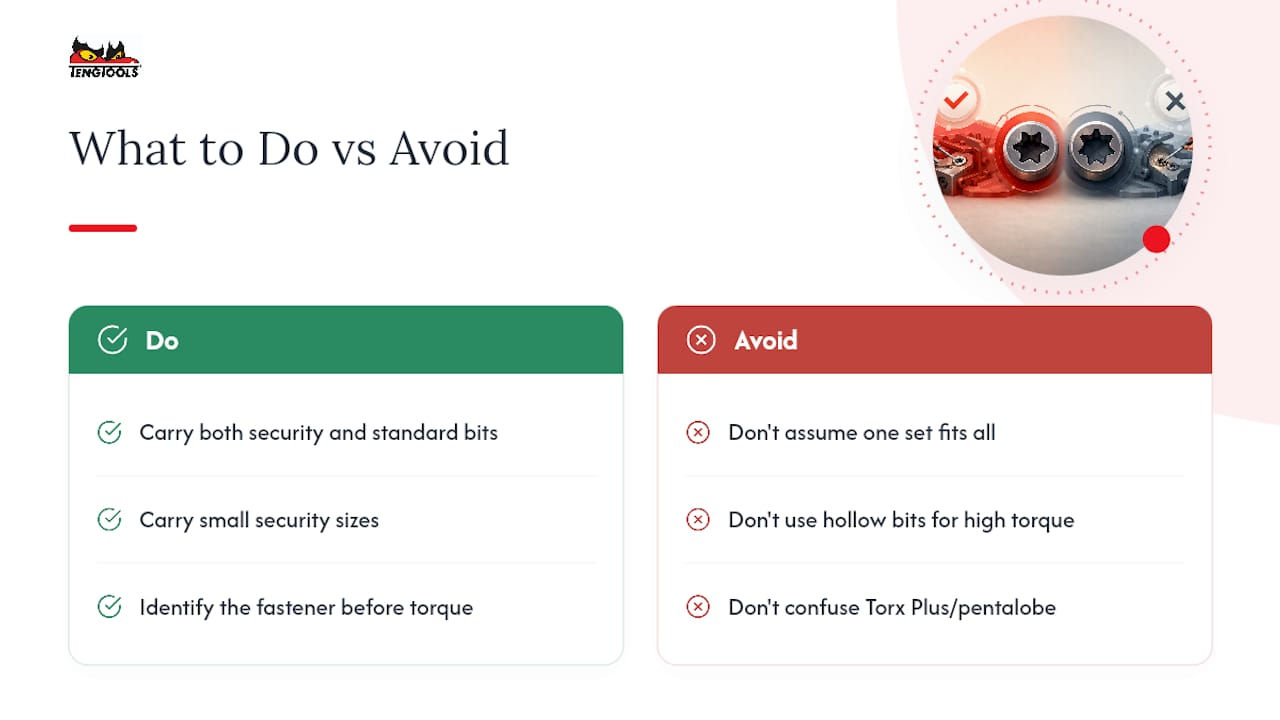
The other overlooked issue is the lookalike problem. Torx Plus and pentalobe fasteners get lumped in with “security Torx” in casual conversation, but they need entirely different bits. Assuming your 6-point security set covers everything star-shaped is how people strip screws that were never going to yield to that bit in the first place.
Prioritize identification before you ever apply torque. That habit alone prevents more stripped screws than any bit upgrade will.
— David
Get the Right Bits Before You Need Them
Waiting until you’re staring at a stripped security screw is the expensive way to learn this lesson. Tengtoolsusa stocks the exact sets this guide points to, built to ISO and DIN spec so the bits hold their edge past the first few uses, backed by a lifetime warranty if one ever doesn’t.
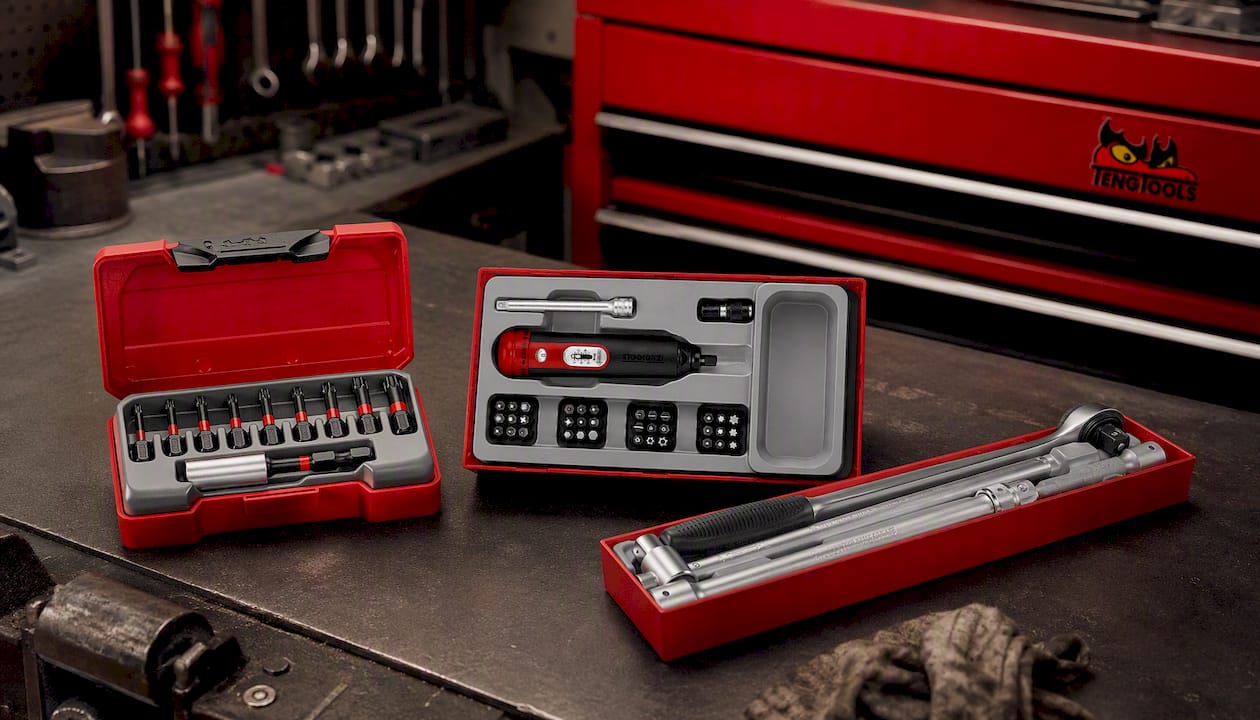
For field techs juggling electronics, automotive trim, and workshop torque work in the same week, a single well-organized security set beats carrying three mismatched packs from three different brands. The Teng Tools Impact Bit Set TX 10 Pieces gives you compact, impact-rated coverage for calls where you don’t know what you’ll find until you get there. Pair it with the Teng Tools Torque Screwdriver Set TT1 39 Pieces for anything torque-sensitive, and keep the Teng Tools 3/4" Ratchet & Accessories Set TTX4 on the bench for the jobs that need real leverage. Same-day shipping from the Fort Worth warehouse means the bit you’re missing today can be in your hand this week. Check availability on any of these sets and build the kit that matches how you actually work.
Sources
- Torx Screws vs. Torx Security Screws: What’s the Difference?
- Torx Screwdriver: A Comprehensive Guide | Pro Tools Guide
- Torx — Wikipedia
FAQ
Will Security Torx Work on Torx?
A security Torx bit (hollow center) works on both security and standard Torx screws, but a standard solid Torx bit will not fit a security Torx screw because the center pin blocks it.
How Do You Get a Security Torx Bit Off a Stuck Screw?
Apply penetrating oil, tap the head to break corrosion, then use incremental torque with the correct hollow security bit; if the head is stripped, try a screw extractor or left-handed bit before drilling as a last resort.
What Does a Security Torx Screw Look Like?
It looks like a standard six-point star recess with a small raised pin standing in the center, and packaging often marks it with a “TR” prefix or “S” suffix.
What Are the Two Types of Torx?
The two main types are standard Torx, with an open six-lobe recess, and security (tamper-resistant) Torx, which adds a center pin; related but non-interchangeable variants include Torx Plus and pentalobe.