
A wrench size chart maps the across flats (A/F) measurement of a bolt or nut to the exact wrench that fits it, in either metric millimeters or SAE fractional inches. The charts below give you both, plus a cross reference for the handful of sizes close enough to swap in a pinch. Three pairs cover most emergency swaps: 19mm and 3/4 inch, 13mm and 1/2 inch, and 10mm and 3/8 inch. Match the number, not the bolt name, and you’ll rarely round a fastener again.
TL;DR:
- Wrench sizes are based on the distance across the flats of a bolt head, not the thread diameter, with standard metric and SAE conversions for quick swaps.
- Slight differences over 0.3 millimeters or 1/32 inch can cause slipping, socket rounding, or stripped fasteners when dealing with high torque or seized bolts.
- Properly measuring bolt heads before choosing a wrench prevents damage and reduces the need for replacing rounded or damaged fasteners.
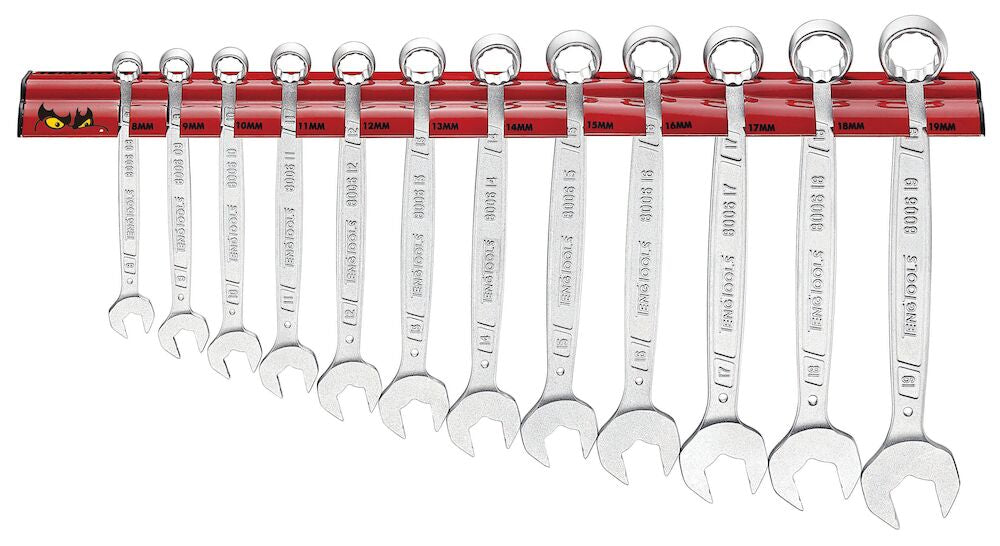
- A core set of metric sizes from 8mm to 19mm and SAE sizes from 1/4 inch to 3/4 inch covers most household and automotive work, with extra sizes for professional shops.
- Organizing wrenches on labeled racks improves efficiency, and using high-quality tools that meet ISO/DIN standards ensures precise fit and durability.
Table of Contents
- Metric Wrench Size Chart for Common Bolts
- SAE Wrench Size Chart with Decimal Equivalents
- SAE to Metric Wrench Conversion Chart
- How to Measure a Bolt and Match the Right Wrench
- What Wrench Sizes Should You Actually Own?
- Why These Wrench Sizes Are Standards-Backed
- Tolerances and Legacy Sizes You’ll Still Run Into
- Combination, Open-End, Box-End, and Adjustable Wrenches
- Avoiding Rounded Nuts and Stripped Fasteners
- An Editorial Take on Owning Both Systems
- Get Your Wrench Sizes Organized, Not Scattered
- Sources
- FAQ
Metric Wrench Size Chart for Common Bolts
Wrench size isn’t the bolt’s thread diameter. It’s the distance across the two parallel faces of the hex head, a measurement engineers call width across flats, or A/F. That’s why an M8 bolt doesn’t take an 8mm wrench. It takes a 13mm one. Here’s how the common metric bolt sizes translate to the wrench you’ll actually grab off the rack.
Notice the M10 and M12 rows carry two values. That’s not a typo. Metric fastener dimensions shifted under ISO 272 back in 1982, and the change trimmed a millimeter off several common head sizes. Older machinery, vintage vehicles, and some imported equipment still use the pre-1982 dimensions, which is why a mechanic pulling an M10 nut off a 1970s engine might reach for a 17mm wrench while the same bolt on a modern assembly takes a 16mm. Keep both in your set if you work on anything with age on it.
Measuring across flats yourself is simple: lay a ruler or caliper across two opposite faces of the hex head, not corner to corner, and read the flat-to-flat distance. If the reading lands between two standard sizes, you’re probably looking at a worn or damaged fastener rather than an oddball size. Metric wrench sizes almost always land on whole or half millimeters.
SAE Wrench Size Chart with Decimal Equivalents
SAE, or standard, wrenches are labeled in fractions of an inch, and matching the decimal equivalent helps when you’re cross-checking against a socket set or a metric caliper reading. Bolt head size runs roughly 1.5 times the nominal bolt diameter for most common SAE fasteners, which is why a 1/2 inch bolt typically wears a 3/4 inch wrench, not a 1/2 inch one.
SAE to Metric Wrench Conversion Chart
Three pairs cover most of your emergency swaps, and knowing the exact gap between them tells you when a substitute is safe versus when it’s a good way to strip a bolt head. The closest matches: 3/8 inch equals roughly 9.53mm, close enough to a 10mm wrench that the 0.47mm gap rarely causes trouble on hand-tight fasteners. A 1/2 inch wrench measures 12.7mm against a 13mm socket, a difference of just 0.3mm. And 3/4 inch lines up with 19mm at 19.05mm, essentially identical.
- 3/8" ≈ 10mm (difference: 0.47mm) — safe for light duty, watch for slop on stubborn bolts
- 1/2" ≈ 13mm (difference: 0.3mm) — one of the closest matches in either system
- 3/4" ≈ 19mm (difference: 0.05mm) — near-identical, safe for most torque levels
- 9/16" ≈ 14mm (difference: 0.71mm) — usable in a pinch, avoid on high-torque bolts
A 0.3mm gap sounds trivial until you’re breaking loose a seized bolt at 80 foot-pounds. Fastener reference charts generally flag anything over roughly 0.3 to 0.5mm as risky once real torque enters the picture, because that little bit of slop lets the jaws walk and round the corners of the head. Rule of thumb: near-swaps are fine for hand-tight assembly, light electronics, or bicycle work. Skip them entirely on suspension bolts, engine fasteners, or anything rusted in place. Grab the exact size or a socket instead.
How to Measure a Bolt and Match the Right Wrench
Guessing wastes time and rounds fasteners. Measuring takes ten seconds.
- Place calipers or a small ruler across two opposite flats of the hex head, not corner to corner.
- Read the measurement and check it against the metric or SAE chart above.
- Test-fit the wrench before applying real force. It should slide on snug with zero wobble.
- If it’s loose or rocks side to side, you’ve got the wrong size, even if it “sort of” fits.
- Choose a socket wrench for recessed or hard-to-reach fasteners, an adjustable wrench for odd or unmarked hardware, and a fixed combination wrench for everyday work where speed matters.
Red flags that mean stop and re-measure: visible rounding on the head’s corners, the wrench slipping under light pressure, or a fastener that looks slightly oversized compared to its neighbors, which often signals a metric bolt in an SAE assembly or vice versa.
Pro Tip: If the wrench needs to be forced onto the head, it’s the wrong size, not a tight fit. Stop, remeasure, and grab the next size up rather than rounding the corners off a bolt you’ll need to remove again later.
What Wrench Sizes Should You Actually Own?
You don’t need every size ever cut. You need the ones that show up over and over.
- Home and DIY starter set: metric 8mm through 19mm and SAE 1/4 inch through 3/4 inch covers most household and light automotive work without constant substitution.
- Automotive and general maintenance: keep 10mm, 13mm, 17mm, and 19mm within easy reach. These four sizes account for the bulk of bolts you’ll touch on engines, brakes, and chassis work.
- Professional and mixed-equipment shops: stock both 16mm and 17mm for M10 fasteners to cover ISO/DIN and legacy equipment side by side, plus long-reach versions for recessed bolts.
For readers building out a bench or wall setup around these ranges, sets like the Teng Tools Combination Spanner Set Anti Slip Wall Rack 12 Pieces and the Teng Tools Long Combination Spanner Set Wall Rack 12 Pieces are built around exactly this kind of core-size logic.
Why These Wrench Sizes Are Standards-Backed
The metric sizes on this page reflect current ISO and DIN dimensional standards, the same specifications that govern how Tengtoolsusa manufactures its hand tools. That matters because a wrench cut to spec fits snug on the first try instead of rocking loose on a worn or slightly off-tolerance head.
Tengtoolsusa’s Get Organized™ tray system keeps every size in its labeled spot, so you’re not digging through a drawer to find the 17mm when you’re mid-job. Every tool carries a lifetime warranty, a practical trust signal when you’re building a set meant to outlast a career, not just a project. This chart was compiled and reviewed by David, drawing on published ISO/DIN reference data and standard fastener conversion tables.
Tolerances and Legacy Sizes You’ll Still Run Into
Wrench manufacturing tolerances matter more than most people realize. A wrench cut even a few hundredths of a millimeter oversized will slip under load, while one cut undersized won’t seat on the head at all. ISO and DIN specifications set the acceptable range for each nominal size, which is why a quality wrench stamped “13mm” fits a genuine 13mm bolt head from any manufacturer that follows the same standard.
Legacy sizing complicates that consistency. Before ISO 272 standardized metric fastener dimensions in 1982, several common bolt sizes used slightly larger head dimensions. M10 commonly measured 17mm across flats instead of today’s 16mm. M12 ran 19mm instead of 18mm. If you work on equipment built before the mid-1980s, or on imported machinery that never fully transitioned, you’ll hit these legacy dimensions regularly.
SAE sizing has its own quirks. Some older American-made equipment used Whitworth or BSF threading, systems with their own wrench sizing that doesn’t map cleanly onto either modern SAE or metric. If a wrench that should fit rocks loose or won’t seat at all on old hardware, that’s often the reason. A specialty Whitworth set solves it, but for most home and automotive work, a solid metric 8 to 24mm range plus SAE 1/4 to 3/4 inch handles the vast majority of what you’ll encounter, legacy sizes included.
Combination, Open-End, Box-End, and Adjustable Wrenches
Not every wrench does the same job, and knowing which type fits which situation saves you a trip back to the toolbox.
Open-end wrenches have a U-shaped opening on each end, typically two different sizes per tool. They’re fast for spinning a nut down once it’s loose, but the open jaw means less contact with the head, which raises the risk of slipping under heavy torque. Most open-end sets run from about 6mm to 24mm or 1/4 inch to 1 inch.
Box-end wrenches fully encircle the fastener, usually with a 6-point or 12-point opening. That full contact spreads force across more of the head’s surface, making box-end tools the better choice for breaking loose a stubborn or seized bolt. The tradeoff is you need clearance to slip the closed end over the fastener.
Combination wrenches put an open end on one side and a box end on the other, same size both ends. This is the workhorse of most sets, including Tengtoolsusa’s spanner lines, because it covers both situations without doubling your tool count. Combination sets commonly span 8mm to 32mm or 1/4 inch to 1 1/4 inch in professional kits.
Adjustable wrenches use a movable jaw to fit a range of sizes, roughly 0 to 1 1/2 inches depending on the model. They’re the right call for odd, unmarked, or metric-in-a-pinch fasteners, but they never seat as tightly as a fixed size and should be a backup, not your primary tool for regular work.
Avoiding Rounded Nuts and Stripped Fasteners
Rounding a fastener almost always comes down to the wrong size, not a weak wrench. Confirm the fit before you push. The jaws should sit flush against both flats with zero play. If you feel any rocking, you’ve grabbed the wrong size even if it technically slides on.

Pull, don’t push, whenever you can position yourself that way. A slipping wrench under a pushing hand tends to send your knuckles into whatever’s nearby. Pulling toward your body keeps a slip from turning into an injury.
Box-end or socket wrenches beat open-end wrenches on anything seized, rusted, or torqued to spec, since full contact with the head resists the twisting force that rounds corners. Save open-end wrenches for fasteners that are already loose and just need spinning off.
Never use a near-swap size on a bolt that’s fighting you. The whole point of a close-but-not-exact match, like a 9/16 inch on a 14mm head, is convenience on easy fasteners. On anything seized or torqued high, that small gap is exactly what lets the jaws walk and chew up the corners. A correctly sized torque wrench matters even more here, since reinstalling with the wrong socket size risks the same rounding on the way back in.
Finally, penetrating oil beats brute force on rusted fasteners. Give it time to work before you lean on the wrench. A patient approach saves both the bolt and your knuckles.
An Editorial Take on Owning Both Systems
Most guides push you toward “just buy metric” or “just buy SAE” depending on what you drive. That advice ignores how mixed the real world actually is. A single home garage might have a Japanese car, a lawnmower with SAE hardware, and furniture with metric fasteners humming along inches apart. The safest habit isn’t memorizing conversions. It’s owning both ranges and organizing them so grabbing the right one takes no thought at all.
Measure before you reach for a near-swap, every time, even on fasteners you’ve handled a hundred times before. That one habit prevents more stripped bolts than any chart ever will.
— David
Get Your Wrench Sizes Organized, Not Scattered
A wrench size chart only helps if you can find the right tool once you know the size. That’s the gap between knowing 13mm fits and actually having a 13mm wrench within arm’s reach instead of buried in a drawer. Tengtoolsusa’s spanner sets mount straight to a wall rack with each size in its own labeled slot, so the lookup work this chart just did for you turns into a two-second grab in the shop.
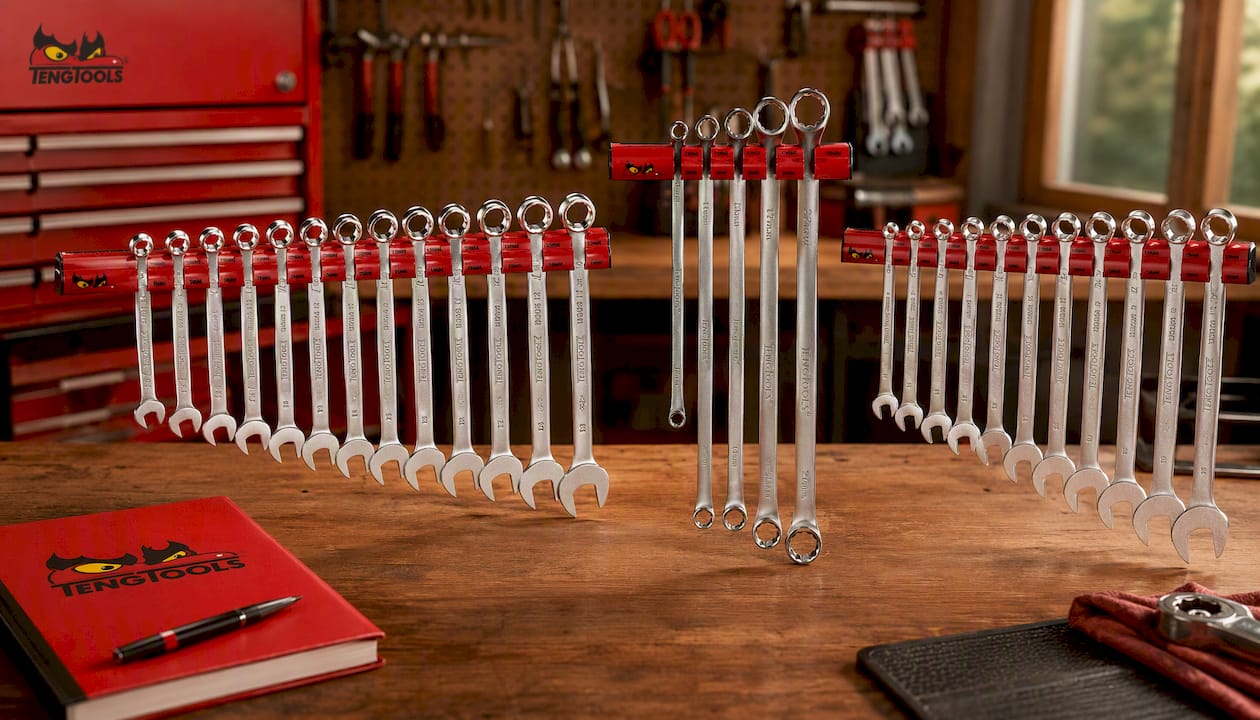
The Teng Tools Combination Spanner Set Anti Slip Wall Rack 12 Pieces covers the core metric range most mechanics reach for daily, mounted on a rack that keeps every size visible at a glance. If your work leans toward tighter clearances or recessed fasteners, the Teng Tools Long Double Ring Spanner Set Wall Rack 5 Pieces adds reach without sacrificing the box-end grip that resists rounding. For a full professional range on one rack, the Teng Tools Long Combination Spanner Set Wall Rack 12 Pieces extends that same organized system across a wider size run.
Every set ships with Tengtoolsusa’s lifetime warranty and same-day shipping from the Texas warehouse. Check current availability on the product pages and get the right sizes mounted before your next job.
Sources
The charts above draw on wrench size and ISO standards data, SAE to metric conversion tables, and recommended kit sizing guidance. For printable references, Tengtoolsusa also publishes a metric to standard conversion chart and a companion SAE to metric chart for spanners and sockets.
- Wrench size — Wikipedia
- Wrench Size Chart: SAE & Metric Wrench Sizes by Bolt (2026) | WorkshopCalc
- Wrench Size Chart: Detailed Metric & SAE Sizes - Mech Forged
- Wrench Conversion Chart – Metric to Standard (SAE/Inches) — MISUMI
FAQ
What are wrench sizes in order?
Metric wrench sizes typically run 5.5mm, 6mm, 7mm, 8mm, 10mm, 12mm, 13mm, 14mm, 17mm, 19mm, and up in roughly one to two millimeter steps. SAE sizes run in fractions: 1/4", 5/16", 3/8", 7/16", 1/2", 9/16", 5/8", 3/4", and larger.
How do I know my wrench size?
Measure straight across two opposite flats of the bolt or nut head with a caliper or ruler, then match that number to the closest metric or SAE size on the chart above. Test-fit before applying force. A correct size slides on snug with no wobble.
What are 10 different types of wrenches?
Common types include combination, open-end, box-end, adjustable, socket, torque, Allen (hex key), pipe, ratcheting combination, and flare-nut wrenches, each suited to different fastener shapes and access points.
What is the standard size of a wrench?
There’s no single “standard” wrench size since fasteners range from tiny 1/4 inch or 5.5mm hardware up to 1 1/4 inch or larger structural bolts. Most home and automotive kits center on metric 8 to 19mm and SAE 1/4 to 3/4 inch, since those cover the majority of common fasteners.