
JIS and Phillips screws are not the same, and swapping one driver for the other is the fastest way to round out a screw head. If you’re working on anything Japanese made, from a carburetor to a camera, reach for a JIS-compatible driver or a modern ISO-compliant Phillips bit instead of an old sharp-tipped Phillips screwdriver.
TL;DR:
- Modern ISO and DIN standard cross-tip drivers are more reliable than legacy Phillips bits, especially for vintage Japanese hardware, because they are manufactured with tighter tolerances.
- A JIS driver with a straight flank and flat bottom generally fits Phillips screws well, but a sharp-tipped Phillips driver on JIS screws can cause stripping due to cam-out mechanics.
- Visual cues like dots or manufacturer origin are unreliable; the best method is testing the fit with a quality driver for flush seating without wobble under actual torque.
- Investing in current ISO/DIN-compliant cross-tip drivers with flat, squared-off tips and proper hardness prevents common stripping issues during repair and restoration projects.
Table of Contents
- JIS vs Phillips: The Tip and Recess Geometry That Actually Matters
- What Happens When You Mix JIS and Phillips Drivers and Screws
- How to Tell a JIS Screw From a Phillips Screw
- What to Buy: Tooling and Standards That Actually Solve This
- Standards, History, and What Field Experience Shows
- Why Most Advice on This Gets the Priority Backwards
- Screwdriver and Bit Sets Built for Cross-Tip Work
- Sources
- FAQ
JIS vs Phillips: The Tip and Recess Geometry That Actually Matters
The difference between JIS and Phillips comes down to a few tenths of a millimeter that decide whether your bit seats or slips. A JIS (Japanese Industrial Standard) recess has straighter flank walls, a smaller corner radius, and a flatter bottom than a classic American Phillips cavity. The Phillips recess, by contrast, tapers more aggressively and carries a rounder shoulder where the blades meet the point.
That taper is not an accident. Phillips drivers were engineered to cam out under torque, pushing the bit up and out of the recess once a set resistance is reached. Early patent filings on cross-head driver designs describe this behavior as a deliberate safeguard against over-tightening on assembly lines, where an air-powered driver spinning at full speed could otherwise snap a fastener or strip its threads. The tradeoff is that any Phillips driver, especially one with a worn or factory-sharp point, tends to ride up out of a JIS recess before it fully engages the flanks, because the JIS cavity was never shaped to accommodate that same cam-out slope.
Two things changed the picture over the following decades:
- ISO and DIN standards bodies gradually pulled cross-head dimensions closer together across manufacturers and countries.
- Bit makers started producing PH-labeled drivers with flatter tips and tighter tolerances that behave more like JIS drivers than the legacy Phillips of the mid-20th century.
The short version: a driver stamped “PH2” today is not guaranteed to be the same shape as a PH2 stamped in 1965, and that gap is exactly where cam-out problems start.
What Happens When You Mix JIS and Phillips Drivers and Screws
Three rules cover almost every situation you’ll run into at the bench:
- A JIS-style driver usually works on Phillips screws. The straighter flanks and tighter fit engage a Phillips recess cleanly, without the slip you’d get running a Phillips bit the other way.
- A legacy, sharp-tipped Phillips driver on a JIS screw is a recipe for a stripped head. The bit rides up under load instead of biting into the flanks, and that’s exactly the cam-out mechanic that field guides warn about when working on Shimano components and other Japanese-made hardware.
- A modern ISO/DIN-compliant PH driver often performs acceptably on JIS fasteners, because the manufacturing tolerances have tightened enough to close most of the gap between the two standards.
Where this bites people hardest: vintage Japanese motorcycles, older bicycle derailleurs and shifters, and consumer electronics assembled in Japan through the 1970s and 1980s. Mechanics restoring these often find heads that previous owners already rounded with the wrong driver, long before the bike or bike shop ever sees them.
There’s one situation where a slightly loose-fitting Phillips driver is actually the smarter move. If you’re working a small screw threaded into soft plastic, the cam-out tendency of a legacy Phillips bit can protect the threads by letting the driver slip before you strip the plastic housing.
Pro Tip: Keep a dedicated JIS #1 and #2 driver in your kit next to your standard Phillips set. The five extra seconds it takes to grab the right one costs far less than drilling out a stripped screw at 11 p.m.
How to Tell a JIS Screw From a Phillips Screw
Visual identification helps, but it’s not foolproof. A small dot or dimple stamped near the recess sometimes marks a JIS screw, and manufacturer country of origin is a decent hint on older gear. Neither cue is reliable enough to bet a screw head on, since plenty of genuine JIS fasteners carry no mark at all, and some Phillips screws have similar-looking dimples for unrelated reasons.
The better test happens with your hands, not your eyes:
- Insert a quality, standards-compliant PH driver and check for full, flush seating with no wobble.
- If the bit rocks, sits high, or wants to climb out under light pressure, switch to a JIS-style tip before you apply real torque.
- Never lean into a screw that feels wrong. That’s the moment cam-out turns into a rounded head.
If a head has already started to strip, stop cranking on it. Try a slightly larger driver, a rubber band between bit and screw for extra grip, or an impact driver to shock it loose before you move to extraction tools like screw removers or drill-out kits.
What to Buy: Tooling and Standards That Actually Solve This
The fix for most JIS/Phillips headaches isn’t a special JIS-only driver set. It’s buying cross-tip drivers made to current ISO and DIN specifications instead of the loose, sharp-pointed Phillips bits that flooded hardware stores for decades. When you’re checking specs on a driver or bit set, look for:
- Explicit mention of ISO or DIN compliance on the product listing, not just a “Phillips” label.
- Flat, squared-off tip profiles in product photos rather than a sharply pointed cross.
- Heat-treated, chrome vanadium, or similarly hardened tips that resist rounding under repeated use.
For sizing, keep #0, #1, and #2 equivalents on hand. That range covers the vast majority of consumer electronics, bicycle hardware, and small-engine work you’ll encounter, and it mirrors both PH and JIS numbering conventions closely enough that you won’t need a separate size chart. If you want a deeper breakdown of which size fits which fastener, a Phillips screwdriver size guide is worth bookmarking, and it’s also worth knowing how Pozidriv bits differ from both JIS and Phillips if you work on European equipment too.
Pro Tip: Store cross-tip bits by profile, not by brand name. A tray that separates JIS-style tips from legacy Phillips tips saves you from grabbing the wrong one under time pressure.
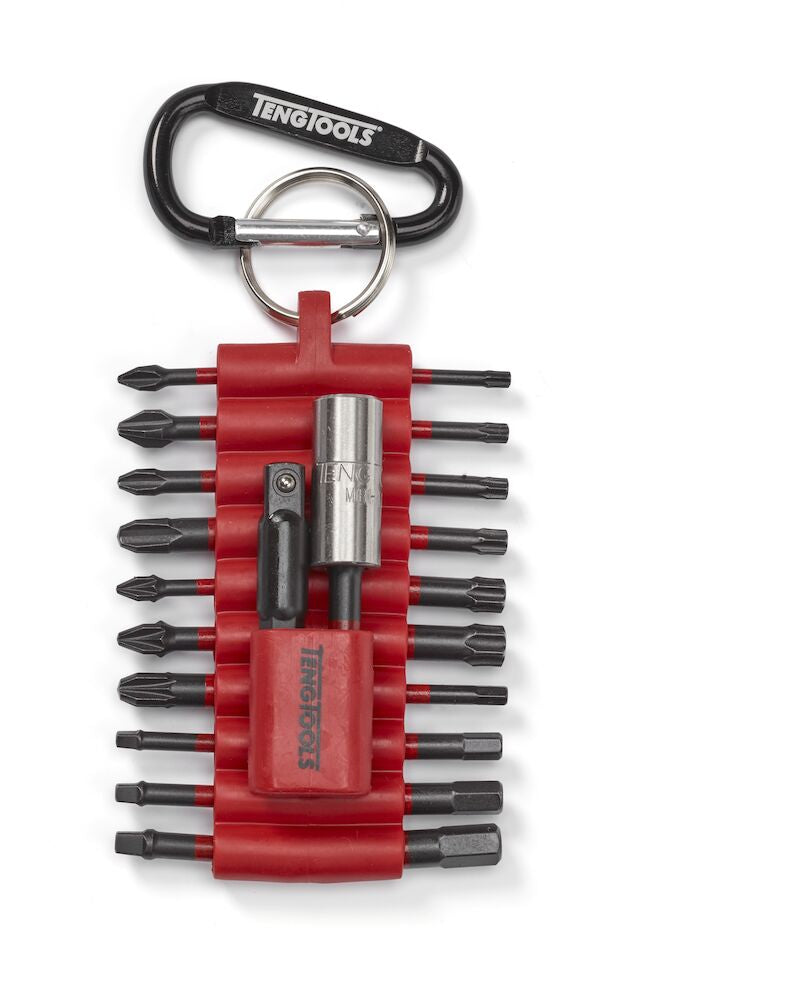
Storage matters more than most toolboxes admit. A driver that’s correct for the job does you no good buried under six wrenches. Teng Tools’ Get Organized™ trays keep cross-tip drivers and bits visible and separated by profile, so the right tool is the one you actually reach for.
Standards, History, and What Field Experience Shows
The Phillips patent’s cam-out behavior wasn’t a flaw; it was built for mid-century assembly lines running powered drivers at speed. JIS emerged separately in Japan and prioritized a tighter, straighter fit for manual and semi-automated work. Over decades, ISO and DIN harmonization pulled the two closer, though the JIS standards handbook still documents recess dimensions distinct from Phillips originals.
Mechanics who work on vintage Japanese motorcycles routinely find heads already deformed by decades of the wrong driver, and their standard practice is a conservative seating check with a quality PH driver before applying any real torque.
Tool quality and adherence to current ISO and DIN specs matter more than whether a bit is stamped “JIS” or “Phillips.” A well-made, standards-compliant tip resolves most of the historic mismatch on its own.
Teng Tools designs its cross-tip drivers and bits to ISO and DIN dimensions, backed by a lifetime warranty, which is exactly the kind of standards-first sourcing this problem calls for.
Why Most Advice on This Gets the Priority Backwards
Most guides treat “JIS vs Phillips” like a trivia question, something to identify correctly and move on. That misses the actual lesson. The real issue isn’t labeling. It’s that decades of cheap, sharp-pointed Phillips drivers trained people to expect cam-out as normal, when it was really a sign of a mismatched or worn tool.
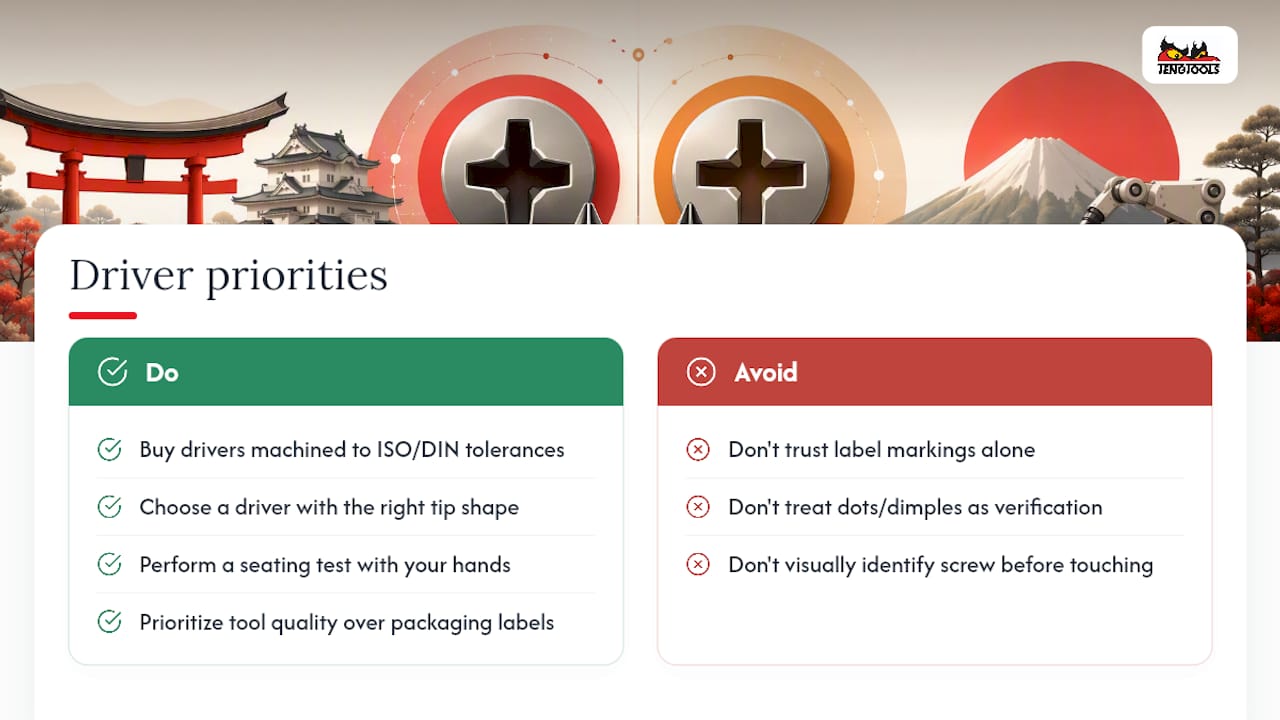
I’d argue the standards convergence is underrated as a solution. Buying a driver because it says “JIS” on the packaging matters less than buying one machined to current ISO or DIN tolerances, because that tolerance is what actually determines whether the tip seats flush. A driver with the right shape solves the problem regardless of what the label says.
Where I’d push back hardest on conventional wisdom: identification marks get too much credit. Dots and dimples are a helpful hint, never a verification step. The seating test with your hands takes five seconds and tells you the truth every time a visual inspection might not. If you take one thing from this article, prioritize tool quality and a proper seating check over trying to visually diagnose a screw before you’ve even touched a driver to it.
— David
Screwdriver and Bit Sets Built for Cross-Tip Work
Once you know a mismatched driver is the real risk, the fix is stocking cross-tip tools built to standard, not grabbing whatever Phillips bit is closest. Teng Tools designs every cross-tip driver and bit to ISO and DIN dimensions, so you’re not gambling on whether a “PH2” stamp means the same thing it did 40 years ago.
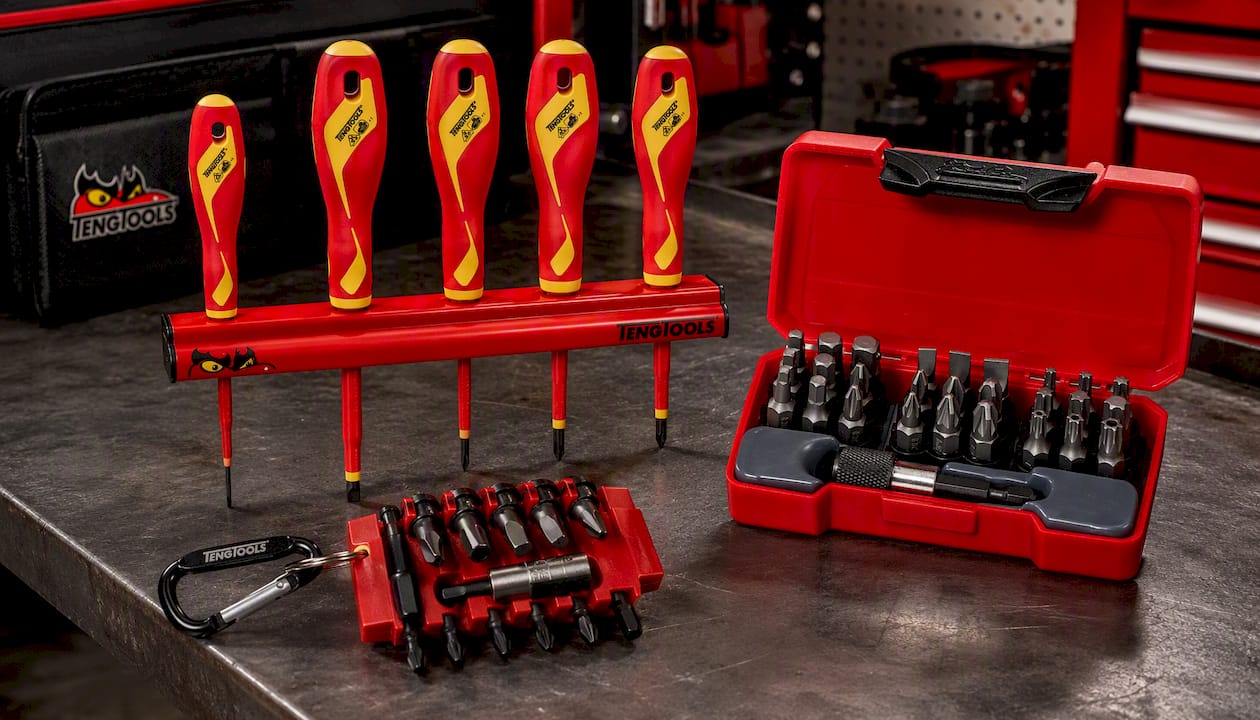
For a bench setup, the Teng Tools Insulated Screwdriver Set Mixed Wall Rack 5 Pieces (WRMDV05N) keeps a spread of insulated cross-tip and flat drivers wall-mounted and visible, ideal if you’re doing electronics or panel work where a slipped bit near live current is a real risk. For field or mobile work, the Teng Tools Hook On Impact Bit Set Mixed 22 Pieces (THBSI22) hooks onto a belt or rail and covers cross-tip sizes without you digging through a drawer. If you want one box that handles nearly everything, the Teng Tools Bit Set Mixed 28 Pieces (TM028) rounds out cross-head, hex, and torx bits in a single case.
Every set carries Teng Tools’ lifetime warranty and snaps into a Get Organized™ tray, so the right bit is always the one you see first. Browse the full lineup at Teng Tools USA and pick the set that matches how you actually work.
Sources
FAQ
Is JIS the Same as Phillips?
No. JIS recesses have straighter flanks and a smaller corner radius than classic Phillips recesses, which changes how each driver seats and how prone it is to slip under torque.
Can You Use a JIS Screwdriver on a Phillips Screw?
Yes, in most cases. A JIS-style driver’s tighter, straighter fit generally engages a Phillips recess cleanly, though a legacy Phillips driver used on a JIS screw is far more likely to cam out and strip the head.
Does Japan Still Use JIS Screws?
Yes. JIS remains a published standard for cross-recess fasteners, and it still shows up on vintage and some current Japanese-made motorcycles, cameras, and electronics, though modern ISO and DIN harmonization has closed much of the gap with Phillips.
What Are JIS Screwdrivers Used For?
JIS drivers are built for Japanese-made fasteners on motorcycles, bicycles, and consumer electronics, where a standard Phillips bit risks rounding out the head. A JIS-compatible or modern ISO-compliant driver handles both without that risk.