
Effective 5S tool organization means combining visual controls, like shadow foam, pegboards, and modular trays, with the two pillars techs skip: Standardize and Sustain. Get those right and every tool has one home, missing items jump out in seconds, and the system holds up after the initial cleanup fades. Modular foam kits are one of the fastest ways to put this into practice on an existing bench.
TL;DR:
- Proper 5S implementation requires assigning a specific owner to each station to maintain standardization and avoid clutter reaccumulation after initial setup.
- Visual controls like shadow boards, two-color foam organizers, and modular trays effectively sustain tool organization when matched to station usage patterns.
- Starting with a single, well-organized bench and documenting its layout prevents overwhelming the shop floor and provides a clear template for expansion.
- Using modular foam kits simplifies setup by providing pre-cut, contrast-colored trays that support quick rearrangement and easy maintenance.
- Focusing initially on the five most-used tools with two-color foam can cut search time in half and significantly improve shop efficiency early in the process.
Table of Contents
- What 5S Means for Your Tools
- Visual Control Methods That Actually Hold Up
- How to Set Up Your First Station
- Making It Stick: Ownership, Audits, and Metrics
- Putting It Into Practice With a Modular Foam Kit
- What Most 5S Rollouts Get Wrong
- Get the Kits That Make This Setup Easy
- Sources
- FAQ
What 5S Means for Your Tools
The five pillars of 5S translate directly to a tool station once you strip away the Japanese terms. Sort (Seiri) means pulling every tool you don’t actually use off the bench. Set in Order (Seiton) gives what’s left a fixed, labeled home. Shine (Seiso) keeps the station clean enough that grime doesn’t hide wear or damage. Standardize (Seiketsu) writes down what “correct” looks like so it’s not a judgment call. Sustain (Shitsuke) is the discipline that keeps it that way past week one.
Done right, this setup produces measurable results on a shop floor:
- Less time hunting for the right socket or driver between jobs
- Fewer tools that vanish into another tech’s cart or a customer’s trunk
- Better safety, since a cluttered bench is where drops and cuts happen
- Higher uptime, because a bay isn’t waiting on a missing tool
- Better morale, since nobody enjoys tearing apart a drawer mid-job
Most 5S rollouts don’t fail at Sort or Shine. They fail because nobody formalizes the standard or assigns someone to own it. Without that, the program tends to collapse back into clutter within a few months.
Visual Control Methods That Actually Hold Up
Pick the visual control that matches how the station gets used, not just what looks impressive on day one.
- Shadow boards work best at fixed stations. A wall-mounted board with painted or vinyl outlines makes a missing wrench obvious from across the bay.
- Two-color foam organizers are the strongest choice for drawers and portable kits. A contrasting base color under a cut top layer, dark on bright or bright on dark, means an empty slot is visible at a glance instead of requiring a manual count. Practitioners generally favor a bright base with a darker top layer for maximum visual gap detection.
- Pegboards and hooks flex well for mixed tool sets that change often, since you can reposition hooks in minutes without recutting anything.
- Modular trays and labeled drawers suit mobile carts and shops running multiple technicians per shift, since a tray can move between stations without losing its layout.
Whichever method you pick, you’ll want a short list of supplies on hand: a foam cutter or hot knife, outline vinyl or paint pens, adhesive backing for foam inserts, peg hooks in a few gauges, and labels rated for shop chemicals and heat. Skimping on the labels is the most common shortcut that backfires. Cheap labels peel within a month, and once labels go, the standard goes with them.
For techs who want a walkthrough on the Sort and Set in Order steps specifically, Tengtoolsusa’s guide to organizing mechanic tools covers the process bench by bench.
How to Set Up Your First Station
Don’t try to convert an entire shop floor at once. Pick one bench, get it right, then use it as the template.
- Photograph the baseline. Take a picture of the station exactly as it sits today, mess included. You’ll want this for comparison later.
- Sort ruthlessly. Pull every tool that hasn’t been touched in recent months and move it to shared storage. If there is disagreement over whether a tool stays, it should probably be removed.
- Apply the three-zone rule. Zone A holds daily-use tools within arm’s reach. Zone B holds weekly tools two or three steps away, typically a nearby cabinet or pegboard. Zone C is centralized backup storage for anything used monthly or less. This frequency-based layout is what keeps a station lean instead of turning into a museum of every tool you might someday need.
- Cut and fit two-color foam. Lay tools on the base layer, trace outlines, then cut the top layer on a foam cutter so the contrasting base shows through each cutout. Test-fit before committing adhesive.
- Mount, label, and photograph the result. Set hook height and drawer depth for a natural reach, not a stretch. Label each zone by frequency, not just by tool name. Then take the “after” photo and post it at the station as the enforced standard.
Pro Tip: Post the “after” photo right at eye level on the station, not in a binder somewhere. Techs comply with a standard they can see, not one they have to go look up.
Making It Stick: Ownership, Audits, and Metrics
Standardize gets a station built. Sustain is what keeps it that way six months later, and it starts with a name attached to every station, not a shared responsibility that nobody actually owns.
Assign one technician per station or tool set and write down what they’re responsible for, including what “pass” looks like. Then run a short audit on a fixed schedule using a checklist that stays simple:
- Every tool present in its outline or slot
- Outlines and labels intact, not peeling or faded
- Bench surface clean and free of unrelated clutter
- Backup or replacement stock in Zone C stocked appropriately
- No unauthorized tools added to the layout
Track key metrics over time such as average search time for a common tool, frequency of missing tools, and audit pass rate to ensure the system is effective. When an audit fails, fix it immediately rather than noting it for later. A missing tool gets replaced or returned same shift, and a peeling label gets reprinted before the next shift starts.
One mistake worth avoiding: don’t trace an outline for every rarely used tool you own. Over-organizing low-frequency items adds maintenance work without adding value. Store them in Zone C with a simple label instead of a custom cutout, and save the detailed foam work for what actually gets touched daily.
Putting It Into Practice With a Modular Foam Kit
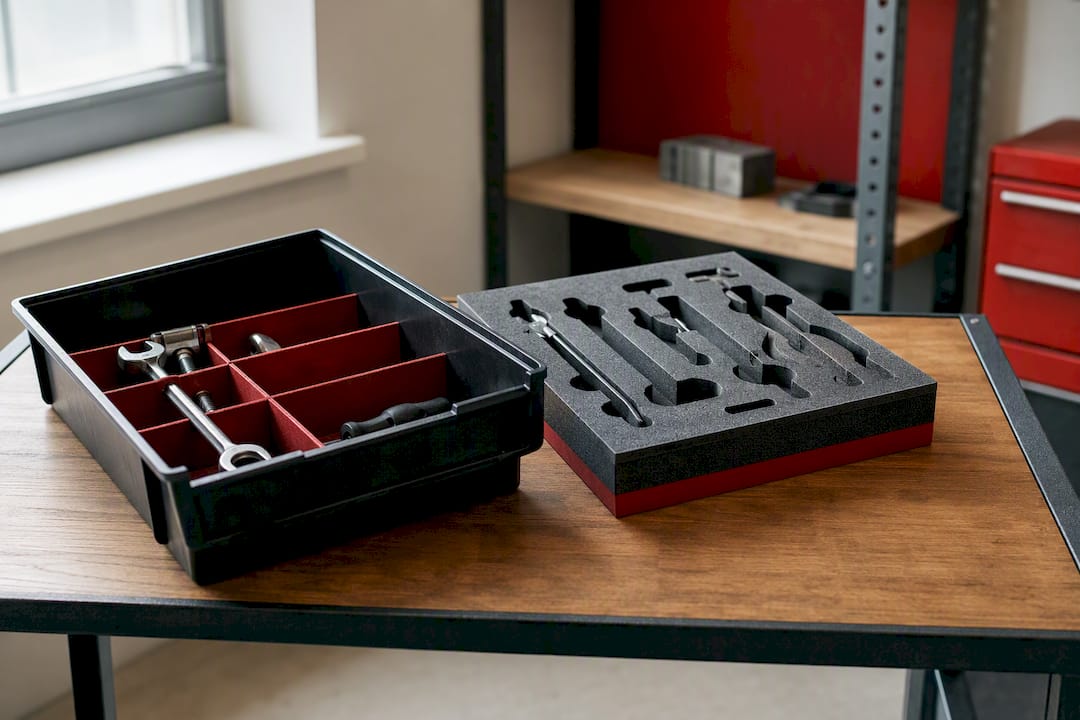
A modular tray system is the fastest way to apply everything above without custom-cutting an entire bench from scratch. Trays click together, so a station can be rebuilt, expanded, or repaired in one sitting instead of a weekend project.
- Each tray functions as its own mini shadow board, pre-cut and ready to mount
- Contrasting foam colors give the same instant missing-tool visibility as a custom board, with zero cutting required
- Trays reassign easily between a fixed bench and a mobile cart, which supports the Zone A/B split without duplicate tool sets
- Pairing a modular tray with a named station owner covers both Standardize and Sustain in one move
For a deeper look at how tray systems save setup time, Tengtoolsusa’s piece on modular tool storage walks through the mechanics station by station.
What Most 5S Rollouts Get Wrong
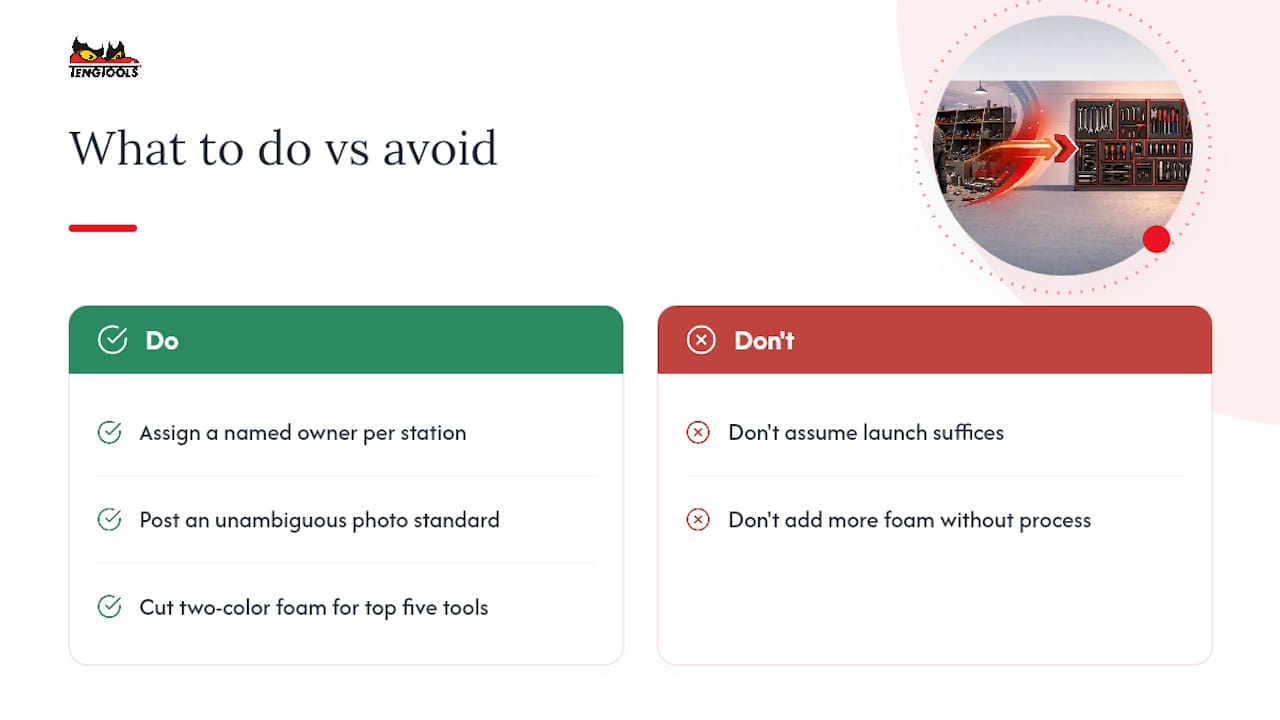
A shop I heard about years back ran a picture-perfect 5S launch, foam cut, boards labeled, everyone excited. Three months later it looked like it never happened. The fix wasn’t more foam. It was assigning one named owner per station and posting a photo standard nobody could argue with.
The single fastest win for any tech starting today: cut two-color foam for your top five most-used tools first. That alone can cut search time in half before you’ve touched anything else.
— David
Get the Kits That Make This Setup Easy
Building a 5S station is faster when the tray layout is already done for you. Tengtoolsusa’s modular foam kits give you the two-color contrast, click-together trays, and lifetime warranty backing that a DIY foam cut can’t match without hours of trial and error.
For a central tool room or a heavy-duty stationary bench, the 53-inch PRO35 Monster kit with 743 pieces gives you enough coverage to run Zone A and Zone B out of one unit. For technician benches or mobile carts, the 37-inch SITEMASTER kit at 525 pieces fits the pilot-station approach without overwhelming a smaller footprint. And if you want to see the two-color foam concept on a small scale before committing a whole bench, the 31-piece screwdriver set makes a ready-made drawer insert you can drop in today. Pick the kit that matches your station type and start your pilot bench this week.
Sources
The ASQ 5S tutorial covers the five pillars in detail, while LeanProduction’s 5S guide breaks down the visual factory concept. For sustainment specifics, ASQ’s case study on 5S collapse and the three-zone rule explainer are worth a full read.
- What are the Five S’s (5S) of Lean — ASQ
- The 5S methodology: guide to workplace organization — SMS360 blog
FAQ
What Are the Tools of 5S?
The “tools” of 5S aren’t physical tools but the five steps themselves: Sort, Set in Order, Shine, Standardize, and Sustain. On a shop floor, they’re implemented through physical aids like shadow boards, two-color foam, pegboards, and labeled trays.
What Is 5S, 6S, and 7S?
5S is the original five-step method. Some organizations add a sixth “S” for Safety and a seventh for Security or Spirit, but the core five (Sort, Set in Order, Shine, Standardize, Sustain) remain the foundation.
What Is a 5S Audit Checklist?
A 5S audit checklist is a short list, typically five to ten items, that verifies tools are present in their outlines, labels are intact, surfaces are clean, and backup stock is available. Audits work best when they take under 15 minutes.
Is 5S a Six Sigma Tool?
No. 5S is a standalone Lean workplace organization method, not a statistical defect-reduction tool, though many organizations use it alongside Six Sigma as a foundation for broader process improvement.