
The right foam for a tool box is closed-cell foam in two contrasting colors with a pocket cut to each tool, so an empty pocket shows the moment a tool is out. You can cut it yourself from layered sheet, have a shop cut it to your tool list, or buy foam tool inserts already cut and sold with the tools; for standard sets, pre-cut tool chest foam inserts are the fastest route, and cutting your own is best kept for the tools no set covers.
TL;DR:
- Tool box foam has three jobs: show a missing tool, hold the tool still, and survive oil and daily use.
- Cut your own (layered kaizen-style foam) for odd, mixed or one-off tools. It is cheap in material and expensive in hours.
- Custom-cut services suit large or unusual layouts. You send the tool list; they send foam.
- Pre-cut foam tool sets arrive with tools and foam matched, sized to a drawer grid. Teng Tools sells these.
- Start from the tool list, not the drawer. The deepest tool decides the foam.
Table of Contents
- What Tool Box Foam Has to Do
- Three Ways to Get Foam Into a Tool Box
- How to Cut Your Own Tool Shadow Foam
- Making It Stick: Keep the Foam Honest
- Building a Drawer From Pre-Cut Foam Modules
- What Most Foam Advice Gets Wrong
- Pre-Cut Foam Tool Sets for the Drawers You Have
- Sources
- FAQ
- Recommended
What Tool Box Foam Has to Do
A sheet of foam on the bottom of a drawer is padding. Foam becomes a tool control insert when it does three things.
- Show a missing tool. This is what people mean by tool shadow foam: a top layer in one color over a base in another, so an empty pocket shows the base color. Single-color foam leaves a dark hole in a dark drawer.
- Hold the tool. A pocket cut to the tool's outline stops it sliding, keeps sizes in order and protects finishes and calibrated instruments.
- Survive the drawer. Closed-cell foam keeps oil and coolant on the surface instead of soaking them up, and denser foam keeps its pocket edges longer.
Two materials cover most of the market: layered polyethylene sheet, often sold as kaizen foam, and high-density EVA. Our kaizen foam vs EVA foam comparison covers density, edge finish and adhesives in detail.
Three Ways to Get Foam Into a Tool Box
1. Cut your own. Layered foam is built to be cut by hand. FastCap's Kaizen Foam documentation describes closed-cell polyethylene laminated in 1/8-inch layers, sold in 2 × 4 ft sheets, three thicknesses and two-color options such as black over red. You trace, cut and peel layers out to depth.
- Best for: mixed brands, odd shapes, one-off kits, a single drawer.
- Watch for: hours per drawer, wasted sheet on a bad cut, stepped pocket walls, and layers that compress under heavy daily use.
2. Custom-cut service. A foam shop cuts inserts from your tool list, photos or tracings, usually on CNC or waterjet.
- Best for: large kits, fleets of identical boxes, unusual instruments.
- Watch for: the time it takes to collect accurate tool data, and a re-order every time a tool changes.
Teng Tools builds bespoke foam layouts too, as part of a tool control specification: the layout is cut to an approved tool list, and that list can include tools you already own.
3. Pre-cut foam tool sets. The tools and the foam are designed together, so fit, depth and labeling are done before you open the box. Teng Tools scans each tool in CAD/CAM and cuts its shape from a three-color EVA block, black top layer, white intermediate and red base, with the size etched beside the pocket.
- Best for: the core hand tools every drawer needs, standard kits across several technicians or bays.
- Watch for: tools from other brands will not fit those pockets.
How to Cut Your Own Tool Shadow Foam
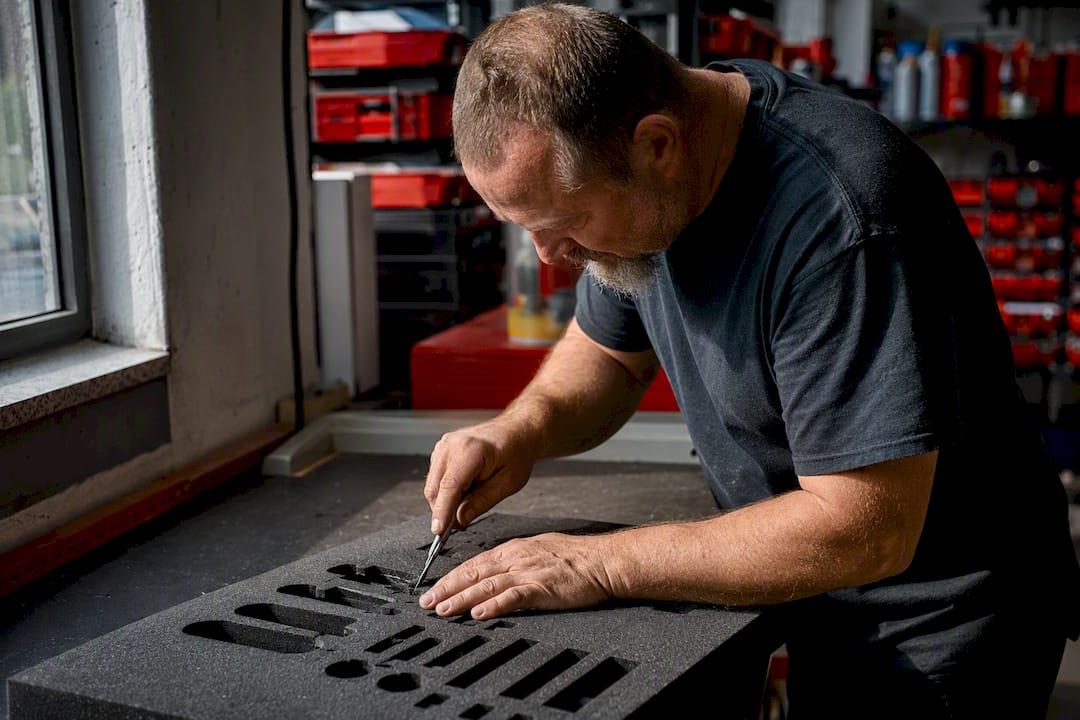
- Measure the inside of the drawer. Width, depth and usable height, net of slides and lips. The outside of the chest tells you nothing.
- Choose thickness from the deepest tool. It must sit below the drawer above with clearance, not just fit the drawer you are cutting.
- Lay out the tools first. Most used at the front, sizes in order, finger room around each handle.
- Trace and cut through the top layer only. A sharp knife held vertical gives clean walls.
- Peel to depth. Deep enough that the tool sits flush or below the surface.
- Add finger pulls beside small tools so they lift out one-handed with gloves on.
- Label each pocket with the size or name, then photograph the full drawer as the standard.
Pro Tip: Test any adhesive on scrap first. FastCap warns that some glues heat as they cure and can melt the foam.
Making It Stick: Keep the Foam Honest
Foam inserts need little care, but they need a habit behind them. NASA Marshall's FOD standard describes the end-of-shift check simply:
"This inventory may be accomplished by a visual sweep of tool shadow-boards and shadowboxes." (MSFC-STD-3598, Rev. D)
- Sweep every drawer at shift end. Red showing means a tool is out. Find it before you close the cabinet.
- Return tools clean. Wipe oil and blow out swarf; closed-cell foam keeps grime on the surface, where it hides pocket edges.
- Re-cut the day a tool changes. A pocket for a tool you no longer own trains people to ignore color.
- Replace torn foam. Ragged edges let tools sit loose and outlines go vague.
When the sweep needs a record, add a check that leaves a trace. KIT digital tool control puts a QR label on each foam drawer, so the audit is a scan and a few taps. Our shadow board guide covers how the visual check becomes tool control.
Building a Drawer From Pre-Cut Foam Modules
Teng Tools foam comes in fixed module sizes, so trays combine in a drawer instead of each one needing its own cut. Published tray dimensions:
- FOAM1: 10.4 × 5.6 in, half a FOAM2. Example: the TEAMD04TXN 4-piece TX screwdriver set.
- FOAM2: 10.4 × 11.1 in. Example: the TED9121 21-piece 1/2-inch impact socket set or the TEDCT06 cutting tool set.
- FOAMX2 and FOAMX4: 4.5 in wide strips, 11.2 and 22.4 in long, for long tools and gap-filling.
- FOAM3: 10.5 × 16.7 in, sized for Teng Tools service cases. Example: the TEFSK57 57-piece wrench and socket set.
- FOAM4X4: 14.8 × 22.4 in, made for a Teng Tools 26-inch drawer. Example: the TTEISK103 103-piece impact socket set.
Most trays are about 2 in deep; some FOAM4X4 sets run deeper for bulkier tools, so check the listed depth against your drawer. The Kit Builder lets you lay trays into the drawer grid and see what fits before you buy. For a wider look at how the formats work as a foam tool organizer, see our tray system guide.
What Most Foam Advice Gets Wrong
Most "foam for tool box" advice starts with the box: measure the drawer, buy a sheet, then fit tools into it. That is backwards. The tool list decides everything that matters.
- Depth comes from the tallest tool, not the drawer. Foam bought to the drawer leaves ratchet heads proud of the surface, catching the drawer above.
- The layout comes from the job. A drawer cut to look neat is not a drawer cut to work fast.
- Contrast is not optional. One-color foam is padding with holes in it. The colored base is what makes it shadow foam.
- "Cheaper to cut your own" counts the sheet, not the hours, and not the re-cut when a tool changes.
Buy the foam for the tools. Never buy tools to fill the foam.
Cutting your own is still right for the odd tools: a borrowed puller, an in-house fixture, a gauge no set includes. Put the standard sets in pre-cut trays and save your knife for the exceptions.
Pre-Cut Foam Tool Sets for the Drawers You Have
If the job is filling drawers with core hand tools, buy the foam with the tools. Teng Tools foam tray sets ship from Fort Worth, Texas, and each comes in its own pre-cut tray.
- A full drawer of general tools: the TTEX219 219-piece general service set in one FOAM4X4, with torque wrenches, rivet and nutsert guns, taps and dies.
- Small parts in the same visual system: the TEA01 7-compartment foam tray keeps fasteners in black and red.
- Foam for a whole chest and cabinet: the 1133-piece set in 33 EVA foam inserts, sold without the chest or cabinet. It was laid out for the 53-inch PRO35 chest and cabinet, and each set is also sold on its own.
- A loose tool that needs a home: a torque wrench or other often-borrowed tool deserves its own pocket, cut by hand if no set covers it.
When the drawer has to record who took a tool, not just show that it is gone, the step up is the Smart Box automated tool control cabinet. Each user opens it with their own card, and most existing company access cards work. Sensors in the foam layout detect each tool leaving and returning, so the cabinet records which user took which tool and when; RFID tool tags are optional and most sites do not need them. Book a specification meeting on that page or call (817) 767-3392.
Sources
- Kaizen Foam product documentation, FastCap
- MSFC-STD-3598 Rev. D, Standard for Foreign Object Damage/Foreign Object Debris (FOD) Prevention, NASA Marshall Space Flight Center
- Shadow Board, Art of Lean TPS reference
- Visual Management, Lean Enterprise Institute lexicon
FAQ
Where Can I Buy Foam for a Tool Box?
Layered foam sheets for cutting your own are sold by lean and 5S suppliers and tool retailers. Foam shops cut custom inserts from a tool list. Pre-cut foam tool sets, with the tools and foam sold together, are available from tool brands; Teng Tools sells its foam tray sets at tengtoolsusa.com, shipping from Fort Worth, Texas.
What Kind of Foam Is Best for Tool Drawers?
Closed-cell foam with a contrasting base color is best, because it keeps oil on the surface and shows an empty pocket at a glance. Layered polyethylene foam is easiest to cut by hand. High-density EVA holds sharper pocket edges and keeps its shape longer under daily use.
How Thick Should Tool Box Foam Be?
Thick enough for the deepest tool in the drawer to sit flush or below the surface, with clearance under the drawer above. Measure usable drawer height, not the outside of the chest. Teng Tools foam trays are mostly about 2 inches deep, with some full-drawer sets deeper for bulky tools.
What Is Tool Shadow Foam?
Tool shadow foam is foam in two or more colors where each tool sits in a pocket cut through the top layer. When a tool is removed, the contrasting base color shows, so a missing tool is obvious without counting. It works in drawers, cases and on wall-mounted shadow boards.